

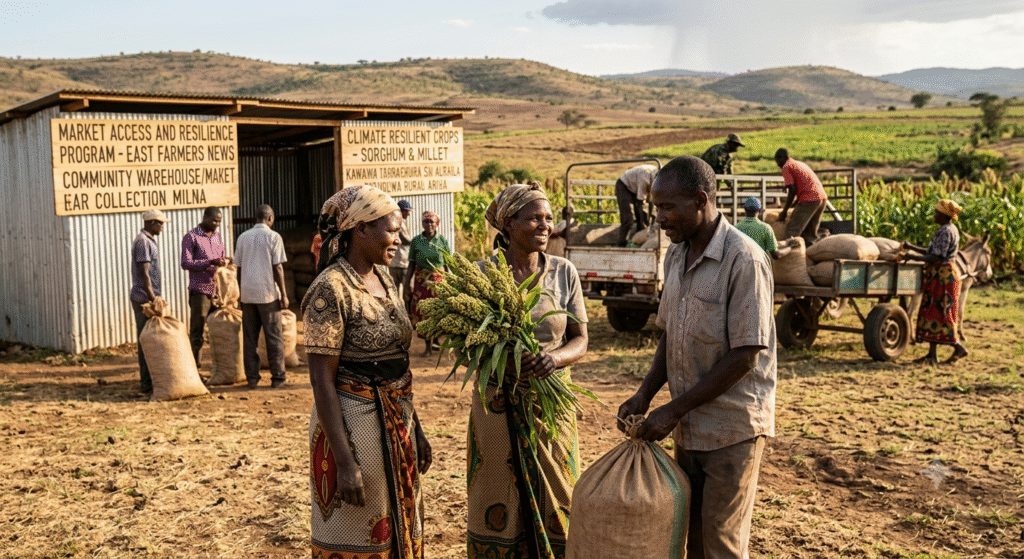
East African farmers are navigating a complex landscape of climate uncertainty, market volatility, and institutional challenges as mid-August 2026 unfolds. From Kenya’s fertiliser delays and maize import decisions to Uganda’s coffee woes and the looming El Niño threat, the news presents a region under pressure—yet one where governments and stakeholders are actively seeking solutions through irrigation investment, market reforms, and technological innovation.
🚨 The El Niño Threat: A Region on Climate Alert
The most significant challenge facing farmers across Eastern Africa is the strengthening El Niño episode. Forecasts indicate a 95 per cent chance that the phenomenon will be categorized as ‘strong’ or ‘very strong’ by late 2026, persisting through early 2027 .
The implications are starkly divided by geography:
- Western parts of the region (including central and northern Ethiopia, the pastoral belt of Sudan, Karamoja in Uganda, and western and northwestern Kenya) have already experienced a very poor start to the June-September season, raising concerns over reduced agricultural production .
- Eastern parts (including Somalia) are expected to receive above-normal rainfall, improving pasture and water availability. However, excessive rainfall substantially raises flood risk, which could lead to crop destruction, loss of life, damage to critical infrastructure, and increased disease outbreaks .
The Food Security and Nutrition Working Group is urging immediate implementation of preparedness and anticipatory action, including informing communities of flood risk and supporting mitigation measures . Uganda’s farmers have already felt the impact, with persistent rains causing Robusta coffee buds to die and rot, resulting in poor harvests across central and western regions. The situation has now reversed to drought, with fields of maize and beans destroyed and water sources drying up .
🇰🇪 Kenya: Fertiliser Delays, Maize Imports, and Irrigation Push
Fertiliser Distribution for Tea Farmers
Kenya’s tea sector, a critical foreign exchange earner, is facing logistical challenges. The Kenya Tea Development Authority (KTDA) will supply two million bags of fertiliser to more than 600,000 tea farmers starting next month, following delays in shipment . The authority has procured 99,000 metric tonnes of fertiliser, which will arrive early next month. KTDA National Chairman Enos Njeru also confirmed that allegations of an irregular payment of approximately Sh322.5 million to a fertiliser supplier are under investigation .
Despite the fertiliser delays, the tea sector continues to perform strongly. Tea export earnings increased to Sh186 billion in 2025, up from Sh181 billion in 2024, with export volumes rising by 9.81 per cent to 652.80 million kilogrammes. Kenya has expanded its tea export destinations to 100 countries, with new demand from Pakistan, Egypt, Oman, Ireland, Japan, and Kazakhstan .
Maize Deficit and Import Decision
A more pressing concern is Kenya’s maize shortage. Agriculture and Livestock Development Cabinet Secretary Mutahi Kagwe has announced that the country will import 25 million 90-kilogramme bags of maize to bridge a projected deficit . Kenya consumes approximately 70 to 75 million bags annually, and drought in key maize-growing areas—particularly Uasin Gishu and Trans Nzoia—has reduced production .
The import decision has sparked debate. While the government claims the country harvested about 71 million bags last year, agricultural experts question this figure. Robert Kemboi, an Eldoret-based expert, suggested the real harvest likely fell well short, citing substandard fertiliser, fake seed, disease outbreaks, and heavy rains during harvest .
Farmers themselves have been reluctant to sell to the National Cereals and Produce Board (NCPB) at Sh4,000 per 90kg bag when private millers offer up to Sh5,400. James Songok, a large-scale farmer in Uasin Gishu, explained that rising costs of seed, fuel, herbicides, and labour made selling to NCPB unprofitable .
Irrigation as the Long-Term Solution
CS Kagwe has been clear: “Kenya cannot continue depending on rain alone to feed its people” . The government is expanding irrigation investments, including the Sh79 million rehabilitation of the Ndigiria Water Pan in Kilifi County, which will directly benefit more than 100 farmers and support a 50-acre smallholder irrigation scheme .
The broader AgriConnect Compact Programme, launched in consultation with county governments and the World Bank, aims to transform agriculture into a “modern, technology-driven and commercially viable sector” while creating employment for youth through technology, artificial intelligence, and modern farming methods .
🇺🇬 Uganda: Coffee Woes and Climate Adaptation
Uganda’s farmers are experiencing the full force of climate volatility. Robusta coffee farmers watched their crop prepare to flower, only to see buds die and rot due to persistent rains . This resulted in poor harvests across central and western Uganda. The rains have since stopped abruptly, leading to widespread crop wilting.
Young farmers, particularly newcomers to coffee production, are now using motorcycles and bicycles to fetch water from swamps to irrigate young coffee trees, highlighting the desperate lengths farmers are going to . Entire fields of maize and beans have been destroyed, and water sources are drying up. The AGRA Food Security Monitor has warned that the coming El Niño could reduce GDP in heavily affected African countries by 1-2 per cent, generating economic losses of $10-20 billion through crop failures and livestock losses .
🤝 Market Access and Value Chain Development
At the 10th AgroFood-Plastpack-Paper Expo in Nairobi, farmers and veterinarians called for stronger coordination across Kenya’s food value chain to improve market access, food safety, and farmer incomes . Kenya National Farmers Federation official Enoch Mutai emphasized that farmers should be treated as “commercial players rather than simply producers of raw commodities” . Stakeholders argued that increased agricultural output alone would not guarantee higher incomes without improvements in storage, processing, packaging, quality assurance, and market access .
The expo showcased smart irrigation systems, AI-powered farm management tools, agricultural drones, and automated poultry systems, reflecting a growing push toward technology adoption .
🚜 Conclusion: Resilience in the Face of Crisis
East African farmers in August 2026 are confronting a perfect storm of climate shocks, market challenges, and institutional hurdles. The El Niño threat, maize deficits, fertiliser delays, and declining traditional sectors like pyrethrum all paint a challenging picture . Yet governments are responding with irrigation investments, market reforms, and technology promotion . The question remains whether these measures will arrive quickly enough to protect the millions of smallholder farmers whose livelihoods—and the region’s food security—hang in the balance.
