

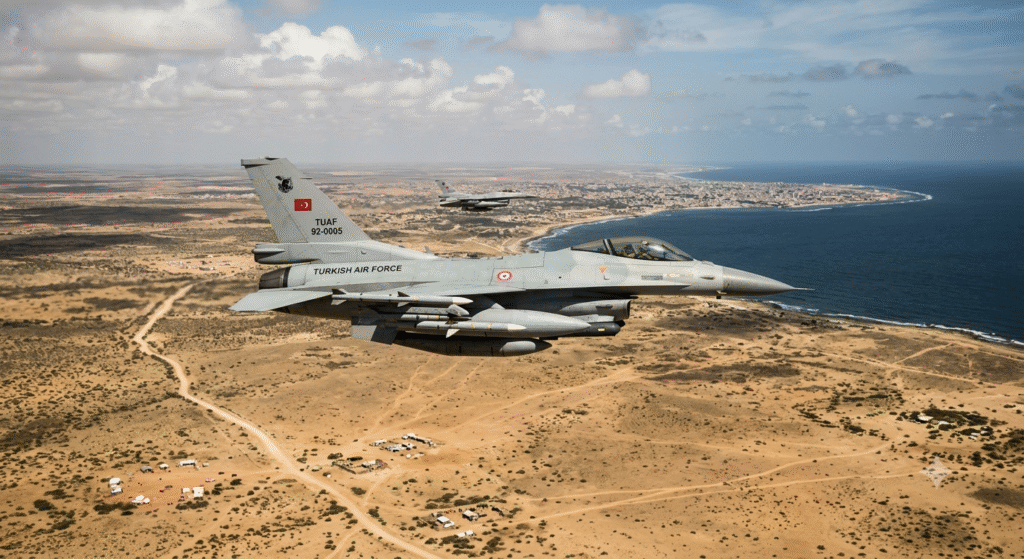
On June 30, 2026, Somali and Turkish forces carried out a series of airstrikes in the Godey area of Lower Shabelle, killing nearly 35 Al-Shabab militants and wounding more than 20 others . The operation marked the first public confirmation of operational combat use of Turkish F-16 fighter jets in Somalia—a qualitative leap in Ankara’s expanding military footprint .
The Strike That Confirmed a New Era
The attack targeted caves, weapons depots, shelters, and vehicles prepared for attacks against civilians. Ministry sources reported secondary explosions, confirming the presence of stockpiles of weapons and explosive materials at the site .
A Somali Defense Ministry statement first explicitly credited Turkish F-16s for the strike, though a later version replaced the reference with “international partners” . The shift likely aimed to downplay Turkey’s direct role amid growing domestic scrutiny and regional rivalries .
The Deployment: From Hangars to Combat
Turkey first deployed three F-16 fighter jets to Mogadishu’s Aden Adde International Airport on January 28, 2026, accompanied by T129 ATAK attack helicopters . The aircraft were operated by Turkish pilots and supported by Turkish ground personnel , arriving after months of infrastructure upgrades including new hangars at the airport .
For more than a decade, Turkey’s role in Somalia had been one of training, infrastructure development, and humanitarian aid. But the deployment of manned combat aircraft “marks the most visible escalation yet in Ankara’s long-running engagement in the Horn of Africa” . The move signals a shift from a “security partnership” to “security partnership plus asset-protection and escalation dominance” .
Why F-16s? Strategic Depth Meets Counter-Terrorism
The F-16 offers capabilities that Turkey’s existing drone fleet cannot match. Unlike unmanned systems, these fighter aircraft provide greater payload capacity, operational flexibility, and faster response times . They expand options for close air support and rapid reaction, while also limiting Al-Shabab’s freedom of movement .
Turkey’s reasoning is multi-layered:
- Counter-Terrorism: Bolstering Somalia’s fight against Al-Shabab, which has waged an insurgency for more than 15 years .
- Asset Protection: Protecting critical infrastructure, including an offshore oil drilling operation and the planned Cagri Bey deepwater exploration vessel . “This looks less like a change of model and more like an escalation in the means Turkey is willing to use to defend what it has already built in Somalia” .
- Geopolitical Signaling: Since Israel recognized Somaliland in December 2025, Turkey has designated Somalia’s territorial integrity a national security priority and condemned Israel’s move as “overt interference” . The F-16 deployment signals Ankara’s determination to counter fragmentation and protect its influence .
- Strategic Node: Turkey sees Somalia as a strategic platform connecting the Red Sea, Gulf of Aden, and Indian Ocean .
Response and Implications
The June 30 strike has drawn mixed reactions. Somalia’s Defense Ministry thanked Turkey for its support and said operations would continue until the threat is eliminated . But the attempt to downplay Turkey’s direct role highlights sensitivity around foreign military involvement in the conflict .
Turkey’s deepening military engagement in Somalia carries consequences for the region’s geopolitical balance. It “deepens Ankara’s commitment by hardening the footprint around strategic infrastructure and economic interests, but it also increases entanglement risk: once you militarily secure energy and critical projects, you inherit more of Somalia’s internal and regional threat environment” .
The message is unmistakable: Turkey is “all in” on Somalia, moving from aid to advisory support to overt deterrence . For Somalia’s government, the partnership offers enhanced military capability. For Turkey, it signals a strategic shift—one that has already reshaped the fight against Al-Shabab and the broader Horn of Africa’s geopolitical landscape.
