

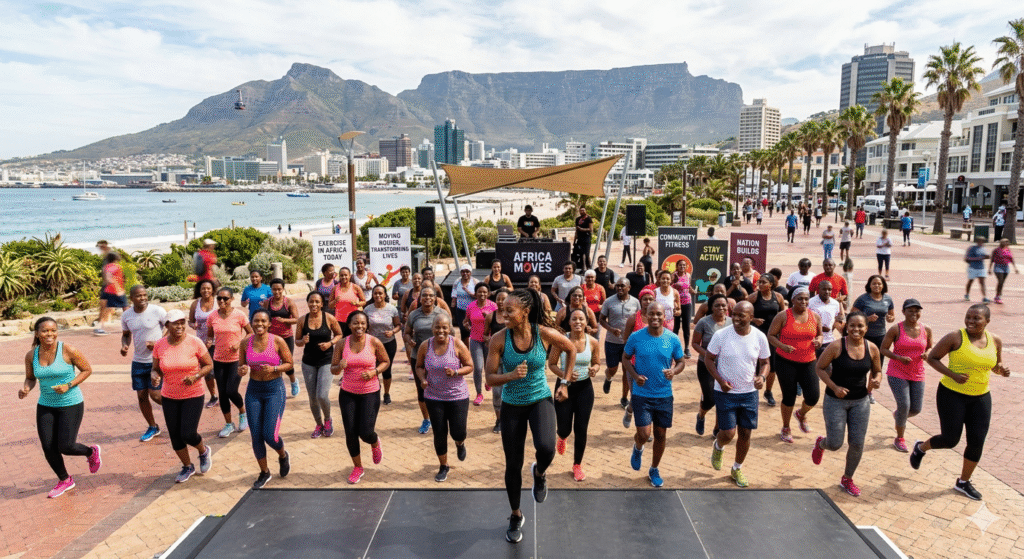
NAIROBI, KIGALI, JOHANNESBURG – In the cool dawn air across Africa, a quiet revolution is taking shape. In Nairobi’s Karura Forest, hundreds of runners pound the trails before work. In Kigali’s car-free zones, families cycle together under the watchful gaze of police. In Lagos, young professionals pack into converted shipping containers for high-intensity interval training. Across the continent, Africans are moving in new ways—and for new reasons. This article examines the state of exercise in Africa across 12 critical dimensions.
Part 1: The Non-Communicable Disease Crisis – Why Exercise Became Urgent
For decades, Africa’s health priorities were infectious diseases: malaria, tuberculosis, HIV/AIDS. But that landscape has shifted dramatically. Non-communicable diseases (NCDs) are projected to overtake infectious diseases as the leading cause of death in sub-Saharan Africa by 2030 . Hypertension, diabetes, heart disease, and stroke are rising rapidly, driven by urbanization, changing diets, sedentary lifestyles, and rising obesity rates .
The World Health Organization estimates that physical inactivity is responsible for over 3.2 million deaths annually worldwide. In Africa, the numbers are climbing. South Africa’s Heart and Stroke Foundation reports that physical inactivity contributes to one in three premature deaths. The medical cost of inaction—treatable NCDs that could be prevented by regular movement—is becoming unsustainable for already strained health systems.
Exercise has shifted from a lifestyle choice to a public health imperative.
Part 2: The Urban Run Revolution – Nairobi Leads the Way
Nairobi has emerged as East Africa’s unofficial running capital—not for elite athletes, but for ordinary citizens. The weekly “Karura Forest Run” attracts over 500 participants every Saturday morning. The “Nairobi City Marathon” has grown from 5,000 to 25,000 runners in just five years. Parkrun events, free weekly 5km timed runs, now operate in over 30 locations across South Africa, Kenya, Uganda, and Namibia .
What drives this movement? For many urban professionals, running is a release valve from traffic, congestion, and job stress. For others, it is social: running clubs have become networking spaces, dating scenes, and support groups. The hashtag #NairobiRunners has over 100,000 posts on Instagram. The movement is grassroots, low-cost, and self-sustaining—requiring only a pair of shoes and the will to move.
Part 3: Traditional Movement – What Was Never Lost
While gym culture is new, movement is not. Across Africa, traditional forms of exercise never disappeared. In Senegal, lutte (traditional wrestling) remains a national passion—combining athleticism, ritual, and community spectacle. In Ethiopia and Kenya, running has always been part of rural life, with children racing to school and back. In South Africa, gumboot dancing—born in the mines as a form of communication and exercise—has been codified into a cardio workout .
These traditional practices are seeing a revival. Fitness trainers are incorporating African dance, drumming, and martial arts into their programming. “Afrobeat cardio,” “Kukuwa fitness,” and “djembe drum workouts” have gained international followings, but their roots are authentically African. The lesson is powerful: exercise does not have to be imported. It can be reclaimed from what was always there.
Part 4: The Gym Boom – A Growing but Exclusive Industry
The commercial fitness industry in Africa is growing rapidly. According to a 2025 industry report, the African fitness market is expanding at 12 percent annually, with South Africa, Nigeria, Kenya, and Ghana leading the way . International chains like Planet Fitness (South Africa), Virgin Active, and local operators like Nairobi’s “The Gym” and Lagos’s “Field of Fitness” are opening new locations.
But there is a significant access problem. A gym membership in Nairobi’s upmarket Westlands area costs between $50 and $150 per month—far beyond the reach of most Kenyans, whose average monthly income hovers around $150. The result is a two-tier system: premium gyms for the wealthy, and nothing for everyone else. This has sparked innovation in low-cost models: community gyms in shipping containers, pay-per-session arrangements, and outdoor boot camps in public parks.
Part 5: The Female Fitness Movement – Reclaiming Space
Perhaps the most significant shift in African exercise culture is the growing participation of women. For generations, public exercise spaces in many African communities were dominated by men. Women who ran in public risked harassment. Gym locker rooms lacked privacy. Cultural norms discouraged women from appearing “sweaty” or “unfeminine.”
That is changing. Women-only gyms have opened in Nairobi, Addis Ababa, and Johannesburg. Female running clubs like “Ladies First” (Uganda) and “Trail Divas” (Kenya) provide safe, supportive environments. The “She Runs” movement, which started in South Africa, has spread to eight African countries, organizing free weekly runs for women of all ages and abilities .
The impact extends beyond fitness. Women who exercise report higher confidence, better mental health, and stronger social networks. For many, joining a running club is the first time they have claimed public space for themselves—without a male chaperone, without apology.
Part 6: School Physical Education – A Lost Generation?
While urban adults embrace fitness, African schoolchildren face a crisis of inactivity. Across the continent, physical education (PE) has been deprioritized. In many public schools, PE periods are used for test preparation. Equipment is non-existent. Playgrounds are bare dirt. Trained PE teachers are rare .
The consequences are already visible. Childhood obesity rates are rising fastest in North Africa and Southern Africa. Type 2 diabetes—once an adult disease—is now diagnosed in African adolescents. The WHO recommends 60 minutes of daily physical activity for children. In most African schools, students get less than 30 minutes per week.
Some countries are responding. South Africa revised its curriculum in 2024 to mandate daily physical activity. Kenya introduced a “Sports in Schools” program, training teachers in basic PE instruction. But resources remain scarce, and implementation remains inconsistent.
Part 7: The Mental Health Connection – Exercise as Medicine
Africa’s mental health burden is massive and largely untreated. The WHO estimates that sub-Saharan Africa has just 1.3 mental health workers per 100,000 people—compared to over 70 per 100,000 in Europe . In this context, exercise is not just fitness; it is accessible mental healthcare.
Depression, anxiety, and post-traumatic stress are widespread across communities affected by conflict, displacement, poverty, and violence. Exercise—particularly group exercise—has been shown to reduce symptoms as effectively as medication for mild to moderate depression. Running clubs in Kenya’s Kakuma refugee camp, for example, have become informal support groups for survivors of trauma .
Across Africa, mental health advocates are prescribing exercise. Walk-and-talk therapy sessions are emerging in South Africa. Community dance classes in Uganda serve as depression interventions. The evidence is clear: moving the body heals the mind.
Part 8: The Digital Fitness Boom – Apps and WhatsApp Workouts
Smartphone penetration in Africa reached 65 percent in 2025, and fitness apps are proliferating. Kenyan startups like “Fiti” and Nigerian platforms like “FitFix” offer streaming workouts designed for local contexts—no equipment, small spaces, culturally appropriate music .
But the most revolutionary platform is simpler: WhatsApp. Fitness coaches across Africa run group workouts via WhatsApp voice notes and video clips. Participants follow along from their living rooms, gardens, or office corridors. The group chat provides accountability, encouragement, and community—without expensive apps or data-heavy streaming.
This low-tech, high-touch approach has democratized fitness. A woman in rural Tanzania with a feature phone and WhatsApp can access guided workouts. A factory worker in Nairobi can join a lunchtime stretching group. Digital fitness in Africa is not about wearables and metrics; it is about inclusion.
Part 9: The Workplace Wellness Shift – Corporate Africa Wakes Up
African employers are beginning to recognize that sedentary employees cost money. Absenteeism due to lifestyle diseases, low productivity from poor mental health, and rising healthcare premiums are driving a corporate wellness revolution .
Major employers—banks, telecoms, tech firms—are investing in workplace exercise programs. Safaricom’s “Fitness Fridays” have employees doing group stretches before the workday. Stanbic Bank’s “Wellness Champions” are trained staff who lead walking meetings and deskercise breaks. The cost of a corporate fitness program is far lower than the cost of one employee’s diabetes treatment.
The shift is still early, but the trajectory is clear. As African economies formalize and employers compete for talent, workplace wellness will become standard—not exceptional.
Part 10: Exercise for Older Adults – The Graying Continent Moves
Africa is aging. By 2050, the number of Africans over 60 will triple to over 200 million . Most of these older adults will be living with preventable chronic diseases. Exercise is the single most effective intervention for healthy aging—maintaining mobility, cognitive function, and independence.
Yet exercise programs for older Africans are virtually non-existent. Park benches are not designed for seated exercises. Public parks lack walking paths. Cultural attitudes sometimes view exercise as “undignified” for elders.
Pilot programs are emerging. In South Africa, “Silver Sneakers” adapts gym workouts for older adults. In Kenya, “Wazee Fit” (Swahili for “Elders Fit”) leads gentle stretching classes in community halls. These programs report dramatic improvements: reduced falls, better mood, lower blood pressure, and social connection for isolated seniors.
Part 11: The Infrastructure Deficit – Where Can People Move?
For all the enthusiasm, one barrier remains stubborn: where can people exercise safely? African cities are notoriously unwalkable. Sidewalks are missing, stolen, or occupied by vendors. Street lighting is poor. Traffic is chaotic. Parks are few, poorly maintained, or fee-charging .
The result is that exercise becomes a privilege of the wealthy—who have gated compounds, private gyms, and safe neighborhoods—while the poor are consigned to dangerous roads or sedentary homes. This is not just an inconvenience; it is an equity issue.
Some cities are responding. Kigali’s car-free days, held twice monthly, close major roads to traffic, turning them into running and cycling corridors. Addis Ababa’s “Light Rail Walkway” project added pedestrian paths along transit lines. But these remain exceptions. Most African cities remain hostile to human-powered movement.
Part 12: The Future – An African Exercise Revolution
The future of exercise in Africa is being written not in policy documents but on the ground, by ordinary people choosing to move. It looks like this: a community-led running club in a Nairobi slum, meeting before dawn when the air is cool and the streets are quiet. A WhatsApp group of 50 women in rural Ghana, following along with a pre-recorded dance video. A school in Soweto where children jump rope during break because it is fun, and because it might save their lives.
The African exercise revolution is not about aesthetics or performance. It is about survival in a world where sitting is the new smoking, and where preventable diseases are filling hospitals. It is about reclaiming public space. It is about mental health in communities with no therapists. It is about aging with dignity.
The barriers are real: poverty, infrastructure, culture, policy. But the momentum is undeniable. Across Africa, people are moving—not because they were told to, but because they discovered that movement feels good, connects them to others, and gives them a fighting chance at a longer, healthier life.
In the cool dawn air, the runners of Nairobi are not just exercising. They are building a movement. And the rest of the continent is starting to catch up.
