

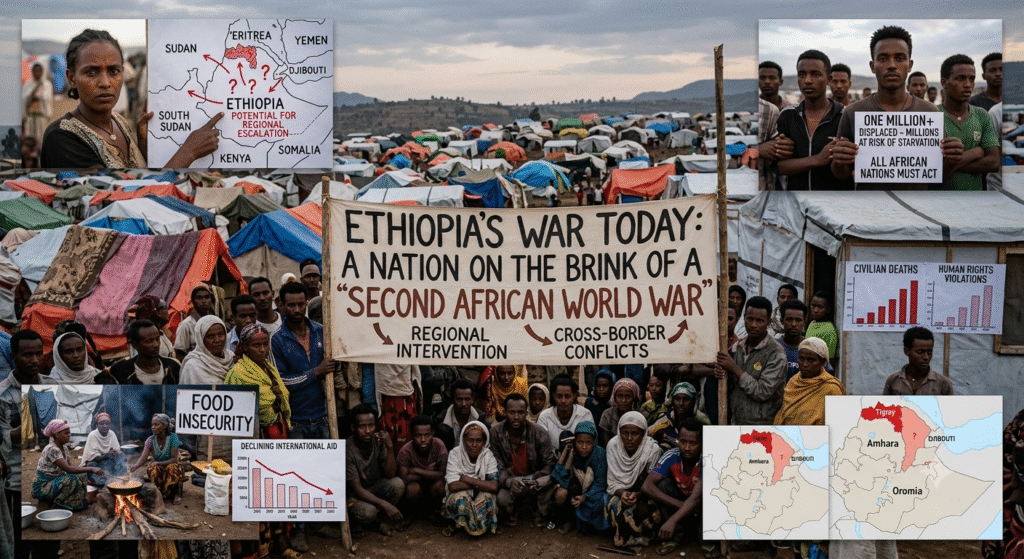
As of September 2026, Ethiopia stands at a dangerous precipice. Multiple concurrent crises—renewed military escalations, a collapsing peace agreement, and horrific ethnic violence—are threatening to plunge the nation into a conflict that regional analysts fear could become a “Second African World War.” The fragile peace that held for four years is now in tatters, and the international community is scrambling to prevent a full-blown catastrophe.
🔴 Tigray: The Unravelling of Pretoria
The most alarming flashpoint is the dramatic deterioration in northern Ethiopia’s Tigray region, where the Pretoria Peace Agreement—which ended the 2020–2022 war that claimed an estimated 600,000 lives—is rapidly disintegrating.
On August 1, heavy fighting erupted between the Tigray Defense Forces (TDF) and Ethiopian National Defense Forces (ENDF) near the Ethiopia-Sudan border in Shererina. The clashes, involving heavy artillery and drones, were followed by the ENDF taking control of the area. This was not an isolated incident; TDF units have deployed reinforcements across multiple locations in Southern Tigray and along the Tigray-Afar boundary, indicating a sustained military posture by both sides.
Drone Strikes Hit Schools and Residential Areas
In a significant escalation, the Ethiopian military has conducted drone strikes deep into Tigrayan territory. On August 10, at least four drone strikes targeted the TDF Army 26 in the Merewa area of Raya Alamata district. Tigrayan military sources confirmed three fighters died and seven were hospitalized after the attack on Merewa Secondary School, which also damaged the building. District Governor Daniel Tamrat reported one civilian killed and four wounded, adding that a nearby river where people fetched water was also hit.
The attacks have intensified. On August 19, a drone strike hit a residential area in Mekelle, the Tigrayan capital, wounding 13 people, including five children and seven women. The TPLF, which controls Tigray, accused the federal government of carrying out the strikes. This represents a significant escalation, as previous strikes had largely targeted contested approaches, now reaching closer to the political and population centre.
The Disintegration of the Interim Administration
The political situation in Tigray has unravelled just as quickly as the military one. The TPLF has removed the interim administration established under the Pretoria Agreement and reinstated its pre-war council, effectively rejecting the federal government’s authority in the region. Both sides accuse each other of failing to implement the peace deal, with key provisions—including the disarmament of Tigrayan forces and the return of displaced people to disputed western Tigray—remaining unfulfilled.
🕊️ Diplomacy Falters Amid a “Futile Process”
International diplomatic efforts to prevent a return to war have so far yielded little. African Union Special Envoy Olusegun Obasanjo visited Mekelle on August 24 to meet with TPLF leadership, but the visit was widely seen as a failure. Tigrayan authorities expressed frustration over “discussions repeated, assurances not kept, and a continuing deterioration of conditions on the ground,” stating the visit did not advance dialogue prospects.
The EU, along with the diplomatic missions of Canada, Norway, and the UK, issued a joint statement expressing “serious concern” and calling for “constructive engagement” to implement the Pretoria Agreement. However, these appeals appear to have had little effect on the ground.
The stakes are profound. Kjetil Tronvoll, a regional specialist at Oslo New University College, warned that a new conflict would likely draw in neighboring states like Sudan and Eritrea, warning it “will be Africa’s second world war”—alluding to the 1998–2003 Congo war that involved nine African nations. The Ethiopian government has accused Eritrea of backing the TPLF, while Sudan’s army has accused Ethiopia of allowing the Rapid Support Forces (RSF) to operate from its territory, raising the spectre of a regionalized conflict.
🩸 Ethnic Violence: The East Wollega Massacres
While the Tigray front has dominated headlines, horrific ethnic violence has erupted elsewhere with devastating consequences. Between August 18 and 29, a coalition of forces tied to Prime Minister Abiy Ahmed’s Oromo Prosperity Party allies tore through the Gida-Ayana and Limu-Gelila areas of the East Wollega Zone, a region in Oromia state.
A preliminary report by the Amhara Association of America confirmed at least 68 civilians killed during this period. Most of the dead were ethnic Amhara or followers of the Ethiopian Orthodox Tewahedo Church. Four historic churches were burned to the ground.
The violence has been described as house-to-house killings, with victims including clergy, elders, and children. The most widely condemned incident was the killing of Komos Aba Tadesse, chief administrator of Andode-Qidist-Selassie Church. Video footage shows him stripped and tortured by Oromia Region Gada Commando forces before his death. In another case, a four-year-old girl was found wounded beside her deceased mother after remaining there for several days with a gunshot wound to her leg.
Human rights advocates describe this as an identity-based emergency requiring immediate international investigation. The attacks have displaced approximately 15,000 people, with homes and villages destroyed.
Shifting Alliances and a Fluid Battlefield
The conflict has produced strange and shifting alliances. In an unusual development on August 8, the Oromo Liberation Army (OLA) coordinated with government security forces for the first time to clash with Fano militias in East Wollega. This illustrates the complex, multi-actor nature of Ethiopia’s conflict, where former enemies may temporarily align against common adversaries.
🕊️ A Glimmer of Hope: Formal Peace in Amhara
Amid the chaos, there has been one positive development. On August 21, the Amhara regional government and the Amhara Fano People’s Organisation formalised an agreement to implement a sustainable peace accord, ending the protracted conflict in that region. The signing ceremony was attended by the Minister of Peace, who urged remaining armed groups to follow suit and abandon the “outdated approach” of pursuing political goals “through the barrel of a gun”.
The deal, facilitated by the African Union and IGAD, builds on a foundational peace framework signed in December 2025. Regional officials report that an increasing number of combatants have been surrendering their arms and returning to civilian life, offering a model for what peaceful resolution could look like elsewhere in the country.
🔮 Conclusion: A Nation in the Balance
Ethiopia is caught in a dangerous spiral of renewed conflict, ethnic violence, and collapsing diplomatic frameworks. The Pretoria Agreement is being openly violated, ethnic cleansing is occurring with impunity in Oromia, and regional actors are preparing to intervene in what could become Africa’s most devastating war in decades.
The international community is watching, but appeals for restraint have had little effect. As the Tigrayan authorities have stated, “peace and stability cannot be achieved through the repetition of the same initiatives or through mere procedural gestures”. Without a genuine commitment to dialogue and accountability, Ethiopia’s wars will continue to produce more victims, more displacement, and more destruction.
