

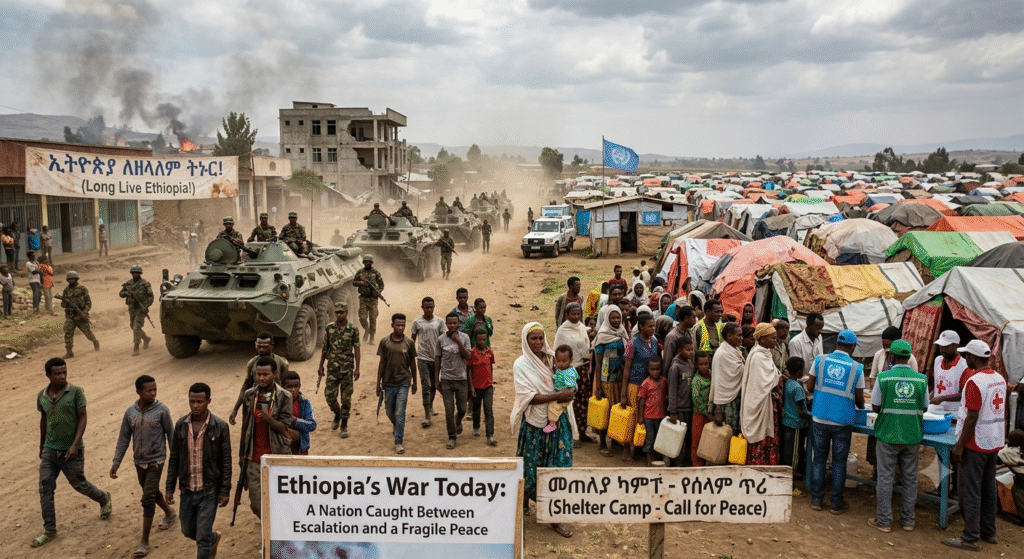
Recent weeks have witnessed a dangerous escalation in Ethiopia’s multiple armed conflicts, threatening to unravel the fragile peace agreements that ended the devastating 2020–2022 civil war. From drone strikes targeting civilian areas in Tigray to ethnic violence in Oromia and tentative peace deals in Amhara, the country is navigating a precarious path between renewed large-scale conflict and diplomatic resolution.
🔴 Tigray: Drone Strikes and the Unravelling of Pretoria
The most alarming developments have occurred in northern Ethiopia’s Tigray region, where the Pretoria Peace Agreement is under severe strain. On August 19, 2026, a drone strike hit Mekelle, the Tigrayan capital, wounding at least 13 people, including five children and seven women. The attack targeted a residential area, with victims ranging from two to 60 years old. A separate drone strike two days earlier near Mekelle had reportedly caused no casualties but signalled an escalation in federal operations.
The TPLF, which controls Tigray, accused the federal government of carrying out the strikes. A local official claimed federal forces struck a farmers’ training centre near Mekelle on August 18, though no injuries were reported. Previous alleged strikes this year had largely targeted Tigray’s contested approaches, making the August attacks—now reaching closer to the political centre—a significant escalation.
The timing is critical. On August 1, heavy fighting erupted between federal forces and TPLF troops near the Sudanese border, with the TPLF accusing the government of launching a “large-scale ground offensive”. The NGO ACLED confirmed the incidents, though the federal government has not publicly commented.
🤝 The Fragile Peace Process: Diplomacy Under Pressure
Key provisions of the Pretoria Agreement remain unfulfilled, creating fertile ground for renewed conflict. Tigrayan forces have not fully disarmed, Amhara forces continue to control much of disputed western Tigray, and hundreds of thousands of displaced people have yet to return home. In May 2026, the TPLF restored its pre-war regional council and reinstated party leader Debretsion Gebremichael as regional president, rejecting the interim administration established under the peace agreement.
Diplomatic efforts continue but face significant hurdles. AU special envoy Olusegun Obasanjo visited Mekelle on August 24 for the second time in two months. However, TPLF officials said the visit was “informal” and did not advance dialogue prospects. The TPLF expressed frustration over “discussions repeated, assurances not kept and a continuing deterioration of conditions on the ground”.
Analysts warn that a new conflict would likely draw in neighbouring states, with Kjetil Tronvoll, a regional specialist, cautioning it “will be Africa’s second world war”—alluding to the 1998–2003 Congo war that involved nine African nations.
🌍 Multi-Front Conflict: Oromia, Amhara, and Shifting Alliances
The crisis extends well beyond Tigray. Ethiopia is fighting on multiple fronts, with armed groups in Oromia and Amhara regions maintaining active insurgencies.
In Oromia’s Gida Ayana district, violence has intensified, with civilians caught in a complex battlefield involving Fano forces, federal troops, Oromia regional security structures, and local militias. Residents describe confusion about who is fighting whom, with competing narratives of victimhood and retaliation.
A significant development has been formalised peace talks between the Amhara regional government and the Amhara Fano People’s Organisation. On August 21, the two sides signed an agreement to implement a sustainable peace accord, facilitated by the African Union and IGAD. Ethiopian Minister of Peace Mohamed Idris urged remaining armed groups to follow suit, arguing that political goals cannot be achieved “through the barrel of a gun”.
However, the situation remains volatile. More than 60 people were killed in ethnic violence in Oromia’s Amuru district in late July and early August, with the Ethiopian Human Rights Commission reporting the attacks displaced 20,000 people. The violence followed killings of ethnic Amharas by the Oromo Liberation Army, with reprisal attacks targeting ethnic Oromos.
💬 Government Response and International Concerns
Prime Minister Abiy Ahmed has framed the crisis as a struggle between peace and forces of chaos. In recent statements, he described alliances among armed groups as signs of “growing desperation” and emphasised that thousands of militants are laying down arms “every day”. He reaffirmed the government’s commitment to dialogue while using harsh language against groups he accused of lacking “any real political vision”.
International observers express growing concern. The United States has been “conspicuously absent” from diplomatic efforts, with analysts arguing Washington should be a key actor in easing tensions. Cameron Hudson of CSIS noted the presence of “a lot of new outside actors” that could drive the conflict, including Sudan and Eritrea. The Ethiopian government has accused Eritrea of backing the TPLF, and Sudan’s army has accused Ethiopia of allowing the Rapid Support Forces to operate from its territory.
🔮 Conclusion: A Nation at the Brink
Ethiopia’s war has entered a dangerous new phase. The drone strikes on Mekelle signal the federal government’s willingness to project force deep into TPLF-held territory. The formalised peace deal in Amhara offers a potential bright spot, but the multi-front nature of the conflict and the involvement of regional actors raise fears of a wider war. As PM Abiy stated, the door to peace “remains open,” but with troops massed on both sides of the Tigray border and key provisions of the Pretoria Agreement unfulfilled, the window to avoid another catastrophic war is rapidly closing.
