

Introduction
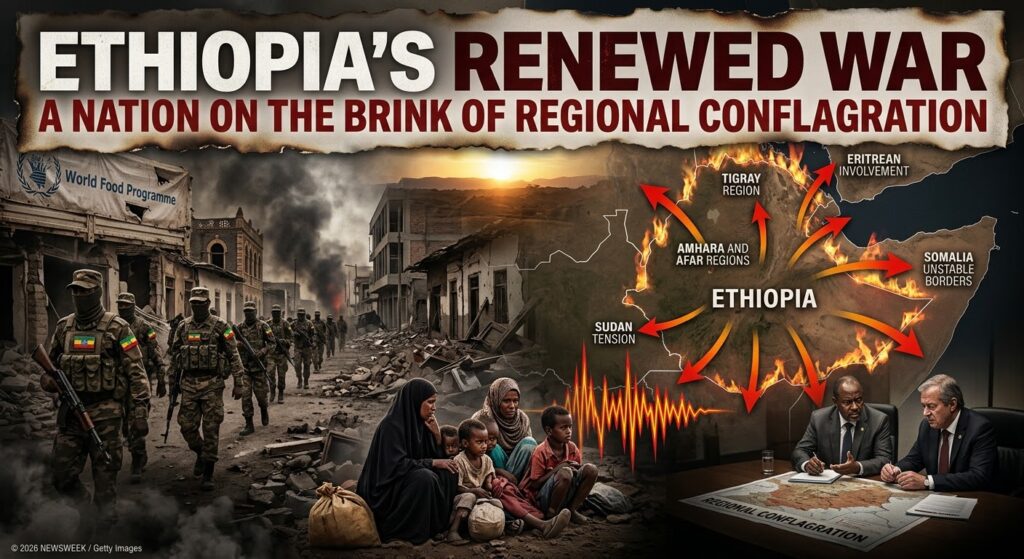
Ethiopia has plunged back into war. In late September 2026, the Tigray People’s Liberation Front (TPLF) and its allies launched a major offensive against federal forces, shattering the Pretoria peace agreement that had ended the devastating 2020-2022 civil war. Within days, the conflict spread across Tigray, Afar, and Amhara regions, triggering mass displacement, a communications blackout, and fears of a broader regional war. On October 1, Ethiopia severed diplomatic ties with Eritrea, and a day later expelled an Egyptian diplomat—a dramatic escalation that threatens to draw the entire Horn of Africa and Red Sea region into the maelstrom. As the African Union appeals for restraint and the United Nations warns of a humanitarian catastrophe, Ethiopia stands at its most dangerous moment since the end of the last civil war.
The Return to War
The latest conflict erupted on September 21, 2026, when TPLF forces launched coordinated attacks against federal positions in northern Ethiopia. According to Amnesty International, the fighting “significantly intensified across southern Tigray and the Northern Amhara and Western Afar regions” within a week, involving “extensive use of heavy weaponry” and “intensified aerial attacks” across Tigray, including in the town of Axum and the regional capital Mekelle .
The TPLF’s offensive came just days after it joined six other armed movements to form the “Ethiopian Peoples’ Forces Alliance for Survival,” a coalition whose stated goal is to overthrow Prime Minister Abiy Ahmed’s government. The alliance includes the Oromo Liberation Army and the Amhara Fano militia—groups that have previously been at odds over competing ethnic and territorial claims . The formation of this alliance marks a significant development in Ethiopia’s security landscape, creating the possibility of simultaneous pressure on Addis Ababa from multiple regions.
Federal forces have pushed back. By early October, humanitarian sources reported that the Ethiopian army had dislodged TPLF fighters from Afar province, retaking the town of Erebti and Maychew in southern Tigray . But the human cost has been staggering. Medical charity Doctors Without Borders reported more than 420 wounded at hospitals in Korem and Alamata by September 25, and over 300 at Shire in western Tigray . A doctor in Alamata told the BBC that at least 52 civilians had been killed during three days of intense fighting .
The violence has also reached the capital. On September 30, explosions were heard near the Ethiopian National Defence Force headquarters in Addis Ababa. A source linked to the rebel alliance claimed responsibility for drone attacks targeting government military facilities—the first known instance of opposition forces striking the capital . The government responded by banning all drone flights around Addis Ababa .
A Diplomatic Rupture with Eritrea
The conflict has triggered a dramatic diplomatic crisis between Ethiopia and Eritrea, former allies who fought together against the TPLF during the 2020-2022 war. On October 1, Ethiopia announced it was closing its embassy in Asmara and expelling ten Eritrean diplomats, accusing them of “direct and indirect acts of hostility and belligerence” against Ethiopian territory .
Eritrea responded swiftly, declaring it had “no option but to reciprocate in kind and sever all diplomatic ties with Ethiopia” . The Eritrean foreign ministry accused Addis Ababa of pursuing “an agenda of incessant hostility” in pursuit of “sovereign access to the sea” through “the invasion of sovereign Eritrean ports and coastal areas” .
The roots of this rupture run deep. Ethiopia lost its coastline when Eritrea gained independence in 1993, and Prime Minister Abiy has repeatedly argued that sea access is essential to Ethiopia’s economic survival. Eritrea, meanwhile, has drawn closer to its former enemy, the TPLF, and aligned itself with Saudi Arabia, Egypt, and Sudan’s army-led government—all of whom oppose Ethiopia’s Grand Ethiopian Renaissance Dam on the Blue Nile . Ethiopia accuses Eritrea of backing the TPLF, while Eritrea denies involvement and claims Ethiopia is blaming neighbors to divert attention from internal problems .
Egypt and the Nile Dimension
The diplomatic fallout extends beyond Eritrea. On October 1, Ethiopia declared an Egyptian embassy employee persona non grata and ordered him to leave within 48 hours. Cairo responded in kind, expelling a senior Ethiopian embassy counsellor . This escalation occurs against the backdrop of long-standing disputes over Nile water resources linked to the GERD, which Egypt fears threatens its access to the river’s vital waters .
Ethiopia’s army chief, Field Marshal Birhanu Jula, has accused Egypt and Sudan of supporting the rebel alliance, saying their success was “pushed, supported and supplied” from abroad . Both countries deny the allegations, but the pattern of accusations reveals how Ethiopia’s internal conflict is increasingly entangled with regional rivalries.
A Humanitarian Crisis in the Making
The United Nations has warned that the situation is rapidly deteriorating into a humanitarian catastrophe. On October 1, UN Secretary-General spokesperson Stéphane Dujarric stated that “escalating drone activity and airstrikes in northern Ethiopia are exposing civilians, critical infrastructure and humanitarian operations to growing risks,” with humanitarian operations in some areas “nearly at a standstill” .
Amnesty International has expressed particular alarm at reports that civilian infrastructure, including several schools, has been damaged or targeted during aerial attacks. The organization also warned that “the disruption of communication services across Tigray, and parts of Afar and Amhara regions combined with increasing restrictions on civic space by the Ethiopian government, raises serious concerns that grave human rights violations could occur under the cover of darkness, hidden from independent monitoring” .
Displacement is already surging. A humanitarian source estimated that about 150,000 people had been displaced in Afar alone . UN Resident and Humanitarian Coordinator Ozonnia Ojielo warned that the renewed conflict was exposing civilians—including people already displaced by the previous war—to “further protection risks while triggering new displacement” .
The scars of the 2020-2022 conflict loom large. That war left an estimated 600,000 people dead, millions displaced, and thousands of women and girls subjected to conflict-related sexual violence. Although hostilities formally ended in November 2022, hundreds of thousands of displaced people remain unable to return home, and victims continue to await truth, justice, and reparations .
Regional and International Responses
The African Union has called on Ethiopia, Eritrea, and Egypt to exercise “maximum restraint” and resolve their differences through “existing diplomatic channels and peaceful dialogue” . But the AU’s leverage appears limited. Amnesty International has urged the AU’s Peace and Security Council to convene an emergency session on Ethiopia, warning that “the AU, which was one of the guarantors of the ceasefire agreement that has now effectively collapsed, must learn from past mistakes and urgently activate its response mechanisms” .
Pope Leo XIV has added his voice, calling on all parties to “choose the path of dialogue” and warning that armed conflict leaves behind only “death, destruction, and resentment” . Six U.S. senators have urged the State Department to engage all parties to halt hostilities and return to mediation, expressing alarm that the deteriorating security situation “risked undermining the 2022 peace agreement” .
The Risk of Regional Conflagration
The most alarming dimension of the current crisis is its potential to merge with other conflicts across the Horn of Africa and Red Sea region. The Soufan Center warns that “with simultaneous conflicts in Ethiopia, Sudan, Somalia and Yemen increasingly linked by the Saudi-Emirati rivalry, there is a growing risk that these wars will merge into a broader regional crisis threatening the entire Red Sea region” .
The alliances are labyrinthine. Ethiopia, along with the UAE, helps fund and supply Sudan’s Rapid Support Forces in their war against the Sudanese army. Eritrea has aligned with Saudi Arabia, Egypt, and Sudan’s army-led government. In Somalia, al-Shabaab has clawed back territory, while across the water in Yemen, the Houthis have launched their first major ground offensive in four years. The porous borders between Horn of Africa countries heighten the risk of further spillover .
Conclusion: A Nation at the Precipice
Ethiopia today stands at a precipice. The collapse of the Pretoria agreement has reopened wounds that never fully healed, and the rapid escalation of hostilities—from Tigray to Afar to Amhara, and now to the capital itself—suggests that this conflict will not be contained easily. The diplomatic rupture with Eritrea and the tit-for-tat expulsions with Egypt reveal how quickly internal grievances can ignite interstate crises.
For the people of northern Ethiopia, the fear is visceral and well-founded. They have lived through one of the deadliest conflicts of the twenty-first century. They know what comes next if the guns are not silenced: the shelling of towns, the flight from homes, the hospitals overflowing with the wounded, the children who will not survive the winter. As the African Union, the United Nations, and the international community issue appeals for restraint, the question is whether anyone with the power to stop this war is listening. The alternative—a regional conflagration engulfing the Horn of Africa and the Red Sea—is too catastrophic to contemplate. Yet it is now a real possibility.