

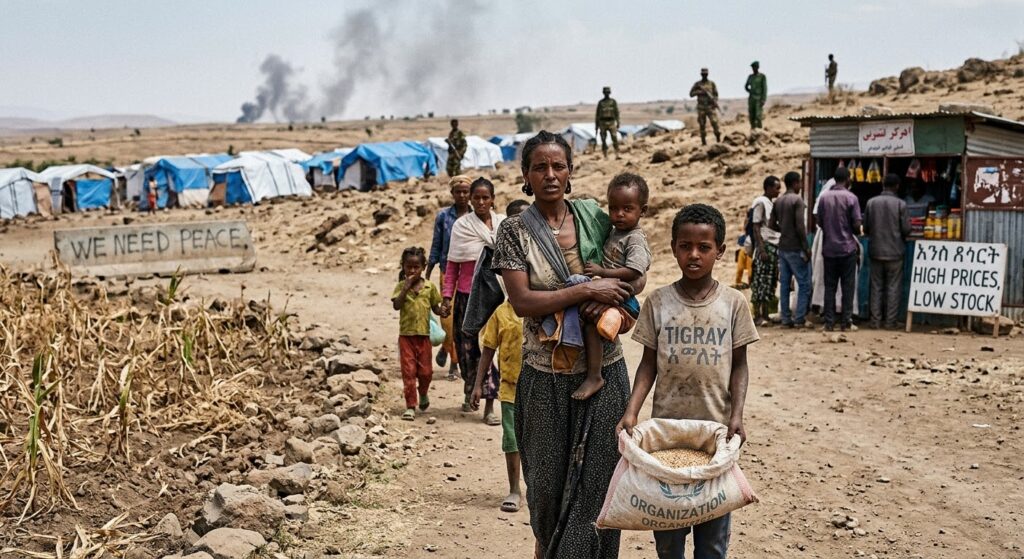
ADDIS ABABA — Ethiopia in October 2026 is a country beset by problems that compound one another. A renewed war in the north has shattered a fragile peace and killed civilians in their homes and displacement camps. An inflation crisis is pushing basic food beyond the reach of ordinary families. Armed violence is spreading in Oromia, claiming dozens of lives in a single weekend. And a diplomatic rupture with Eritrea and Egypt has raised the specter of a regional conflict that could engulf the Horn of Africa. Each crisis feeds the others, and together they present the most serious challenge to Ethiopia’s stability in years.
The War in the North
The most immediate problem is the renewed conflict that erupted on September 21 when the Tigray People’s Liberation Front (TPLF) launched attacks on federal forces, effectively collapsing the Pretoria peace agreement that had ended the 2020-2022 civil war . Fighting spread from Tigray into Afar and Amhara, with heavy weaponry, drone strikes, and aerial attacks reported across the region .
The human cost has been severe. A drone strike on an internally displaced persons camp in Sheraro killed at least eight people, including a mother and four of her children . Amnesty International reported credible accounts of civilian infrastructure, including schools, being damaged or targeted in aerial attacks, and warned that the disruption of communications services across Tigray, Afar, and Amhara was concealing potential atrocities from independent monitoring .
Federal forces have since regained control of Mekelle and advanced into the town of Adwa, roughly 40 kilometers from the Eritrean border, meeting little resistance as TPLF forces withdrew . Flights to Mekelle resumed and telecommunications were partially restored. But residents of Adwa described shuttered shops, looted government institutions including the local hospital, and deserted roads. “People are very afraid of theft,” one resident told AFP .
The UN Secretary-General called for an immediate cessation of hostilities and urged the signatories to return to dialogue under the Pretoria framework . But the agreement’s collapse has exposed how little reconciliation actually occurred. Amnesty International noted that the 2020-2022 conflict killed hundreds of thousands, displaced millions, and saw thousands of women and girls subjected to conflict-related sexual violence—yet “meaningful and independent accountability remains largely absent” .
Diplomatic Isolation and Regional Rivals
The war has triggered a diplomatic crisis that has left Ethiopia increasingly isolated. Ethiopia severed diplomatic ties with Eritrea on October 1, expelling ten Eritrean diplomats and closing its embassy in Asmara, accusing them of “direct and indirect acts of hostility” . Eritrea reciprocated by cutting all relations. Ethiopia also expelled an Egyptian diplomat, prompting Cairo to respond in kind .
Ethiopia has accused Eritrea of backing the TPLF and of deploying thousands of soldiers into Tigray, allegations Eritrea denies. A foreign security source told AFP that between 5,000 and 8,000 Eritrean soldiers were present in Tigray . Eritrea has asked the UN Security Council to take “deterrent measures” after what it called Ethiopia’s “declaration of war” .
The diplomatic rupture has coincided with a gathering of Ethiopia’s regional rivals. On October 4, the leaders of Egypt, Eritrea, Somalia, and Sudan met in El-Alamein, Egypt, calling for disputes to be resolved through “peaceful means” and stressing “respecting the sovereignty, unity and territorial integrity of states” . The four countries have strained relations with landlocked Ethiopia, driven by disputes over Red Sea access, the Nile dam, and allegations of foreign interference in Sudan’s war.
The African Union urged Ethiopia, Eritrea, and Egypt to exercise “maximum restraint,” but its statement became a point of contention when Egypt objected to being mentioned . The episode underscored the limits of the AU’s ability to mediate a crisis involving its own host country.
Inflation and the Cost of Living
Even as war dominates headlines, a quieter crisis is squeezing Ethiopian households. A grassroots boycott of high-end butcheries spread across Addis Ababa in October after beef prices climbed to as much as 6,000 birr per kilogram, with residents organizing on social media to steer shoppers away from expensive vendors . The boycott was a visible symptom of a deeper problem: living costs have climbed at a pace that bears little relationship to what people earn.
The causes are multiple. Market concentration in the hands of a small number of importers, wholesalers, and retailers allows prices to be steered largely at will. Low productivity limits the supply of basic goods. External debt servicing consumes government resources. Corruption and illegal checkpoints along trade routes add costs. And the eroding purchasing power of the birr drives up the price of imports .
The government has responded with fuel and fertilizer subsidies, expanded Sunday markets, and localized price ceilings. Prime Minister Abiy Ahmed told Parliament that inflation is an inevitable companion of 10 percent economic growth and that low wages, particularly in the private sector, must be examined and regulated . But critics argue that piecemeal interventions and price caps offer only short-term relief and distort markets further. The Reporter newspaper warned that letting the cost-of-living crisis fester is “like sitting on top of a powder keg that could go off without warning” .
Armed Violence in Oromia
Beyond the northern war, Ethiopia faces persistent armed violence in Oromia, the country’s most populous region. On October 24, armed men attacked several villages in the Shirka district, about 270 kilometers south of Addis Ababa, killing more than 40 people according to residents and a deacon who spoke to AFP. The attackers targeted an Orthodox church and surrounding homes. One resident said his 75-year-old father was among the dead, and that 51 people had been killed in total .
The Ethiopian Orthodox Tewahedo Church described the attacks as a “massacre,” stating that 20 houses were burned to the ground and that five of those killed were children . A local official blamed the attacks on a newly formed rebel coalition, the Alliance for Survival, which includes the Oromo Liberation Army (OLA). The OLA has not commented but has denied carrying out previous such attacks .
The violence is not isolated. The Ethiopian Human Rights Council reported in July 2026 that 458 people had been killed in attacks in that area over the previous four years, with armed groups repeatedly targeting local communities, particularly Orthodox Christians . The church said it had repeatedly raised concerns about insecurity with authorities at different levels of government, but that “so far there has been no solution” .
A Humanitarian System Under Strain
The compounding crises have placed immense pressure on Ethiopia’s humanitarian system. The UN’s Protection Cluster warned in August that Ethiopia continues to face “multiple, compounding crises of armed violence, localized insecurity, and the increasing impacts of climate variability,” with armed violence persisting in Amhara, Benishangul-Gumuz, Gambella, Oromia, and contested areas . Displacement has become “protracted and cyclical,” with communities facing multiple waves of shocks and limited access to basic services .
The Protection Cluster identified priority risks including gender-based violence, trafficking, restrictions on freedom of movement, attacks on civilians, and impediments to legal identity and justice . It also noted that fuel shortages, liquidity constraints, and inflation are emerging as significant drivers of protection risks, affecting access to essential services and humanitarian assistance .
The UN’s Central Emergency Response Fund allocated $8.5 million in October for conflict-related displacement in northern Ethiopia, noting that the situation is increasing the risk of additional displacement, disrupting essential services, and constraining humanitarian access . But funding shortfalls have severely impacted protection programming, undermining the scale and reach of life-saving services .
A Country at a Crossroads
Ethiopia’s problems today are not separate crises but a single, interlocking emergency. The war in the north consumes resources and attention that could address inflation and Oromia’s violence. The diplomatic rupture with Eritrea and Egypt raises the risk of a wider conflict that would make all other problems worse. The inflation crisis erodes the government’s legitimacy and fuels public frustration. And the absence of accountability for past atrocities, as Amnesty International and Human Rights Watch have warned, creates the conditions for new ones .
The government projects confidence, pointing to economic growth and development ambitions. But for the families in Sheraro mourning children killed in a drone strike, for the residents of Adwa afraid to leave their homes, for the mourners burying victims in Shirka, and for the households in Addis Ababa who can no longer afford meat, the problems of Ethiopia today are measured not in growth figures but in loss. The question is whether the country’s leaders can address those losses before they become irreversible.