

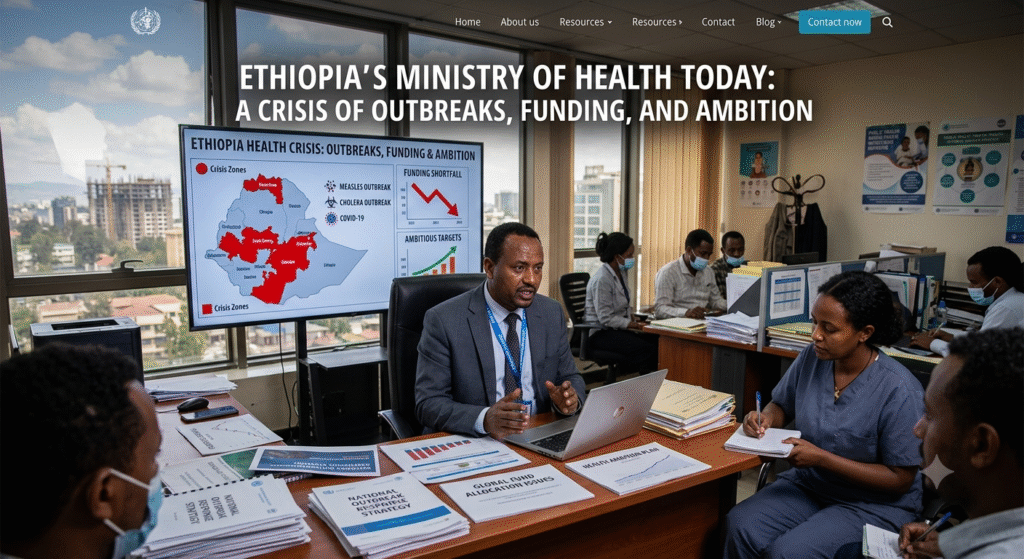
Just days ago, on July 1, 2026, the Ministry of Health triumphantly declared the end of a Marburg virus disease outbreak that had struck the Southern Ethiopia Region. For 42 consecutive days, no new cases had been reported . Yet, mere hours after that announcement, the Ministry was forced to confirm that the virus had not been fully vanquished .
This paradox captures the reality of the Ministry of Health today: balancing hard-won successes against the unrelenting pressure of new outbreaks, all while navigating a massive influx of international funding and an ambitious drive for continental self-sufficiency.
The Marburg Challenge: A Victory and a Warning
The Ministry of Health, led by Minister Dr. Mekdes Daba, has been at the forefront of a grueling battle against the Marburg virus . Recent laboratory tests from the Ethiopian Public Health Institute (EPHI) confirmed cases in the Southern Ethiopia Region, with a total of 73 suspected individuals tested. Tragically, 6 patients have died from the virus, while 5 others are still receiving treatment .
The Ministry’s rapid response has been crucial in containing the spread. A massive contact-tracing operation was launched, identifying 349 people who had come into contact with confirmed cases. A significant number—119 of them—have already completed their isolation period .
Minister Daba personally expressed condolences to the families of those who lost their lives . To bolster this effort, the Ministry, alongside the EPHI, held a forum with the German Embassy, the Robert Koch Institute, and the WHO to strengthen the capacity of the country’s Emergency Medical Teams (EMTs) . This international collaboration is proving vital in managing the outbreak and reinforcing the country’s emergency response systems .
The $1.6 Billion Partnership with the U.S.
In a landmark move on July 6, the governments of Ethiopia and the United States signed a monumental Memorandum of Understanding (MoU) worth $1.616 billion to strengthen Ethiopia’s health sector over the next five years . The agreement represents a significant expansion of long-standing health cooperation between the two nations .
Under the deal:
- The U.S. government has committed up to $1.016 billion in grant financing, with an additional $150 million available based on performance milestones .
- The Ethiopian government has pledged up to $450 million in co-financing, alongside policy leadership and oversight .
The agreement was formalized by Finance Minister Ahmed Shide, Health Minister Dr. Mekdes Daba, and U.S. Ambassador Ervin Massinga .
A Push for Continental and Domestic Health Security
The Ministry is also playing a leading role in a continental push for health sovereignty. At the 39th African Union Summit, Dr. Mekdes Daba highlighted a major success: by improving the drug procurement system to prioritize domestically produced products, Ethiopia has increased domestic demand coverage from just 8% to 42%. The ambitious goal is to reach 60% within the next five years .
At the launch of the “ACHIEVE Africa” initiative, which aims to ensure the continent’s vaccine and medical sovereignty, Dr. Daba noted that Ethiopia is playing a leading role in achieving the African Union’s goal of meeting 60 percent of the continent’s vaccine needs by 2040 .
Furthermore, the Ministry hosted a high-level forum with the Africa CDC to launch the African Pooled Procurement Mechanism (APPM) for medicines and medical devices . Ethiopia is one of the first 10 countries to sign a Memorandum of Understanding to begin implementing this integrated procurement and supply system .
The Annual Volunteer Health Drive
At the same time, the Ministry launched its annual volunteer health service initiative. The ambitious goal is to provide free medical care to five million citizens who cannot afford treatment . The week-long program, under the theme “Volunteerism for a Healthy Society,” offers medical counseling, examinations, and treatment at no cost . It builds on previous years’ successes, which saw 4.5 million people reached, and shows the Ministry’s commitment to bridging the gap in healthcare access for the most vulnerable populations .
The Human Cost: A Balancing Act
The Ministry’s headline today is one of remarkable ambition and international support. However, this progress is being made in a context of profound human cost. The Marburg outbreak, while contained, is a stark reminder of the fragile nature of public health security . As the Ministry pursues its grand goals of vaccine sovereignty and continental leadership, it must continue to prioritize the immediate, life-and-death battles on the ground.
