

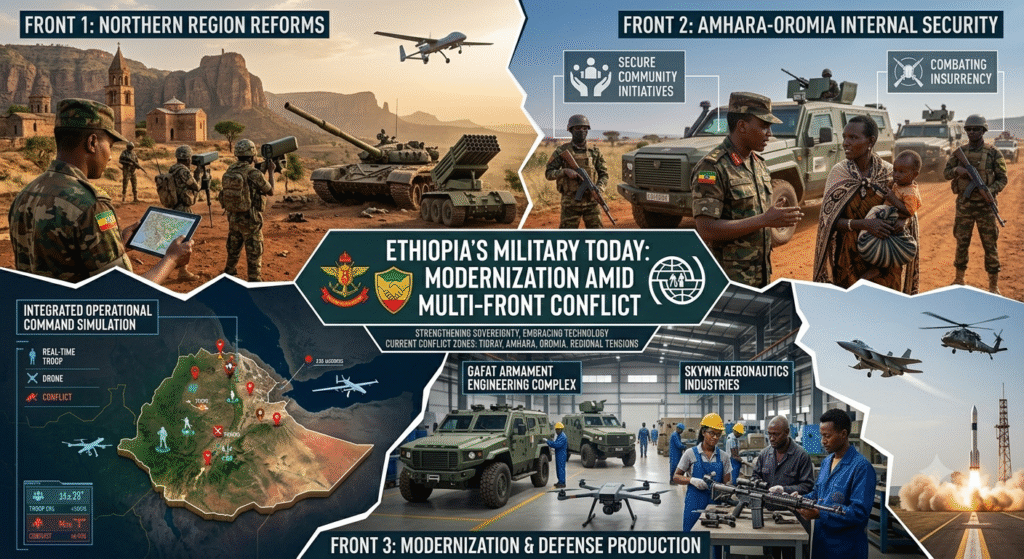
Ethiopia’s military finds itself at a critical crossroads in August 2026. The Ethiopian National Defense Forces (ENDF) are simultaneously pursuing an ambitious modernization drive aimed at becoming a top-tier African military power, while being stretched thin across multiple internal conflicts that threaten the nation’s fragile peace . From the disputed territories of Tigray to the insurgent strongholds of Amhara and Oromia, the ENDF is engaged in a complex struggle that tests its capacity, its international standing, and its commitment to the Pretoria Peace Agreement.
A Force in Transition: The Modernization Drive
Despite the intense conflicts, Ethiopia’s military leadership is publicly committed to building a modern, technologically advanced force. Chief of General Staff, Field Marshal Birhanu Jula, recently affirmed that the country has established a “modern, reliable and versatile military institution strengthened by skilled manpower, professionalism and advanced technology” . This modernization is a key pillar of Prime Minister Abiy Ahmed’s broader national reform efforts.
The numbers underscore this ambition. Ethiopia has surged to become the 5th most powerful military on the continent and 47th globally, according to the latest Global Firepower Index . This ascent reflects significant investment in manpower—the country can tap into a pool of over 56 million people of military age, with an active-duty personnel count exceeding 500,000, the largest standing army in the region .
Under a strategic roadmap aimed at reaching the global top 30 by 2030, the government has prioritized the air force, diversifying its fleet with advanced fourth-generation fighters and one of the most varied drone inventories in Africa. From Turkish Bayraktars to Chinese Wing Loongs, these unmanned aerial systems have redefined the nation’s combat capabilities, allowing for high-precision operations in terrains that were previously difficult to secure .
The Special Operations Command, celebrating its 65th anniversary, has been restructured for the “modern era.” By integrating Airborne, Commando, and Special Anti-Terrorist forces, the Command now stands “ready to efficiently execute missions at any time and under any condition” . This is a clear signal that the military is preparing for a future of complex, asymmetric warfare.
The Tigray Front: A Peace Agreement on the Brink
The most serious test for the ENDF is the unraveling of the Pretoria Peace Agreement that ended the 2020-2022 Tigray War. In early August, intense clashes erupted between federal forces and the Tigray People’s Liberation Front (TPLF) in western Tigray, near the Sudanese border .
The TPLF accused the federal government of launching a “large-scale ground offensive” in the Shererina area, a violation of the peace deal . The federal government has not officially confirmed the offensive but has accused the TPLF of initiating the fighting . The clashes, involving heavy artillery, drones, and machine gun fire, have sparked fears of a return to the full-scale war that claimed an estimated 600,000 lives .
The strategic importance of the area is immense. Shererina lies in western Tigray, a disputed territory that remains unresolved under the Pretoria Agreement . The fighting has also drawn in regional actors. The federal government has been accused of allowing Sudan’s Rapid Support Forces (RSF) to use Ethiopian territory, and Eritrea has reportedly thrown its weight behind the TPLF, internationalizing the conflict .
The humanitarian consequences are immediate. Hundreds of civilians have fled to Sudan, and projectiles have struck refugee camps along the border, causing casualties . The African Union and human rights groups like Amnesty International have called for restraint, but the lack of independent access to conflict zones and the collapse of international human rights monitoring in Ethiopia have raised alarm .
The Multi-Front Challenge: Amhara and Oromia
While the Tigray front has grabbed international headlines, the ENDF is also deeply engaged in a protracted conflict in the Amhara region against the Fano militia, and in Oromia against the Oromo Liberation Army (OLA).
In June, the military claimed to have “neutralized” 230 Fano fighters in a week-long operation across the North Gojjam, West Gojjam, Awi, and South Gondar zones . The army described it as a “law enforcement operation” and reported seizing various weapons . However, these claims are difficult to verify, and Fano-affiliated media have frequently disputed federal casualty figures . The conflict in Amhara shows “little sign of de-escalation” .
The ENDF has also claimed to have foiled a coordinated attack by Fano and OLA fighters in the East Wollega Zone of Oromia . This suggests a worrying trend of insurgent groups coordinating their activities. The military warns that these armed groups are “scrambling to achieve their handlers’ goals” by misleading communities .
Conclusion
Ethiopia’s military is a paradox. It is a force that is simultaneously modernizing with advanced technology and a massive manpower base, and a force that is dangerously overstretched by a multi-front conflict that threatens the country’s stability. The government is seeking to build a world-class military, but it is also accused of deploying it to suppress regional forces and disrupt a fragile peace. The fighting in Tigray is the most dangerous manifestation of these tensions. It has not only revived the trauma of a brutal civil war but has also drawn in regional players, raising the specter of a wider conflict that could have devastating consequences for the entire Horn of Africa. The international community is watching closely, and the decisions made by the Ethiopian government and its military leadership in the coming weeks will determine whether the region moves toward dialogue or deeper destruction.
