

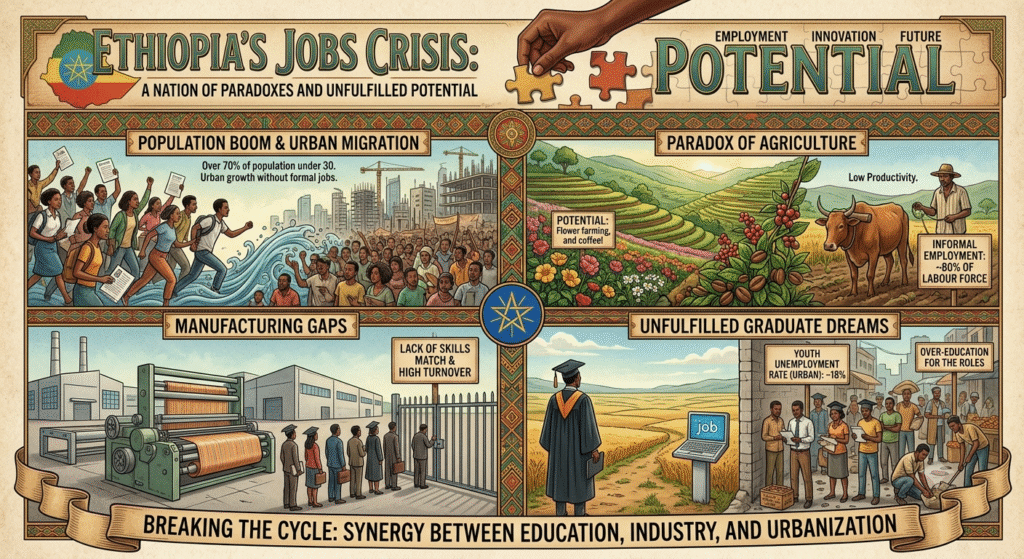
As of mid-2026, Ethiopia finds itself trapped in a profound and deeply paradoxical employment crisis. Despite being one of the fastest-growing economies on the African continent, with the United Nations forecasting a staggering 10.2 percent growth rate , the country cannot generate enough quality jobs for its rapidly expanding, predominantly young population. The crisis is characterized by a baffling coexistence of high unemployment and severe labor shortages, a failing education system that churns out unemployable graduates, and a cultural tension between urban aspiration and the demands of a developing economy .
The Paradox of Jobless Growth
At the heart of the crisis lies a phenomenon described as “jobless growth.” Between 2000 and 2022, Ethiopia’s economy grew at an annual rate of 8.9 percent, yet this rapid expansion failed to translate into meaningful employment opportunities. While labour productivity nearly tripled, over 96 percent of these gains came from improvements within existing sectors rather than through structural changes that move workers into more productive jobs .
The classic industrialization model, which has driven transformation in other economies, has failed to deliver in Ethiopia. Manufacturing’s employment share declined from 5.2 percent to 3.1 percent, even as output expanded. New production did not create new jobs. Instead, most workers who left agriculture moved into informal services such as petty trade, where productivity and wages remain low .
This dualistic economy—characterized by high-productivity but job-scarce manufacturing alongside low-productivity but labour-absorbing services—has created a growing mismatch between rising educational attainment and limited employment opportunities. High-skill, high-productivity service subsectors remain small and capital-intensive, unable to absorb the waves of new graduates entering the labour market each year .
The Education and Skills Mismatch
The education system is failing to prepare young Ethiopians for the workforce. The recent national secondary school leaving examination results sent shockwaves across the nation, with more than 90 percent of students failing to achieve a passing grade . Of the 150,000 examinees who sat for exit exams from private institutions, only 17 percent managed to graduate .
The failure is not limited to academic education. Technical and Vocational Education and Training (TVET), intended to produce a competent middle-level workforce, faces persistent quality issues. Research reveals that the employment rate for agro-food processing graduates was limited to just 21.6 percent, with competence and wage employment opportunities negatively correlated . Graduates often lack the practical skills employers need due to shortages of human and material resources, as well as weak cooperative training practices .
For students like Jebril Kedir, a final-year IT student who failed his exit exam, the outcome hardly matters. “Even if I passed, it’s not like I’ll get a job,” he told reporters. The federal government is freezing new hires in the public sector, leaving graduates with few options. With over 200,000 followers on TikTok, Jebril is exploring entrepreneurial ventures but struggles to mobilize seed capital and acquire proper licenses. “I’m constantly looking for ways to leave the country,” he admitted .
He is not alone. 839,000 Ethiopians migrated to other countries in the span of five years, with over three-quarters between the ages of 15 and 29. 51,000 of these migrants went missing, while many perished using dangerous land and sea routes .
The Start-Up Struggle: A Policy Vacuum
For the entrepreneurial-minded youth who choose to stay, the environment is hostile. There is no legally defined categorization for startups in the country, leaving most struggling while labelled under Small & Medium Enterprises or Private Limited Companies . A start-up proclamation drafted by the Ministry of Innovation & Technology, which entails tax incentives and the creation of an innovation fund, has been making rounds at various ministries for three years and remains unratified .
The Addis Ababa Chamber of Commerce has partnered with the European Union to provide incubation programs for 16 companies, but this is a drop in the ocean. According to the BIC project manager, “We don’t predicate our selection of companies on founders’ educational achievements,” acknowledging the huge gap in practical business skills .
As one entrepreneur put it: “We are toiling in the trenches for now” .
The Cultural Dimension: “There Are Jobs But No Workers”
Perhaps the most controversial dimension of the crisis is Prime Minister Abiy Ahmed’s recent indictment of what he describes as a work culture that has curdled into entitlement. In a blunt address to Parliament, Abiy stated: “There are people, and to a certain extent there are jobs, but there are no workers” .
He cited examples: contractors forced to recruit labourers in Addis Ababa and bus them to the Wenchi crater lake tourism site because locals refused the work; the new airport project in Bishoftu struggling to find manpower despite operating around the clock. “What people want is to immediately drive a car, to immediately own a house, not to work two jobs,” he said .
Abiy held up the Ethiopian diaspora in the United States as a counter-example—teachers who drive Ubers after class, workers stacking two 16-hour shifts. “If our families here just sit around looking at Facebook and claim there is no work, I don’t think they will succeed in the future,” he warned .
Yet this narrative of a “lazy” workforce may be overly simplistic. Research shows that corruption—nepotism, cronyism, and bribery—significantly affects competent graduates’ access to wage employment. Poor graduate competence and corrupt employment practices have created an environment where competence and employment are inversely related .
The Missing Bridge: The Case for Job Centres
In response to these challenges, experts are calling for the establishment of a national network of job centres. Drawing on European models like the UK’s Jobcentre Plus and the EU’s Youth Guarantee, advocates argue that Ethiopia needs an institutional bridge between education and employment .
Such centres would provide career guidance, real-time job matching, short demand-driven training, apprenticeships, and entrepreneurship support. “Instead of letting exam ‘failures’ drift into unemployment, job centres would ensure every young Ethiopian has a second chance,” argues one policy analyst .
Conclusion
Ethiopia’s jobs crisis is not a simple story of unemployment numbers—it is about the quality, dignity, and sustainability of work available to millions. The official unemployment rate of 3.4 percent obscures a far more complex reality of underemployment, informal work, and despair . With a population exceeding 120 million and a highly productive age group between 18 and 34 accounting for over 30 percent of the total, the nation cannot afford to waste this demographic dividend .
The path forward requires a hybrid strategy: reviving labour-intensive manufacturing, diversifying tradable services, upgrading the informal economy, and aligning skills with market demand . Above all, it requires confronting the corruption and cultural inertia that prevent competent graduates from finding dignified work. As Prime Minister Abiy himself warned, “Development that discards the poor, discards the farmer, and pushes away the needy will lead nowhere” .
