

ADDIS ABABA — July 15, 2026
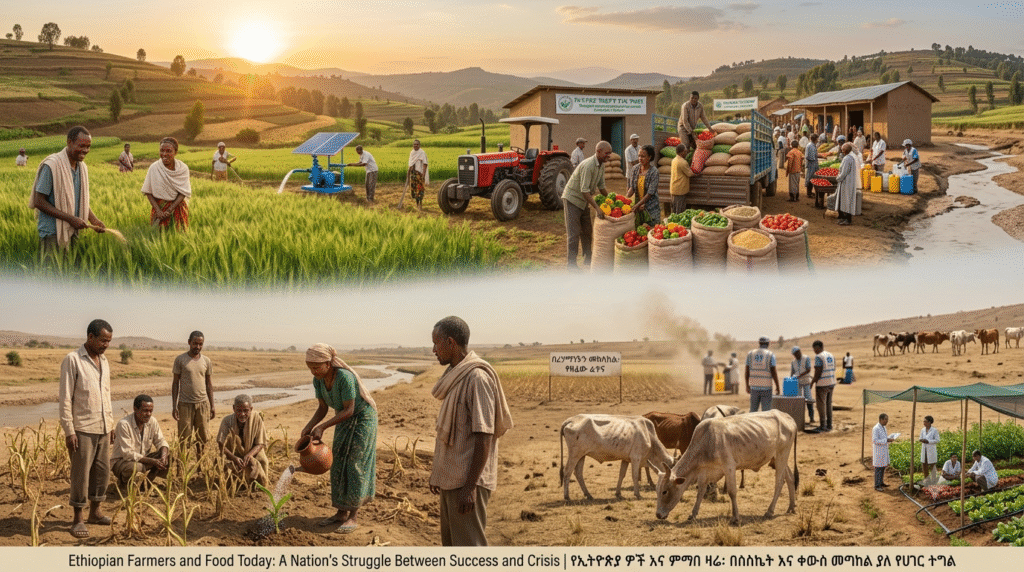
Ethiopian farmers are living through one of the most challenging periods in recent memory. As the 2026 lean season peaks, millions of rural households are facing widespread hunger, with the worst-affected areas in the country’s south and southeast reaching Emergency (IPC Phase 4) levels of acute food insecurity . Yet this crisis masks a deeper, more complex story: an agricultural sector undergoing rapid transformation, achieving remarkable successes in wheat production while struggling to overcome structural vulnerabilities that leave it exposed to climate shocks, conflict, and economic instability .
The Lean Season Crisis: A Nation Hungers
From June to September, as the 2026 lean season reaches its peak, Crisis (IPC Phase 3) conditions are widespread across northern, central, and southern Ethiopia . Food access has declined sharply due to high prices, limited income-earning opportunities, and heavy market reliance. The worst conditions are concentrated in the East Hararghe lowlands, where crop failures have pushed many households to the breaking point .
In these areas, food stocks from the 2025 meher harvest are critically low following widespread crop failures caused by inadequate kiremt rains during key stages of crop development. The lowlands experienced complete crop failure, and households have been dependent on market purchases since November 2025—months earlier than usual . With staple food prices remaining abnormally high and income opportunities shrinking, families are being forced into extreme coping strategies, including sending younger children to relatives to eat and migrating long distances in search of labor .
In the pastoral south and southeast, the situation is equally dire. The poor performance of both the March-May 2025 gu/genna and October-December 2025 deyr/hageya rainy seasons has created severe shortages of pasture and water . Waterpoints that once sustained communities have dried up completely. In Ethiopia’s Somali Region, every monitored waterpoint was dry by January 2026 . In Borana, the share of completely dry waterpoints doubled within a year, rising from 37% to 74% .
For pastoralists, the consequences are devastating. Livestock body conditions have deteriorated, milk production has dropped, and animals have lost market value. Households are being forced into distress sales of productive animals—an irreversible decision that undermines future herd recovery . The ripple effects extend to human health: reduced milk availability, often the primary source of nutrition for children in pastoral households, is raising malnutrition risks .
The Structural Crisis: A Sector Under Strain
The current emergency is not a one-off disaster, but the latest chapter in a long-running crisis. Between 2020 and 2023, compounding conflict, drought, and economic shocks severely eroded household assets and access to typical food and income sources . Recovery of livestock herds, labor markets, and household assets is expected to take years, leaving households highly vulnerable to future shocks.
The agricultural sector itself faces deep structural challenges. Approximately 80% of Ethiopians depend on smallholder agriculture, and about 90% of farming is rain-fed . The 2020-2023 drought sharply reduced herd sizes, leaving many poor households with minimal livestock holdings. The 2025 deyr/hageya season was extremely dry, slowing herd regeneration to a crawl .
Climate change is making matters worse. Extreme weather events have reduced land productivity by approximately 24%, with crop and livestock losses reaching up to 93% and 91%, respectively . The ongoing El Niño is expected to result in below-average June-September kiremt rainfall, with the largest deficits forecast in central and northeastern areas, likely affecting meher production, particularly rainfed maize and sorghum in eastern Amhara, Tigray, northeastern Oromia, and other central and northeastern cropping areas .
Land degradation compounds these challenges. Ethiopia’s cultivated area increased by about 3,700 square kilometers between 2000 and 2020, mainly through the conversion of forestland and shrubland, yet per capita farmland has continued to decline since 2010 due to population growth . Today, 85% of Ethiopian land is degraded to various degrees, a major obstacle to achieving land resource sustainability and food security . High population density and land fragmentation in the highlands, limited income diversification, and widespread underemployment constrain livelihood capacity even in average years .
The Human Cost: Rising Hunger and Malnutrition
The consequences are being measured in human lives. According to recent data, 62% of households face food insecurity, rising to 67% in highland areas, and wheat yields have fallen by 12% . An estimated 5.5 million people in Somalia face severe acute food insecurity between April and June 2026, with close to 1.6 million in emergency levels—and Ethiopia faces similar threats.
Gender inequalities are worsening the crisis. Female-headed households are 40% more likely to skip meals during droughts compared to 25% among male-headed households . This reflects deeper disparities in access to resources and decision-making that limit women’s adaptive capacity.
Conflict is exacerbating food insecurity, particularly in northern Ethiopia. In Tigray, heavy clashes resumed in early 2026, leading to panic purchasing, cash shortages, rising food prices, and fuel constraints . In Amhara, clashes between Fano militias and government forces continue to disrupt road access and market activity, while conflict between the Oromo Liberation Army and government forces constrains livelihoods in western Oromia .
The Transformation: Wheat Self-Sufficiency and Agricultural Reform
Yet there is another story being written. Despite the current crisis, Ethiopia has made remarkable strides in transforming its agricultural sector. The country that once spent nearly $1 billion annually on wheat imports has now become the largest wheat producer in Africa, tripling Egypt’s output .
The “Wheat Revolution,” initiated by Prime Minister Abiy Ahmed, has transformed the country’s food resilience. Through the expansion of irrigated farming, use of improved seed varieties, and adoption of modern farming techniques, annual wheat production has reached 231 million quintals . In addition to completely replacing wheat imports, this program has strengthened food and nutrition security and earned recognition from international organizations, including the FAO, which awarded Prime Minister Abiy the Agricola Medal in 2024 for his leadership in pursuit of food self-sufficiency .
The Green Legacy Initiative, launched in 2019, has planted over 40 billion seedlings, many of which are fruit-bearing species such as avocado, mango, and papaya. Forest cover has increased from 17.2% in 2019 to 23.6% in 2023 . This strategic focus on edible trees enhances food security, improves nutrition, and generates income for farming communities.
The “Bounty of the Basket” (Yelemat Tirufat) program, launched in 2022, aims to increase production of fish, dairy, eggs, chicken, and honey. The results are impressive: chicken meat production surged from 70,000 to 208,000 tons, milk production from 7.2 billion to 10 billion liters, and honey production from 128,000 to 272,000 tons .
The Way Forward: A Synergistic Approach
Experts argue that achieving a resilient and productive agricultural transformation requires a synergistic policy approach that integrates context-specific technology with secure land rights and robust extension services . Emergency interventions are urgently needed in the hardest-hit areas: water trucking, rehabilitation of critical waterpoints, targeted fodder provision, and food assistance for vulnerable households .
But long-term solutions are equally critical. The rangeland early warning system developed by the Alliance of Bioversity International and CIAT demonstrates how precision data can guide anticipatory action . The challenge now is institutionalizing these tools, ensuring that early warnings trigger rapid response rather than merely documenting disaster .
Ethiopia’s food security situation remains precarious. The ongoing El Niño threatens the upcoming meher harvest, and the country’s strategic food reserve, while growing, still faces immense pressure . Yet the transformation underway offers hope. As one analysis concluded, “by strengthening resilience, reducing dependency, and laying the groundwork for sustainable growth, Ethiopia is emerging as a model for agricultural transformation in Africa” .
For Ethiopia’s farmers, the struggle continues—between feast and famine, between the crisis of today and the promise of tomorrow.