

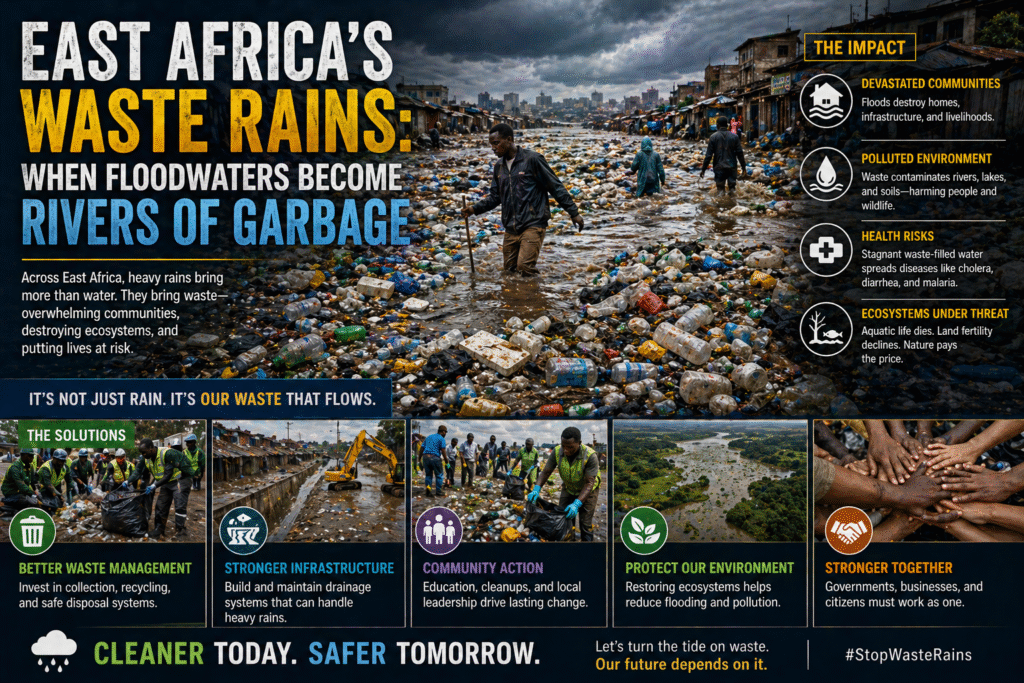
The April 2026 rains have arrived in East Africa with a fury that meteorologists did not fully predict. In Nairobi, a staggering 112 to 160 millimeters fell in just 24 hours—more than the capital typically receives in an entire month . In Mombasa, three consecutive days of downpour displaced over 300 people and submerged critical infrastructure . But the death toll—at least 112 lives lost in Kenya alone—tells only part of the story . The deeper catastrophe lies in what the floodwaters are carrying: an avalanche of plastic waste, garbage, and industrial pollution that is turning seasonal rains into a toxic torrent.
This is the reality of East Africa’s “waste rains”—a crisis where poor waste management transforms natural flooding into a public health and environmental emergency.
Part 1: Nairobi’s Underwater Crisis – A City Built on Neglect
The evening of March 7, 2026, will be etched into the memory of Nairobi’s residents. Streets turned into rivers. Vehicles were swallowed by muddy water. Families watched helplessly as the Nairobi River burst its banks and swept through homes in Kibera, the country’s largest informal settlement .
“Everything was swept away,” said Onesmus Kahi, a Kibera resident. “The water rose so quickly and people had no time to react. Crossing bridges became dangerous; we were lucky not to be carried off. But homes were destroyed, and sadly, one woman lost her life” .
The human toll across Kenya is staggering. According to the Ministry of Interior, at least 110 people have died as floods devastate 30 counties. Nairobi recorded the highest fatalities at 37 . Over 2,700 families have been displaced, and dozens of vehicles have been swept away .
Yet as climate scientist Dr. Jackson Koimbori notes, even these numbers fail to capture the full picture. “Extreme weather is becoming more frequent and disruptive—heatwaves, floods, strong winds, and even cold snaps are now the new normal,” he warns .
Part 2: The Drainage Collapse – A Legacy of Neglect
The immediate cause of Nairobi’s flooding is meteorological—but the scale of the disaster is man-made. Urban planner Patrick Adolwa offers a blunt diagnosis: “It is general knowledge in the Kenyan capital that the city’s drainage system is a mess. If not corrected in time, the situation will only worsen further” .
Nairobi’s population, now approaching five million, has exploded without corresponding investment in infrastructure . The drainage system, much of it built decades ago, cannot handle the volume of water. But the more insidious problem is clogging—not just from silt, but from solid waste.
Kahi explains the vicious cycle: “When you look at this river and its drainage channels, you’ll notice a buildup of solid waste, largely due to poor garbage collection. People continue dumping waste here, and during heavy rains, it ends up blocking the entire drainage system” .
Part 3: The River Athi – Choking on Plastic
The problem extends far beyond Nairobi’s city limits. The recent deluge has revealed a national emergency along the iconic River Athi, which winds through Machakos County. As floodwaters recede, an astonishing volume of single-use plastic bags has been left behind—trapped on vegetation along the riverbed .
This is happening despite a nationwide ban on plastic bags introduced by the Kenyan government in 2017. Under the law, manufacturers and users face fines of up to Sh4 million or imprisonment. Yet according to the United Nations Environment Programme, Kenya still generates more than 966,000 metric tonnes of plastic waste annually—with plastics accounting for about 20 percent of total waste volume .
Kajiado County Environment Chief Officer James Ngugi admits the ban has failed. “The resurgence of plastic bags in major towns was alarming,” he told Climate Action. “The vast peri-urban county has only two gazetted environment officers who can arrest and prosecute an offender against populous urban centres” .
A cartel of unscrupulous traders allegedly sneaks plastic bags into Kenya through the porous Tanzania border, while some local companies continue manufacturing the banned products. A spot check in Athi River, Mlolongo, and Kitengela towns found plastic bags still in regular use at retail shops and roadside eateries .
Part 4: Solid Waste Meets Storm Water – The Jinja Nightmare
The crisis is not confined to Kenya. In Uganda’s Jinja City, residents living near the city’s manned landfill have raised the alarm about garbage spillovers that intensify during heavy rains. When the downpours come, excessive runoff water carries garbage uncontrollably into nearby homes .
Zam Nalwadda, a resident, recounts a harrowing night: “While sleeping, I woke up to the threat of garbage flooding into my sitting room. The heaps broke down the front door and inundated my house” . She lost belongings worth two million shillings—a devastating sum she has yet to recover.
Andrew Mulowozo, who lives less than five meters from the landfill, says he now relocates his family during rainy seasons to protect them from garbage spillovers. He fears that without intervention, a tragedy similar to the Kitezi incident—which left many dead and others homeless—could unfold in Jinja .
Part 5: The Climate Connection – Why the Rains Are Getting Worse
While poor waste management amplifies the damage, the rains themselves are intensifying—a direct consequence of climate change. Climate scientist Clifford Omondi explains that a steady warming of the Indian Ocean is driving a powerful ocean-driven system known as the Indian Ocean Dipole (IOD) .
During a positive IOD phase, the western Indian Ocean becomes warmer—and that warmth acts like a moisture engine. “The warming acts like a moisture engine, pulling large amounts of water vapour into the atmosphere so that during a positive IOD phase, the moisture is released over East Africa, resulting in intense rainfall,” Omondi explains .
Ngao Leli, Lamu County Director of Meteorological Services, adds that warmer ocean temperatures mean “lots of convective activity is taking place and clouds are formed, hence resulting in heavier, more destructive rainfall events like what is being witnessed at the moment” .
Perhaps most unsettling is what Omondi calls “climate whiplash”—the abrupt swing between drought and flood. “The line between drought and flood is becoming thinner, and the swing between the two is also more abrupt,” he warns . This means the same communities devastated by flooding may face severe water scarcity within months.
Part 6: The Deadly Toll – What the Numbers Reveal
The scale of devastation across Kenya is now quantifiable. According to the Kenya National Police Service, as of late March 2026, at least 108 deaths had been confirmed. More than 2,700 families—representing tens of thousands of individuals—have been displaced .
In Mombasa, the situation reached crisis levels in late April. County Commissioner Mohamed Hassan confirmed that six sub-districts—Changamwe, Jomvu, Kisauni, Likoni, Mvita, and Nyali—were affected. Infrastructure damage included Inuka Police Station, forcing operations to shift to Shelly Beach. Al-Mandhry Mosque and electricity poles in Mtongwe and the Tudor-Mworoto informal settlement were also heavily impacted .
Two Tanzanian nationals were rescued at Bamburi Beach after strong winds blew them off course. They had reportedly been drifting from Pemba Island since April 14 before landing on Wednesday .
Part 7: Accra’s Desperate Clean-Up – A Model of Action
One response to the crisis offers a glimpse of what proactive intervention might look like. In Ghana’s capital, Accra, the Metropolitan Assembly has partnered with The Or Foundation and the Kantamanto Obroni Wawu Business Association to undertake a major desilting operation on the Okai Kwei Road storm drain .
The scale of neglect is breathtaking. The storm drain—which stretches from Tema Station through Okai Kwei Road to the June 4 Market and eventually into the Korle Lagoon—had not been desilted since its construction .
Within the first 12 hours of work, 400 meters of the drain were cleared. Approximately 60 tonnes of waste—including plastic, silt, and textile debris—have already been removed, with an estimated 120 tonnes more expected . Waste workers from Tide Turners and the June 4 Task Force accessed the underground drainage system through newly created entry points, breaking through concrete covers to reach decades of accumulated garbage .
Accra Mayor Michael Kpakpo Allotey emphasized that the AMA would continue to collaborate with stakeholders to strengthen drainage systems, improve sanitation, and build a more resilient city . But the exercise also highlighted a deeper problem: without behavioral change—specifically, stopping the dumping of waste into drains—any clean-up will be temporary.
Engineer Solomon Noi, Head of Waste Management at AMA, expressed optimism that once completed, the impact of rainfall in Kantamanto market would be greatly reduced, protecting lives, property, and livelihoods .
Part 8: The Ocean Connection – How Inland Waste Becomes Marine Crisis
The waste that chokes Nairobi’s rivers and Jinja’s landfills does not disappear when floodwaters recede. It travels downstream—eventually reaching the Indian Ocean, where it threatens the region’s blue economy.
Mombasa, a city of 1.4 million nestled between two creeks on an island, has seen its marine ecosystem suffer dramatically. Microplastics are harming fish and jeopardizing the livelihoods of fishermen. Plastic bags entangle and kill sea turtles. Some marine species, such as sea cucumbers, have been driven to local extinction .
Basil Angaga, Mombasa County’s chief sustainability officer, describes the stakes: “The ocean is our heritage. It’s what keeps the city running—the entire economy revolves around it” .
But there are signs of hope. In 2018, Mombasa closed the Kibarani dumpsite, a sprawling landfill located at the confluence of the creeks where persistent floods had been causing waste to leak into the ocean. The site has since been transformed into a seaside recreational park with a playground and rows of plants .
Local initiatives like PlastSafi organize monthly clean-ups along Tudor Creek and pay waste pickers to collect plastic bottles for recycling. One participant, university student Ben Kalume, earns around 15,000 Kenyan shillings (US$150) each month—enough to pay for his education and support his mother and four siblings. “Waste is wealth,” he says .
Part 9: Solutions on the Horizon – From Crisis to Opportunity
If East Africa’s “waste rains” expose the high cost of neglect, they also point toward solutions. Experts argue that preventing future disasters requires more than emergency response measures.
Urban planner Patrick Adolwa outlines a comprehensive approach: protecting urban ecosystems, upgrading drainage infrastructure, halting construction on floodplains, and planning for a population growing faster than the city’s foundations can support .
“If we had a system that distributed our population across the country in a balanced way, Nairobi would not face this level of pressure,” Adolwa explains. “The planning of Nairobi has always been complicated. Every day, thousands of people move in and out, making it difficult to know how many people to plan for” .
In Mombasa, authorities are tackling the problem at the source—working with manufacturers to redesign packaging to reduce waste and partnering with USAID to foster solutions for marine pollution . A new pilot initiative will aid 800 households with waste sorting and recycling, nearly half of which are in low-income areas .
The results are already visible. According to a recent survey by the European Investment Bank, plastics have fallen from 20 percent of Mombasa’s waste stream to just 6 percent since 2022 .
Part 10: The Science of Prediction – Early Warnings Save Lives
One of the most critical tools in mitigating the impact of “waste rains” is accurate forecasting. Chris Ng’etich, a climate scientist at the Kenya Meteorological Department, explains that the ongoing rains are largely convectional—driven by intense surface heating that forces warm, moisture-laden air to rise rapidly, forming towering storm clouds and triggering thunderstorms .
The main drivers include the position of the Inter-Tropical Convergence Zone (ITCZ) and the influx of moist air from the Congo Basin rainforest. The ITCZ is currently situated over Kenya, forcing moist air to rise and triggering widespread convection .
As Dr. Koimbori argues, climate information is a national asset. “Early warning systems and impact-based forecasts save lives and guide resilient development,” he says . Yet across much of East Africa, such systems remain underfunded and underutilized.
Part 11: The Transboundary Nature of the Crisis
The floods do not respect national borders. The April 2026 rains have affected multiple countries across Eastern and Southern Africa. According to the Global Weather Hazards Summary, flooding and landslides have occurred in Liberia, Ethiopia, Angola, Zambia, Tanzania, Malawi, and Mozambique .
In southern Africa, the World Weather Attribution report found that some areas recorded a year’s worth of rain in just 10 days—rainfall that climate change made up to 40 percent more intense than in a cooler world .
This transboundary nature demands regional solutions. The waste that clogs one country’s rivers becomes another’s marine pollution. The floods that displace families in one region overflow dams that supply water to another.
Part 12: The Path Forward – Breaking the Cycle
East Africa stands at a crossroads. The “waste rains” of April 2026 are not an anomaly—they are a preview of a future shaped by climate change. As Dr. Koimbori warns, “In a world of extreme weather swings, climate-resilient agriculture, water management, early warnings, and disaster preparedness are essential to safeguard lives and livelihoods. The challenge isn’t just understanding the weather—it’s using climate data fast enough to protect communities before disaster strikes” .
The solutions are known: enforce plastic bans, upgrade drainage infrastructure, stop construction on floodplains, invest in early warning systems, and confront the waste crisis at its source. What remains uncertain is whether governments will act—and whether communities will change behavior.
For residents like Onesmus Kahi, watching the Nairobi River surge through Kibera, the lesson is painfully clear. “This was not a surprise,” he says. “We have been warning for years. The question is: will anyone listen before the next rains come?” .
Conclusion
East Africa’s “waste rains” reveal a region caught between two accelerating crises: a changing climate that brings more intense rainfall, and a waste management system that cannot contain the garbage those floodwaters carry. The result is a toxic combination that claims lives, destroys property, and threatens the ocean ecosystems upon which millions depend for their livelihoods.
From the clogged drains of Nairobi to the plastic-choked River Athi, from the overflowing landfill in Jinja to the polluted creeks of Mombasa, the problem is not the rain itself—but what the rain uncovers about decades of neglect, underinvestment, and failed enforcement.
The April 2026 floods are a warning. Whether East Africa heeds it will determine not only the severity of future disasters but the health, safety, and prosperity of millions who call this region home.