

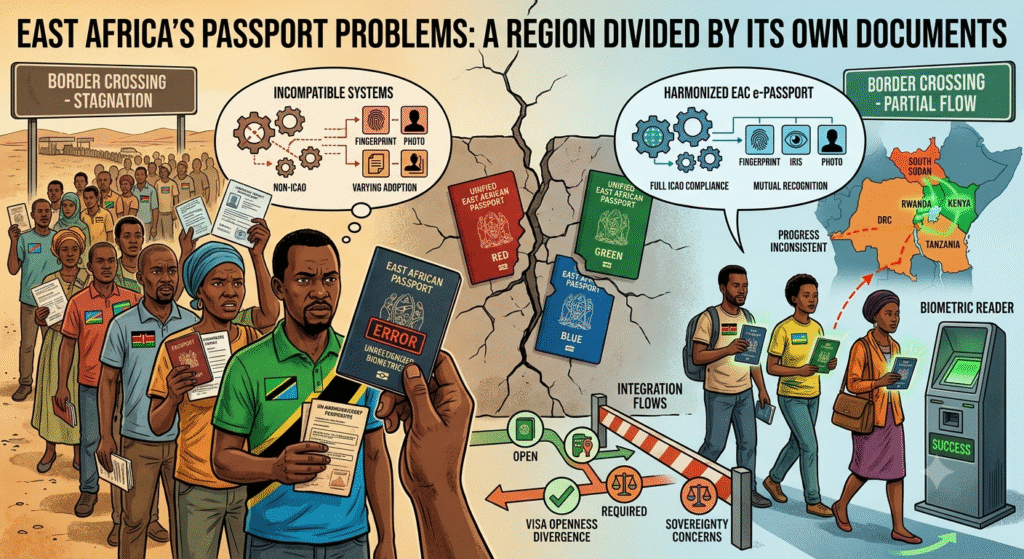
Despite the East African Community’s (EAC) ambitious vision of seamless regional integration, the reality for citizens traveling within the bloc tells a very different story. In 2026, the promise of a common passport and unrestricted movement remains largely unfulfilled, with East Africans confronting a frustrating maze of inconsistent fees, technical failures, political interference, and administrative roadblocks that undermine the very purpose of regional unity.
When Integration Falls Short
The EAC’s Common Market Protocol, established to facilitate the free movement of persons, labor, and services across member states, has become more aspiration than reality . Twenty-five years after the EAC’s revival, leaders who are “uncommitted to the EAC Treaty’s Four Pillars” are accused of undermining the integration dream . The consequences are felt daily by ordinary citizens.
The case of Somalia exemplifies the disconnect between membership and benefits. Despite joining the EAC in March 2024 after a 15-year effort and paying an initial membership fee of $3.5 million, Somali citizens continue to face significant travel restrictions . Notably, Somali passport holders still do not enjoy visa-free entry to Kenya—a privilege extended to most other African nations, with the exceptions of Somalia and Libya . This disparity places an added burden on Somali citizens and businesses, who had hoped membership would ease their frequent travel within the region .
A Patchwork of Fees and Inconsistencies
The fragmentation of East Africa’s passport regime is perhaps most visible in the widely differing costs and requirements across member states. Burundi’s passport stands as the most expensive in the EAC at a staggering $500—more than five times the cost of Uganda’s passport at $71 and nearly ten times Rwanda’s at $48-68 . This exorbitant cost effectively makes international travel a privilege for the wealthy, with applicants also facing waits of more than six months just to receive acknowledgment of their application . Even the laissez-passer, a basic travel document, has become virtually unavailable, plunging citizens into uncertainty .
The inconsistency extends beyond pricing. While Kenya, Uganda, and Rwanda allow entry with biometric identity cards, this measure is not yet generalized across the bloc . Burundian travelers, for instance, must carry a laissez-passer or passport when visiting Tanzania and the Democratic Republic of Congo . Some Burundians have mistakenly assumed that EAC membership grants them automatic entry without proper documents—a misunderstanding that has led to arrests in neighboring countries .
A Bureaucratic Nightmare
The practical challenges of obtaining travel documents across the region are immense. In Malawi, the passport system is in crisis, with a backlog of 154,576 unprocessed applications and only 16,280 booklets in stock—enough for roughly two weeks at current demand . Foreign exchange shortages have prevented the government from honoring contracts with passport printers, disrupting the delivery of key components . Citizens like Steven Matumba have waited over a year for their passports, repeatedly traveling long distances at significant personal expense only to be told to return “in the next two weeks” .
Uganda has faced similar challenges with its newly issued EAC e-passports. Of the 19,000 passports issued so far, the electronic chips contain only facial recognition data and lack vital bio data such as fingerprints, date of birth, and contact information . The Ministry of Internal Affairs has acknowledged the problem, stating they will add the remaining data when they receive it from the National Identification Authority .
Growing Tensions and Political Roadblocks
The erosion of free movement is increasingly manifesting in political tensions. In May 2026, prominent Kenyan activists including former Chief Justice Willy Mutunga and Senior Counsel Martha Karua were detained, had their passports confiscated, and were deported from Tanzania—simply for attempting to observe the treason trial of opposition leader Tundu Lissu . The group has since filed a case at the East African Court of Justice, accusing Tanzania of violating multiple provisions of the EAC Treaty, including those guaranteeing the right to free movement . This case could set a major precedent for the enforcement of regional rights within the EAC .
Adding to the fragmentation, South Sudan imposed a $50 visa fee on citizens of Kenya, Uganda, Rwanda, and the Democratic Republic of Congo in July 2026, while Tanzanians continue to enter visa-free . This departure from the EAC’s push for unrestricted movement will most impact Kenya and Uganda—South Sudan’s main links to regional markets, whose citizens account for a significant share of traders, drivers, and professionals traveling to Juba .
A Broken Promise
The EAC’s vision of free movement remains a distant dream. Professional mobility is severely restricted, with lawyers from Tanzania unable to practice in Kigali and engineers from Kigali unable to build houses in Arusha . Mutual Recognition Agreements, designed to allow professionals to work across borders, remain unsigned or unrecognized by member states . While the bloc agreed to use national identity cards as travel documents, only Kenya, Rwanda, and Uganda have implemented this .
For the millions of East Africans who dream of a truly integrated region, the current passport problems represent more than bureaucratic inconvenience—they symbolize the gap between political rhetoric and lived reality. As Rwanda’s efficient passport system (costing $48-68 with five-day processing) demonstrates, the technology and processes exist . What remains lacking is the political will to implement them consistently and the commitment to uphold the fundamental principle that East Africans should be able to move freely within their own community. Until then, the EAC’s passport remains a promise unfulfilled.
