

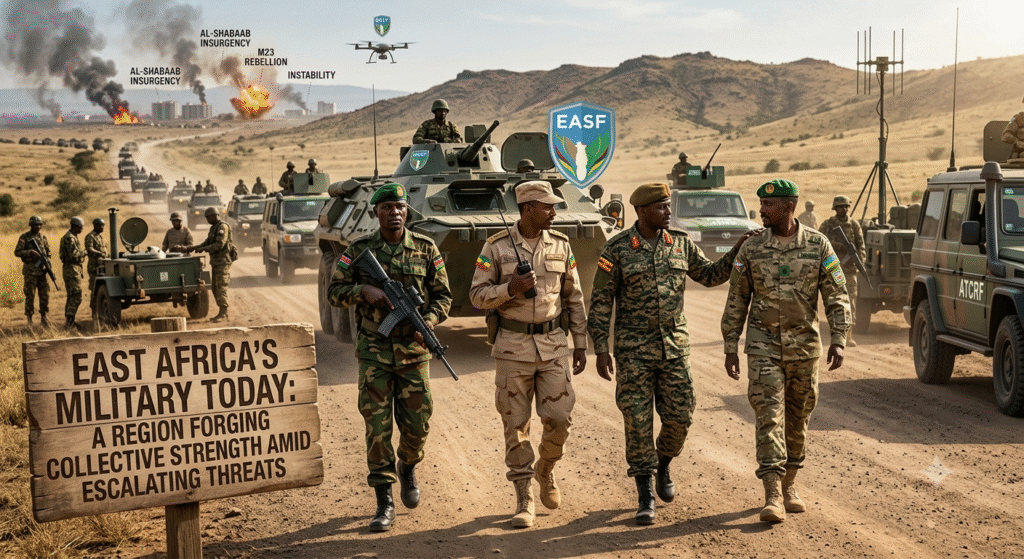
As of August 2026, East Africa’s military landscape is undergoing a profound transformation. Faced with a reduction in international financial support for peace operations and an increasingly complex security environment, regional powers are aggressively pushing for greater self-reliance. From strengthening the Eastern Africa Standby Force (EASF) and expanding bilateral partnerships to confronting the ever-present threat of terrorism and a potential new war in Ethiopia, the region’s military forces are at a pivotal moment .
🛡️ The Eastern Africa Standby Force: Pushing for Self-Reliance
The most significant military development this month is the concerted effort to revitalize the Eastern Africa Standby Force (EASF). The 36th Ordinary Policy Organs Meeting, held in Kampala, Uganda, concluded with a firm resolve to make the regional security mechanism more credible and self-sufficient .
The driving force behind this push is the declining financial support from traditional international donors. EASF Director Brigadier General Ronald Rwivanga highlighted that reduced financing for missions like the African Union Transition Mission in Somalia (AUSSOM) necessitates a new approach: “Africa must increasingly be prepared to finance, manage, and sustain its own peace support operations” .
🗺️ Pledging Capabilities and Commitment
To turn this ambition into reality, member states are making concrete pledges of military assets. The EASF has expanded its roster of contributing nations from four to six, with the expectation that all nine member states will have made their pledges by year’s end .
Key contributions include:
- Ethiopia: Strategic airlift capability using C-130 aircraft.
- Kenya: Air reconnaissance capabilities.
- Rwanda: Medical evacuation helicopters.
- Uganda: Search and rescue capabilities .
This diverse set of pledges is a major step toward building a truly integrated and interoperable regional force.
🏛️ Political Will at the Highest Level
The momentum extends beyond technical meetings. Ugandan President Yoweri Museveni, in his capacity as Chair of the East African Community, has pledged to rally regional leaders. His key priorities are to convene the EASF Heads of State Summit for the first time since 2014 and to strengthen the force’s financial capacity . This political backing is crucial for translating pledges into operational readiness and for securing the long-term, sustainable funding the EASF needs to respond effectively to crises .
🇹🇷 Turkey’s Expanding Military Role in Somalia
Turkey has solidified its position as a key security partner in the Horn of Africa. The Turkish Parliament has approved a two-year extension of its military mission in Somalia, reaffirming Ankara’s commitment to supporting Somali forces against a range of threats, including terrorism, piracy, and arms smuggling .
This extension is part of a broader, decade-long engagement. Through its TURKSOM military training base in Mogadishu, Turkey has trained thousands of Somali soldiers and continues to provide advisory support to strengthen Somalia’s security institutions .
Just this month, high-level coordination was demonstrated when the Somali Army Chief and the TURKSOM Commander visited Baidoa for security talks with the South West State leadership, reaffirming their commitment to coordinated operations against Al-Shabaab .
🚨 The Threat of a New Conflict in Ethiopia
Despite these efforts to build collective security, the region is on edge due to escalating tensions in Ethiopia. A series of drone strikes and ground clashes in the Tigray region have raised fears of a return to large-scale war, a conflict that claimed an estimated 600,000 lives just a few years ago .
💥 Drone Strikes in Mekelle
In a significant escalation, drone strikes targeted residential areas in Mekelle, the Tigrayan capital, in late August. A hospital official confirmed receiving 13 casualties, including five children and seven women, after one strike . While the Ethiopian federal government has not publicly acknowledged responsibility, regional specialists view the strikes as a message: “the government is ready to use harsher means against the TPLF” . The TPLF, which controls Tigray, has accused the federal government of carrying out the attacks .
🌍 A “Possible Second World War” for Africa
The situation is made more volatile by the presence of “new outside actors” who could drive the conflict . The Ethiopian government has accused Eritrea of backing the TPLF, while Sudan’s army has accused Ethiopia of allowing the Rapid Support Forces (RSF) to operate from its territory .
Analysts warn that a new conflict would likely draw in neighboring states like Sudan and Eritrea. Kjetil Tronvoll, a regional specialist at Oslo New University College, cautioned that it “will be Africa’s second world war” . The involvement of multiple internal armed groups, including the Fano militia in Amhara, further complicates the military landscape, with strange alliances forming as historical enemies shift loyalties .
📈 Conclusion: A Region at a Crossroads
East Africa’s military posture in August 2026 reflects a region at a critical crossroads. On one hand, there is a strong, unified push to build a more self-reliant and capable regional security architecture through the EASF. On the other, the persistent threat of terrorism and the escalating crisis in Ethiopia threaten to destabilize the entire region. The success of the EASF’s transformation and the ability of regional leaders to prevent a devastating new war will be the defining tests of East Africa’s military and political cohesion in the coming months.
