

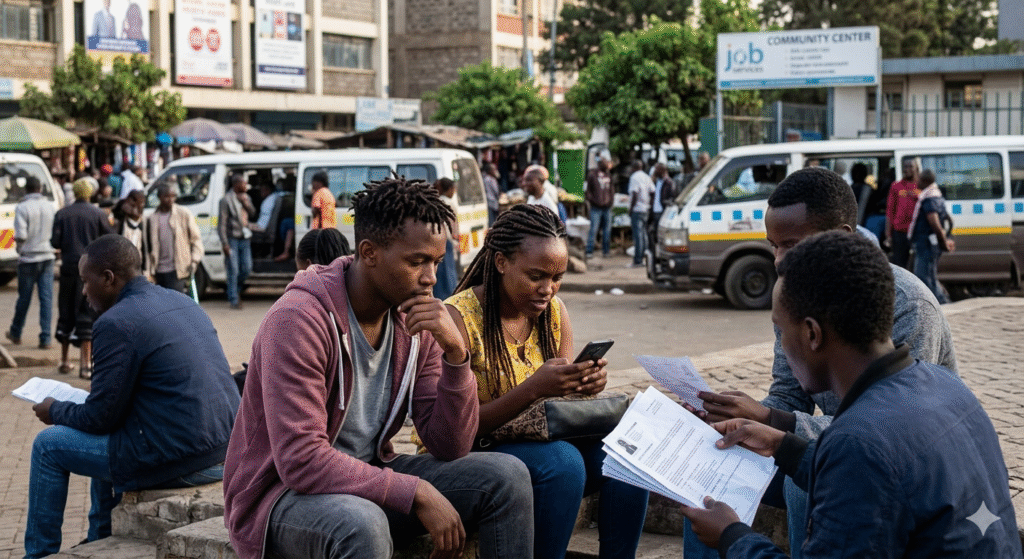
The numbers are staggering. Across East Africa, nearly 8 million young people enter the labor market every year, yet fewer than one million secure formal salaried employment. The rest are absorbed into an informal economy characterized by low wages, no job security, and limited prospects for advancement. This investigation examines the depth and complexity of the region’s employment crisis across 13 critical dimensions.
Part 1: The Growth-Jobs Disconnect
East Africa faces a paradox that economists call “jobless growth.” While regional economies have expanded, this growth has failed to translate into meaningful employment opportunities, particularly for young people.
According to research by World Data Lab, the MasterCard Foundation, and the University of Cape Town’s Development Policy Research Unit, one percent economic growth across Africa yields just 0.4 percent growth in youth employment. Globally, the same growth rate produces up to 0.7 percent job growth. This disconnect stems from the nature of growth itself.
“The conversion rate from growth to employment is lower and for the same amount of growth, we create fewer jobs relative to the rest of the world and for young people, that conversion rate is much lower,” explains Haroon Bhorat, economics professor at the University of Cape Town and director of the Development Policy Research Unit.
“This is because the nature of growth we have is not the type of growth that generates large numbers of wage jobs or even low-skill wage jobs. Most of the jobs that are created are actually low-productivity informal sector jobs,” Bhorat adds.
By the end of 2026, an estimated 2.3 million people aged 15 to 35 are projected to find jobs across the region, but only 282,693—approximately 12 percent—will be formal positions.
Part 2: The Jua Kali Economy’s Growing Shadow
The informal sector—known across East Africa as “jua kali” (Swahili for “hot sun”)—has become the region’s primary employer. On average, 92 percent of employed youth in East Africa work in the informal sector, compared with a global average of 60 percent.
Formal employment accounts for just 8 percent of youth jobs, even as overall youth employment averages 57 percent. Rather than shrinking as economies develop, informality is rising as the youth population expands.
Several countries are expected to post higher informality rates than two years ago. The trend reflects a structural reality: the region’s economies are creating plenty of survival jobs—street vending, casual labor, small-scale repairs—but not enough stable positions with contracts, benefits, and advancement potential.
The jua kali sector offers flexibility and autonomy for some, particularly small-scale entrepreneurs. However, researchers warn that “an overwhelming share of informal workers lack contracts, social protection, income stability, and prospects for career advancement”.
Part 3: Working Poverty – The Cruel Paradox
Perhaps the most devastating revelation from recent labor data is the link between employment and poverty. Across East Africa, having a job does not guarantee escaping poverty.
Kenya illustrates this paradox starkly. While 53 percent of Kenyan youth are employed, more than one-third (35 percent) live in extreme poverty—one of the highest proportions among countries analyzed. In Tanzania, the situation is even more dire: at least one-third of working youth are extremely poor, and more than 70 percent are moderately poor, despite the country having one of the region’s highest employment rates.
“In countries with higher youth employment rates, the share of employed young people living in extreme poverty is higher,” researchers note. “The link between high employment and high working poverty is particularly strong for young women”.
Ghana, with a youth employment rate of 49 percent, records a working poverty rate of 24 percent—significantly lower than Kenya’s 35 percent despite similar employment levels.
Part 4: The Gender Gap in Quality Employment
Young women across East Africa bear a disproportionate burden of the jobs crisis. Although they account for 44 percent of employed youth regionally, they represent 48 percent of working youth living in extreme poverty.
The disparities extend to formal employment access. Young women make up just 38 percent of young people in formal jobs, highlighting persistent gender gaps in accessing quality employment. These figures suggest that even when women work, they are more likely to be concentrated in lower-paying, less secure positions.
Multiple factors drive this gap, including lower educational attainment in some areas, cultural expectations around family roles, workplace discrimination, and concentration in traditionally female sectors like domestic work and agriculture that tend to be informal and low-paid.
Part 5: Country-by-Country Breakdown
The employment crisis varies significantly across East Africa, with some nations performing markedly better than others.
Rwanda stands as the regional leader. Of the projected 63,586 new jobs in 2026, 45,061—or 71 percent—will be formal. Rwanda also tops East Africa for existing formal youth employment at 16.8 percent.
Somalia and Democratic Republic of Congo show moderate formal sector growth, with 23 percent and 20 percent of new jobs respectively expected to be formal, despite high baseline informality.
However, five East African countries will see formal roles account for less than 10 percent of new jobs:
- Kenya: 3 percent formal (just 8.6% of employed youth overall in formal jobs)
- Burundi: 4 percent formal
- Tanzania: 5 percent formal (5.4% of youth in formal jobs)
- Uganda: 4.6% of youth in formal jobs
These figures reveal a regional labor market where young people are working in large numbers but largely outside secure, regulated employment.
Part 6: Ethiopia’s Perfect Storm
Ethiopia’s labor situation has deteriorated dramatically over the past year, with workers facing what Addis Standard describes as “a workforce grappling with overlapping crises”.
The crisis began in January 2025 when a series of earthquakes in the Afar region displaced more than 58,000 people, including 4,000 workers from Kesem Sugar Factory. By February 2025, the factory issued layoff warnings affecting more than 1,100 workers after operations were halted due to earthquake damage.
Labor tensions escalated in May 2025 when health professionals launched a rare nationwide strike demanding better pay and working conditions. The strike was met with arrests and intimidation, with Amnesty International warning of a “crackdown” in which workers were being “arbitrarily rounded up”.
By March 2026, grievances had evolved into protests in Tigray, where thousands of teachers and civil servants rallied against months of unpaid salaries. The federal government suspended payments to the region since November 2024, leaving essential public service workers without income.
The Confederation of Ethiopian Trade Unions has proposed tax relief measures, recommending that workers earning up to 8,320 birr per month be exempt from income tax. While Parliament raised the tax-free threshold to 2,000 birr, it also increased the minimum tax rate from 10 to 15 percent—a reform the union criticized as disconnected from economic realities.
Part 7: The Education and Skills Mismatch
A fundamental driver of the jobs crisis is weak human capital development. Only nine percent of Africa’s youth have completed tertiary education, leaving the vast majority ill-equipped for a changing labor market that increasingly demands technical and digital skills.
The problem is cyclical and self-reinforcing. Large numbers of school-age youth are already working in low-paid informal jobs. This depresses educational attainment and skills development, which in turn reinforces a cycle of precarious employment.
“Low educational attainment, poverty, and a lack of social protection accelerate the school-to-work transition in low-income countries,” the study warns, “a transition that risks undermining long-term employment in more formal higher-paying jobs”.
In Kenya, the Federation of Kenya Employers estimates that while overall unemployment stands at 12.7 percent, youth aged 15 to 34—who make up 35 percent of the population—face an unemployment rate as high as 67 percent, reflecting both job scarcity and prolonged transitions into stable work.
Part 8: The Gig Economy Controversy
As traditional formal employment remains elusive, development organizations and policymakers have increasingly promoted gig work and digital piecework as solutions for youth employment. But young people themselves are pushing back.
At a February 2026 forum in Nairobi themed “Whose Future Is It Anyway?” Kenyan youth accused policymakers and development organizations of “recycling short-term fixes while ignoring unstable jobs, voter apathy and a mental health crisis”.
Annmercy, an information technology expert focused on governance, challenged the gig economy narrative directly: “Statistics say that businesses started in sub-Saharan Africa, 70 percent of them are bound to fail before they hit their five-year mark. We are also talking about the gig economy, but what is this kind of structured job where you have a job today and then in two weeks you’re jobless?”
She called on organizations and policymakers to move beyond quick fixes: “We have to include young people to come up with sustainable ways that empower and create working systems to help young people generate jobs that will employ other young people and themselves”.
Part 9: The Mental Health Toll
An unexpected but forceful theme emerged from recent youth consultations: the psychological toll of the jobs crisis. Amabelle Nwakanma, LEAP Africa’s director of programmes and partnerships, argued that no leadership agenda can succeed while ignoring the mental health impact on young people.
“This generation of young people are some of the most mentally unwell in history,” Nwakanma stated, citing anxiety, depression and burnout driven by global crises and social media pressure.
“You cannot be trying to optimise them as leaders, as humans, and you’re not addressing the health and well-being. We have to do more of those programs here,” she added.
The connection between employment instability and mental health is clear: constant uncertainty about income, inability to plan for the future, and the psychological weight of “hustling” without progress take cumulative tolls that manifest as anxiety, depression, and burnout.
Part 10: Political Disengagement and Voter Apathy
The jobs crisis has political consequences that extend far beyond the labor market. Youth leader Benson Gachoki drew a contrast between Kenya’s civic struggles and outright repression elsewhere in the region, warning that different symptoms point to the same underlying disease.
“The same issues we have are almost the same. However, in countries like Uganda, there is oppression of the media and the silencing of dissenting voices,” Gachoki noted.
“In a country like Kenya, which is headed to an election, we are struggling with young people who are not involved in elections and voter apathy”.
The forum concluded that this apathy is not indifference but a symptom of democratic processes that consistently lock youth out. When political participation offers no pathway to economic improvement, young people disengage—not from laziness, but from rational calculation that the system offers nothing for them.
Part 11: The EACOP Exception
Amid the bleak landscape, one major infrastructure project offers a counter-narrative: the East African Crude Oil Pipeline (EACOP). As the project moves closer to completion in 2026, Ugandans are increasingly taking up the majority of jobs.
EACOP Deputy Managing Director John Bosco Habumugisha announced at the 11th Oil and Gas Convention that the project currently employs over 4,000 people across EACOP staff and subcontractors. As the project nears completion, roles previously handled by expatriates are being transitioned to Ugandans, particularly those who have undergone sector-specific training.
According to Uganda’s Petroleum Directorate, the project is expected to generate 14,000 direct jobs, 45,000 indirect jobs, and 105,000 induced employment opportunities. Significant capacity building has been undertaken through trainings, internships, and international deployments in France, Malaysia, and Oman.
Beyond direct employment, the project includes community development initiatives: reconstruction of schools, sanitation improvements, a sports complex in Masaka, clean water projects, and environmental programs including over 138,000 trees already planted.
However, even this success story represents a fraction of the need. The 105,000 induced jobs EACOP will create, while significant, would employ just 1.3 percent of the 8 million young people entering the regional labor market annually.
Part 12: The World Bank’s $972 Million Response
Recognizing the scale of the crisis, the World Bank has launched a new regional training initiative targeting 18 million young people in East and Southern Africa, backed by $972 million in financing from the International Development Association.
The program, known as SET4Jobs—Skills for Economic Transformation and Employment in East and Southern Africa—is designed to strengthen education and equip young people with practical skills that match labor market needs.
“Working closely with the private sector, we will help align training with growing industries such as agribusiness, energy, healthcare, tourism and manufacturing,” said Ndiamé Diop, the World Bank’s vice president for Eastern and Southern Africa.
SET4Jobs will be implemented through investment projects in the Comoros, Democratic Republic of Congo, Madagascar, Mozambique, São Tomé and Príncipe, Tanzania, and Zambia. The Inter-University Council for East Africa will coordinate the initiative, working with governments to strengthen skills development, higher education, research, and business incubation systems linked to employment.
The program will run through 2034 using a multi-phase approach designed to drive job creation at scale. It will also establish a regional knowledge-sharing platform to help participating countries exchange best practices.
Part 13: Pathways Forward
Solving East Africa’s jobs crisis requires addressing multiple interconnected challenges simultaneously. Economists and policymakers have identified several priority areas.
Accelerating growth: “First, our growth must be higher,” argues Wolfgang Fengler, CEO of World Data Lab and former World Bank country representative for Kenya. “Then, the business environment should be improved. If entrepreneurs have the opportunity to hustle more efficiently, then they’ll also hire more”.
Reforming education: The education-to-employment pipeline needs fundamental restructuring. Only nine percent of African youth complete tertiary education, and even those who do often lack relevant skills for available jobs.
Prioritizing job quality over job quantity: The region has plenty of work happening; what it lacks is good work. Formalization strategies, social protection expansion, and labor law enforcement must accompany job creation efforts.
Addressing gender disparities: Young women face systematically worse outcomes in employment quality and pay. Targeted interventions—from girls’ education to workplace protections—are essential.
Sustainable mega-project development: While infrastructure projects like EACOP create significant employment, the region needs a pipeline of such projects rather than isolated successes.
Moving beyond gig economy quick fixes: As young people themselves argue, promoting unstable piecework as a development solution addresses neither the desire for stability nor the need for career-building opportunities.
The East Africa jobs crisis is not simply a statistics problem—it is a human crisis affecting millions of young people who are educated, motivated, and ready to work, but find themselves locked out of economic participation. For the 6.5 million youth across the region who are neither in school nor employed in any kind of job—including 3.6 million young women—the path forward remains unclear.
The coming decade will determine whether East Africa harnesses its demographic dividend or descends into the instability that widespread youth unemployment can fuel.
