

ARUSHA — June 11, 2026
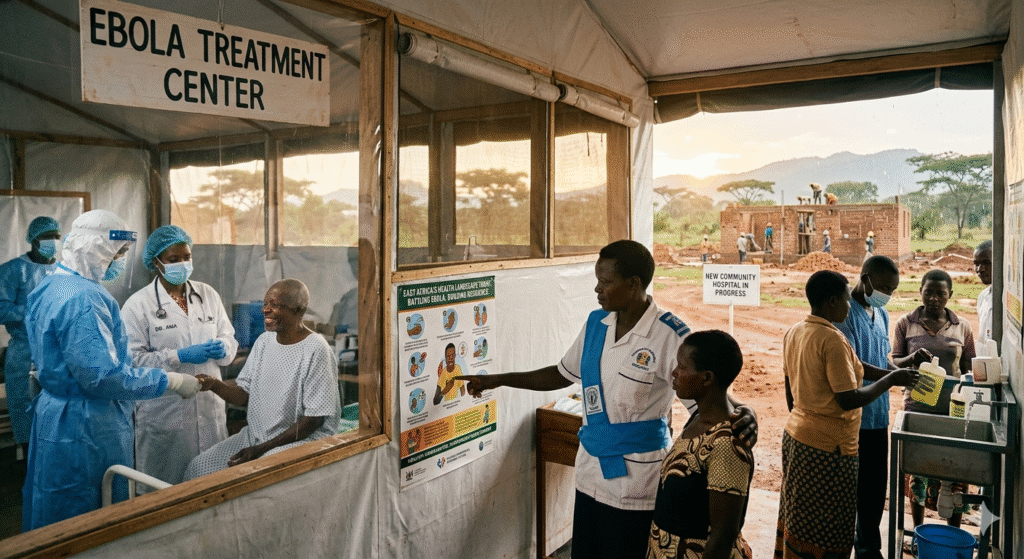
The past ten days have underscored a fundamental reality about health in East Africa: in a region where borders are porous and populations highly mobile, no single nation can protect itself from infectious diseases alone. As the Ebola outbreak linked to the rare Bundibugyo strain continues to spread in the Democratic Republic of the Congo and Uganda, the East African Community has activated its most ambitious coordinated health response to date.
From emergency ministerial meetings to the deployment of mobile laboratories, from clinical training programmes to a new regional pandemic framework, East Africa is demonstrating that the painful lessons of COVID-19, Marburg, and previous Ebola outbreaks are finally translating into institutional capacity. Yet significant gaps remain—in funding, in clinical infrastructure, and in the sheer speed at which the region can respond to emerging threats.
Here is a comprehensive look at health in East Africa today.
Part 1: The Ebola Outbreak — Numbers and Scope
The current Ebola outbreak, declared officially on May 15, 2026, is driven by the Bundibugyo strain of the Ebola virus . This strain is particularly concerning because there is currently no licensed vaccine or specific treatment available, unlike the Zaire strain for which vaccines exist .
The numbers as of late May paint a troubling picture:
In the Democratic Republic of Congo:
- 263 confirmed cases
- 42 confirmed deaths
- 1,077 suspected cases under investigation
- 246 suspected deaths awaiting confirmation
The outbreak is concentrated in eastern DRC, particularly Ituri Province — a region characterized by high population mobility, ongoing insecurity, and significant cross-border trade . North Kivu and South Kivu provinces have also been affected.
In Uganda:
- 7 confirmed cases
- 1 confirmed death (as of May 25, 2026)
Crucially, the first two confirmed cases in Uganda involved patients who had travelled from the DRC and sought treatment in Uganda — a stark illustration of how quickly infectious diseases cross borders .
WHO Director-General Tedros Adhanom Ghebreyesus, after visiting the outbreak’s epicenter in eastern DRC, warned that the outbreak had “a big head start” and that response teams were still working to catch up. He noted that contact tracing remains a major challenge, with only about 45 percent of identified contacts being effectively followed up, citing insecurity, population displacement, and high mobility as complicating factors .
There is some positive news. On May 31, health authorities announced that five patients infected with the Bundibugyo virus had recovered in Bunia, the capital of Ituri province . Their recovery demonstrates that with proper clinical care, survival is possible even without a specific antiviral treatment.
Part 2: The Emergency Ministerial Response
In response to the escalating crisis, the East African Community convened an extraordinary virtual meeting of health ministers from June 1 to June 2, 2026 . The meeting brought together all eight EAC Partner States: Burundi, the DRC, Kenya, Rwanda, Somalia, South Sudan, Tanzania, and Uganda.
The ministers agreed on a comprehensive regional strategy with several key components :
Harmonized border screening: Partner states will strengthen surveillance at airports, ports, and land border crossings, in line with national regulations and WHO guidelines.
Regional Technical Taskforce: A new EAC taskforce on Ebola response and other high-consequence diseases has been established, comprising experts nominated by partner states and the EAC Secretariat. The taskforce will monitor the outbreak, coordinate technical interventions, review epidemiological trends, and provide regular updates to policymakers.
Real-time information sharing: The ministers emphasized the importance of immediate sharing of epidemiological data among partner states to facilitate early detection of cases.
Mobile laboratory deployment: Nine mobile laboratories are being deployed at strategic border points across the region, including Beni in eastern DRC, Busia in Kenya, Nimule-Elegu on the South Sudan-Uganda border, Kobero in Burundi, Kagera and Kigoma regions in Tanzania, health districts in Rwanda, and Bwera Hospital in Uganda .
Rapid response experts: A pool of more than 180 rapid response specialists has been activated .
“The ongoing outbreak underscores the need for collective action to prevent further cross-border transmission within the region,” the ministers stated in a communique issued after the meeting .
Part 3: The Clinical Capacity Gap — From Detection to Survival
While rapid detection and border screening have improved significantly across East Africa, a different challenge has emerged as the critical determinant of patient outcomes: clinical management .
A WHO analysis published in May 2026 notes that in recent years, investments in surveillance, laboratory systems, and rapid response have strengthened the region’s ability to detect outbreaks earlier and respond faster. Across Tanzania, Uganda, and Ethiopia, early warning systems are functioning more effectively, and laboratory confirmation is increasingly timely .
Yet patient outcomes continue to vary. The reason is clinical capacity.
Caring for patients with high-consequence infectious diseases requires highly skilled teams operating in full personal protective equipment under strict infection prevention protocols. These conditions are physically demanding and technically complex. Where bedside capacity is limited, mortality increases — regardless of how quickly cases are identified .
To address this gap, from April 27 to May 1, 2026, clinicians, infection prevention specialists, and experts from across the EAC convened in Nairobi for a specialized training focused on clinical care for high-consequence infectious diseases. The programme, funded by GIZ with support from Charité, Universitätsmedizin Berlin, focused on critical care, patient monitoring, safe PPE use, and maintaining high-quality clinical operations under outbreak conditions .
Designed as a training-of-trainers platform, it aims to build a cadre of experts who can cascade knowledge nationally, ensuring that capacity is not limited to individual facilities but embedded within health systems. This reflects a broader shift: rather than rebuilding capacity during each emergency, countries are working to retain and expand it over time .
Part 4: The Pandemic Framework — A Long-Term Blueprint
The Ebola emergency is unfolding against the backdrop of a major institutional achievement. On January 21, 2026, the East African Community launched its inaugural Regional Pandemic Prevention, Preparedness, and Response (PPPR) Policy Framework .
The framework, approved by the EAC Sectoral Council of Ministers of Health in May 2025, provides a harmonized roadmap for collective action during public health emergencies. It draws on lessons from recent outbreaks including Ebola, Marburg virus disease, COVID-19, cholera, and mpox .
Key features of the framework include:
One Health approach: Recognizing that diseases can be transferred from animals to humans, the framework involves multiple sectors, including agriculture, livestock, tourism, and climate change .
Whole-of-government approach: “Pandemic preparedness is not the responsibility of the health sector alone,” said EAC Deputy Secretary General Andrea Aguer Ariik Malueth at the launch. “It requires a whole-of-government and whole-of-society approach” .
Addressing structural weaknesses: The framework targets long-standing challenges including fragmented coordination, limited resources, weak surveillance and information systems, and insufficient community and gender-responsive approaches .
Leveraging opportunities: It highlights digital health, regulatory harmonization, pooled procurement, and regional pharmaceutical manufacturing as tools for advancing self-reliance .
“The adoption of this policy framework stands as a powerful endorsement of what we can achieve when we choose unity over isolation,” said Dr. Joseph Gichuru, Deputy Executive Director of the African Population and Health Research Center .
Part 5: The Controversial US-Kenya Quarantine Proposal
Not all regional health initiatives have proceeded smoothly. A US proposal to establish an Ebola quarantine and treatment facility in Kenya for American personnel has sparked intense debate and drawn sharp warnings from the Africa Centres for Disease Control and Prevention .
Africa CDC Director General Dr. Jean Kaseya publicly raised alarms about the pressure such an arrangement would place on Kenya’s domestic healthcare architecture, which is already under strain from the ongoing regional health crisis. He noted that international financial commitments for the outbreak response have plummeted from $498 million to just $219 million — leaving a massive resource deficit across the continent .
For Somalia, which is rapidly consolidating its integration within the EAC, the prospect of a high-consequence pathogen hub in neighboring Kenya introduces significant cross-border risks. The Bundibugyo strain has no proven vaccine or therapeutic solution. Regional data highlights that misdiagnosis has already accelerated early transmission among healthcare workers in the DRC, where patients were initially treated for severe malaria after an early testing failure on May 5 .
The Katiba Institute in Nairobi has filed a civil lawsuit to legally halt the bilateral arrangement. Kenyan Medical Services Principal Secretary Dr. Ouma Oluga has defended the plan, stating that Kenya has a global obligation to health security and possesses the requisite emergency response capabilities .
Public health experts in Mogadishu warn that any systemic failure or accidental breach within Kenya’s healthcare perimeters could cascade across the highly fluid airspace and land borders connecting Nairobi to the Somali capital, threatening national security and disrupting vital trade routes .
Part 6: The Rapid Deployable Expert Pool
One of the EAC’s most practical assets in the current outbreak is the Rapidly Deployable Expert (RDE) Pool — a growing network of trained professionals supporting pandemic preparedness and response across partner states .
The RDE Pool has been activated for the current Ebola response, with more than 180 rapid response specialists available for deployment. The experts span multiple disciplines, including epidemiology, laboratory diagnostics, infection prevention and control, risk communication, and community engagement .
The pool represents an institutional innovation: instead of each country building its own surge capacity from scratch during each emergency, the region maintains a shared roster of experts who can be deployed wherever they are needed most. This approach is particularly valuable for smaller or less-resourced member states that might otherwise struggle to mount an adequate response.
Germany has been a key supporter of EAC health capacity-building efforts. The EAC has secured €12 million for the operationalization of Phase III of the Regional Network of Reference Laboratories for Communicable Diseases Project, a three-year initiative running from July 2025 to July 2028 .
Part 7: Somalia’s New ICU — A Local Success Story
Amid the regional emergency response, a quieter but significant health development has occurred in Somalia. On November 20, 2024 — with the impact now being felt across the region in 2026 — an Intensive Care Unit was opened at the University of East Africa in Bosaso, Puntland, marking the first unit of its kind in the region .
The unit serves approximately 800,000 people in the Bosaso region, in addition to thousands who come from neighboring areas to seek health services. It is equipped with the latest global medical technologies and features the ability to receive remote medical consultations, enabling advanced healthcare without patient travel .
The project was supported by Ain Shams University Hospitals (Egypt), the Islamic Development Bank, and the Indonesian International Development Agency (Indo Aid). A specialized Egyptian team, consisting of intensive care consultants and specialized nurses, was sent to support the unit’s operation for three months .
Intensive training programs have been implemented to build the capacity of medical and IT teams, with about 40 people participating in these programs. Ain Shams University continues to provide ongoing support through remote medical consultations .
The ICU represents a strategic step toward establishing a virtual intensive care network in Africa, leveraging Egyptian expertise to benefit patients across the continent .
Part 8: Laboratory Capacity — The Backbone of Surveillance
Effective outbreak response depends on rapid, accurate laboratory diagnosis. The EAC has been systematically strengthening laboratory capacity across the region through the Regional Network of Reference Laboratories for Communicable Diseases Project .
Phase III of this project, running from July 2025 to July 2028 with German support through KfW Development Bank, focuses on:
- Strengthening laboratory capacities for pandemic prevention and response
- Aligning with the One Health approach across the EAC region
- Enhancing readiness to respond effectively to health emergencies
The nine mobile laboratories being deployed as part of the current Ebola response represent the practical application of this long-term capacity-building effort. These units can be rapidly positioned at strategic border points, providing testing capabilities where they are most needed .
The mobile laboratories will be stationed at Beni (eastern DRC), Busia (Kenya), Nimule-Elegu (South Sudan-Uganda border), Kobero (Burundi), Kagera and Kigoma regions (Tanzania), health districts in Rwanda, and Bwera Hospital (Uganda). The initiative receives technical support from the Bernhard Nocht Institute for Tropical Medicine .
Part 9: The Vaccine and Treatment Gap
One of the most significant challenges in the current outbreak is the absence of medical countermeasures for the Bundibugyo strain. The existing Ebola vaccines (including rVSV-ZEBOV, commonly known as Merck’s Ebola vaccine) target the Zaire strain and are not effective against Bundibugyo .
The EAC is exploring a regional mechanism to accelerate the approval and registration of Ebola vaccines, treatments, and diagnostic tools specifically targeting the Bundibugyo strain. However, development of such products takes time — time the region does not have while the outbreak is active .
This gap underscores a broader vulnerability: the global medical countermeasure pipeline is not designed to respond quickly to rare viral strains, particularly those that primarily affect African populations. Until that changes, East Africa will remain dependent on public health measures — surveillance, contact tracing, isolation, and clinical care — to control outbreaks.
Part 10: The Funding Crisis
The Ebola response is severely under-resourced. Africa CDC Director General Dr. Jean Kaseya revealed that international financial commitments for the outbreak response have dropped from $498 million to just $219 million — a reduction of more than half .
Kaseya issued a one-week ultimatum to international organizations that have reduced their funding pledges, threatening to publicly identify them. He commended the World Bank and the African Development Bank for successfully reallocating budgets to support continental defenses .
The funding crisis has real consequences. Without adequate resources, surveillance systems cannot be maintained at full capacity. Contact tracing cannot reach all identified contacts. Mobile laboratories cannot be deployed to all needed locations. Community engagement — essential for building trust in affected areas — cannot be sustained.
Part 11: One Health in Practice
The EAC’s pandemic framework integrates the One Health approach, recognizing that diseases can be transferred from animals to humans and therefore requiring the involvement of multiple sectors beyond health .
In practical terms, this means coordination between:
- Health ministries (for case detection and clinical management)
- Agriculture and livestock ministries (for animal surveillance, as Ebola can be transmitted through bushmeat)
- Tourism ministries (for managing risks in wildlife tourism areas)
- Climate change and environment ministries (for understanding ecological drivers of disease emergence)
This integrated approach is not merely theoretical. The current Ebola outbreak, like previous outbreaks, is linked to zoonotic transmission. Addressing it effectively requires expertise from veterinary medicine, wildlife ecology, and environmental science alongside clinical medicine and public health.
Part 12: The Path Forward
As East Africa confronts its latest health emergency, the foundations for effective response are stronger than they have ever been. The pandemic framework provides a blueprint. The rapid deployable expert pool provides surge capacity. The mobile laboratories provide diagnostic reach. The clinical training programmes provide better-equipped healthcare workers.
Yet significant gaps remain. The funding crisis threatens to undermine these gains. The absence of a Bundibugyo vaccine leaves responders without a key tool. The ongoing insecurity in eastern DRC complicates access to affected populations. The high mobility of populations across borders makes containment exceptionally difficult.
The WHO’s assessment is sobering: the outbreak had “a big head start,” and response teams are still working to catch up . Only 45 percent of identified contacts are being effectively followed up — a figure that must improve dramatically to bring the outbreak under control .
Conclusion
Health in East Africa today is a story of two realities. The first is the grim reality of an expanding Ebola outbreak, a funding shortfall, and a viral strain against which existing vaccines do not work. The second is the encouraging reality of regional cooperation, institutional capacity, and a pandemic framework that would have been unimaginable a decade ago.
The East African Community has demonstrated that it can detect outbreaks faster . The question now is whether it can contain them faster — and whether the international community will provide the resources necessary to do so.
As EAC Secretary General Stephen Mbundi stated: “Our strength lies in coordinated action, shared responsibility, and regional solidarity” . Over the coming weeks and months, that solidarity will be tested as never before.