

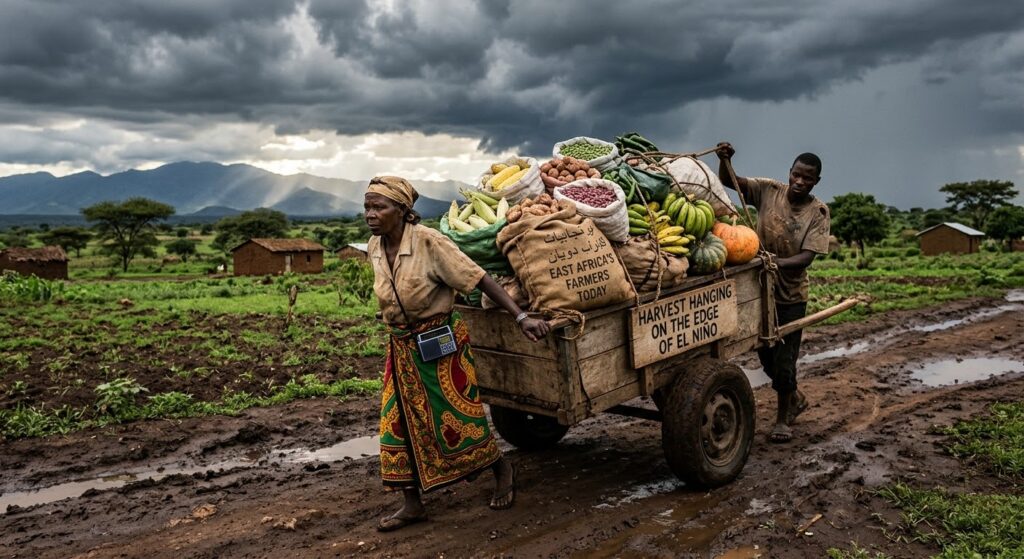
NAIROBI — East Africa’s farmers enter the final quarter of 2026 caught between two opposing forces. The October-to-December rains have arrived, and in many areas they promise relief after a punishing drought. But the same El Niño that is bringing the rain is also threatening to bring floods, and the ground beneath the region’s farms is already weakened by a year of extremes. In Kenya’s maize belt, torrential early rains raised hopes of a strong long-rains harvest, only for a mid-season dry spell to cut into yields . In Ethiopia’s Amhara region, farmers are planting without the fertilizer they need because the supply never arrived . In Tanzania, maize production is projected to fall by three percent after delayed rains and disrupted input deliveries . And across the region, 40.3 million people are already facing high levels of acute food insecurity—nearly three times the number recorded in 2016 .
Kenya: A Maize Harvest Undermined
Kenya’s farmers in the southwestern maize basket—Bungoma, Trans Nzoia, Uasin Gishu, Nakuru, and surrounding counties—began the 2026 long-rains season with exceptional promise. Cumulative rainfall between early February and late March was more than three times the long-term average in high-potential cropping areas . The abundant rains supported planting, and the main-season cereal harvest, due from October onwards, was expected to benefit.
But the season did not cooperate. The FAO’s country brief notes that a transition to El Niño conditions in June 2026 was likely to produce below-average rainfall between June and September, with a negative impact on yields . Fertilizer imports were also delayed by Middle East conflict disrupting trade flows and supply chains, affecting timely application at the start of the season, particularly in market-oriented agricultural areas of western Kenya. Reduced application rates are expected to affect crop yields .
The price picture offers little comfort. Maize retail prices in February 2026 were 15 percent higher year-on-year, driven mainly by high fuel prices that inflated transport costs. In southeastern and coastal marginal areas, where short-rains crops performed dismally due to the 2025 drought, maize prices were up to 20 percent higher year-on-year . In pastoral areas, the terms of trade have deteriorated sharply: in Wajir and Mandera counties, a medium-sized goat now buys only 30 to 35 kilograms of maize, down from 55 kilograms a year earlier .
The Kenyan government has moved to reduce input costs. Deputy President Kithure Kindiki announced that a 50-kilogram bag of fertilizer, which cost Sh7,000 in 2022, now sells for Sh2,000, while certified maize seed prices have been halved from Sh600 to Sh300 for two kilograms . Kindiki urged farmers to take advantage of the coming rains and the affordable inputs to increase production. But for farmers who planted without fertilizer at the start of the season, the price cuts came too late.
Ethiopia: Fertilizer Shortages and a Failing Harvest
In Ethiopia’s Northern Shewa Zone, Amhara Region, farmers are facing a crisis that has little to do with rainfall. Solomon Teka, 48, farms three hectares of onion, wheat, and teff to support a family of five. His land typically yields about 15 quintals of teff and 40 quintals of wheat annually—but only if he can apply the 15 quintals of NPS and urea fertilizer he needs each year. This season, the cooperative union he relies on could only provide one quintal, at a cost of 3,500 birr. On the parallel market, fertilizer prices have tripled to 15,000 birr per quintal .
“I would have bought it,” Solomon told Addis Fortune. “It’s not like I have much of a choice” .
Official data from the Amhara Agriculture Bureau shows that only three million quintals were delivered to unions out of the 5.2 million quintals procured for the region. A group of 20 farmers traveled 72 kilometers to Addis Ababa to petition the Ministry of Agriculture. They were told to be patient—the fertilizer was still on its way . Meanwhile, the consequences are already visible in the country’s food security outlook. Over 56 million quintals of teff were harvested from 2.9 million hectares, with Amhara and Oromia contributing more than half. The fertilizer shortage now threatens next year’s crop .
The broader picture in Ethiopia is equally grim. FEWS NET expects the June-to-September kiremt rains to rank as the driest in the historical record, with deficits above 50 percent across much of the country. The meher harvest that follows accounts for more than 85 percent of national crop production, and it could come in up to 30 percent below average, with little or nothing expected in parts of Tigray, northeastern Amhara, and the Hararghe lowlands . “We have never experienced a drought like this,” said Alem Misgana, a resident of Alitena in Tigray .
Tanzania: Delayed Rains and Disrupted Inputs
Tanzania’s maize production for the 2026/27 marketing year is projected to fall by about three percent to 7.3 million metric tons, according to the USDA’s Foreign Agricultural Service. The decline is driven by delayed and uneven rainfall during the October-December 2025 period and disruptions to subsidized input delivery following post-election government crackdowns on opposition groups .
In unimodal regions—the Southern Highlands and Central areas—rains began late in mid-November and were followed by prolonged dry spells from December to mid-January. Yields are projected to fall to 1.83 metric tons per hectare, partly because of erratic early rains and delayed fertilizer delivery. The lockdown and curfew that followed the October elections disrupted port operations and delayed fertilizer deliveries by several weeks. Most farmers planted without fertilizer. When it eventually arrived in early December, farmers were forced to apply planting and top-dressing fertilizer simultaneously, reducing nutrient-use efficiency and increasing the risk of fertilizer burn .
The pricing picture is also problematic. Vice President Deogratius Ndejembi has directed the Ministry of Agriculture to review the crop pricing system, citing the example of maize production in Makambako, Njombe Region, where a farmer spends between 600,000 and 700,000 shillings to cultivate an acre and harvests between 10 and 20 bags. Selling at 450 to 500 shillings per kilogram may leave farmers struggling to recover their investment, particularly when yields are low . In Songwe Region, the Vice President directed the ministry to urgently investigate falling maize prices and find solutions to protect farmers’ earnings .
The El Niño Threat to the Next Season
The rains that farmers across the region depend on are now arriving with a dangerous intensity. The Greater Horn of Africa Climate Outlook Forum gives a 90 percent chance of enhanced October-to-December rainfall over southern Ethiopia, central and southern Somalia, and northeastern Kenya, with seasonal totals above 400 millimeters expected across central Kenya, the Lake Victoria Basin, Burundi, western Rwanda, and western Tanzania. In parts of Ethiopia, Kenya, and Somalia, this one season supplies up to 70 percent of the year’s rain .
ICPAC named 1997 and 2023 as the closest analogue years. Both are remembered for what they cost. The 1997 floods killed 2,823 people across Ethiopia, Kenya, Somalia, and Uganda—the deadliest El Niño-linked flooding on record. In 2023, floods killed 705 people and displaced about 1.3 million in Somalia, 633,000 in Ethiopia, and 546,000 in Kenya .
For farmers, the danger is compounded by the drought that preceded the rains. Soil baked hard and stripped of vegetation absorbs water poorly, so heavy storms run off faster and carry more topsoil with them. The scientists who studied the 2023 floods pointed to the preceding drought and unsustainable land management as part of why its impacts were so severe . In Uganda’s Karamoja region, poor rainfall destroyed roughly 50 to 70 percent of crops during the March-to-May rains . Now the same areas face the risk of flooding.
IGAD’s member states adopted a High-Level Call to Action on El Niño Preparedness in September, committing to activate contingency plans, pre-position supplies, protect agriculture and livestock, and ensure warnings reach communities in time. The commitments include translating forecasts into timely advisories on planting and harvesting, protecting seed and food stocks, and vaccinating livestock ahead of the rains . Whether these commitments translate into action on the ground—for farmers like Solomon Teka in Amhara, or the maize growers of Trans Nzoia, or the pastoralists of Mandera—will determine whether this season becomes a story of recovery or another chapter in a cycle of crisis. The rains have arrived. The harvest is not yet secured.