

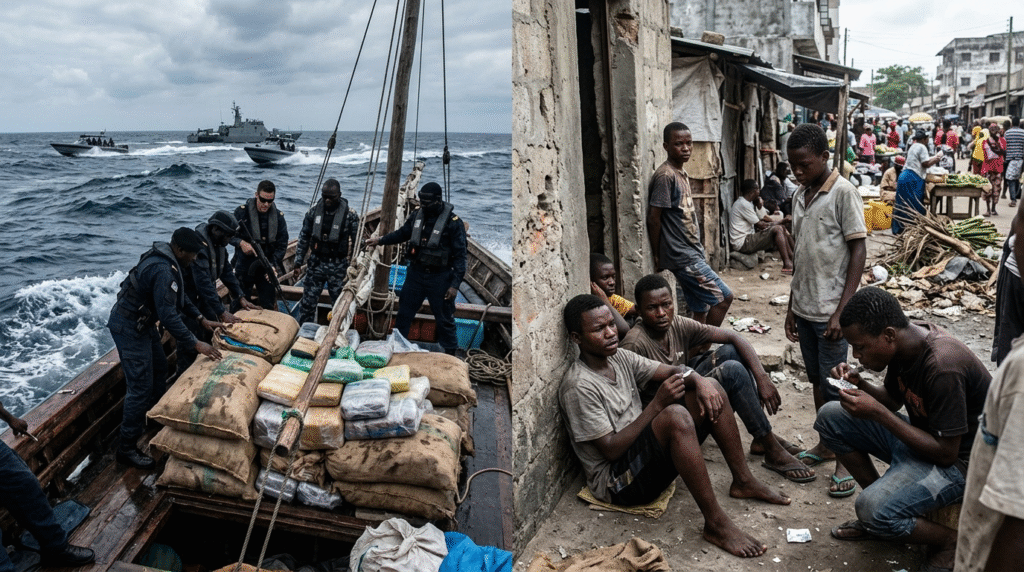
East Africa’s drug landscape is shifting with alarming speed. This week alone, courts in Kenya advanced one of the region’s largest-ever narcotics prosecutions, Uganda extradited a former military officer to face drug and arms trafficking charges in the United States, and police across three Kenyan counties dismantled distribution networks in coordinated raids. The common thread: a region that was once merely a transit corridor for narcotics bound for Europe and Asia is now a destination market in its own right, with devastating consequences for its youth.
The Sh8.2 Billion Meth Trial
In Mombasa, the Shanzu Law Courts delivered a significant ruling in the case against six Iranian nationals accused of trafficking more than one tonne of methamphetamine valued at approximately Sh8.2 billion ($63.4 million). Chief Magistrate Anthony Mwicigi found that the prosecution had established a prima facie case against all six accused, placing them on their defence under Section 211 of the Criminal Procedure Code .
The six—Jaseem Darzadeh Nia, Nadeem Jadgal, Hassan Baloch, Raheem Baksh, Imran Baloch, and Imtiyaz Daryay—are charged with trafficking 1,036.044 kilograms of methamphetamine aboard the vessel Mashaallah, described as unregistered and stateless. The vessel was intercepted on the high seas between October 17 and 20, 2025, after Kenyan authorities received intelligence about a suspicious ship in the Indian Ocean .
During the trial, 12 witnesses testified. Investigators told the court the consignment had been loaded at Pozm Port in Iran and was destined for Mauritius. A search of the vessel uncovered 769 packets of white crystalline substance concealed in six of its seven compartments, with forensic analysis identifying the substance as methamphetamine at 98 percent purity .
The case represents a landmark in Kenya’s efforts to combat maritime drug trafficking. The vessel’s interception was the result of a multinational operation targeting Indian Ocean trafficking routes, and the prosecution’s success in establishing a prima facie case signals growing capacity to pursue complex, cross-border narcotics cases .
Extradition Exposes Narco-Militant Nexus
In Uganda, the extradition of former Uganda People’s Defence Forces officer Michael Mpeirwe Katungi to the United States has exposed a disturbing convergence of drug trafficking, arms dealing, and terrorism financing. Justice Minister Norbert Mao authorised the extradition on September 1, and Katungi was flown to Virginia last week to face trial .
The indictment, filed in the US District Court for the Eastern District of Virginia, details a sophisticated conspiracy. Katungi faces charges including conspiracy to distribute and possess with intent to distribute five kilogrammes or more of cocaine, conspiracy to possess firearms—including a machine gun and a destructive device—in furtherance of a drug trafficking crime, and conspiracy to provide material support to a designated foreign terrorist organisation .
According to the indictment, Katungi allegedly conspired with Peter Dimitrov Mirchev, a Bulgaria-based arms dealer, and others to export 50 AK47 assault rifles and ammunition from Bulgaria to the CJNG, a Mexican drug cartel. The weapons were purportedly part of a planned arms deal between the governments of Russia and Uganda, with forged delivery verification protocols used to obscure the transaction. Mirchev allegedly discussed further plans to supply the cartel with surface-to-air missiles, anti-aircraft drones, and the ZU-23 anti-aircraft system, with a proposed sale of nearly $58 million .
The case underscores a reality that security analysts have long warned about: East Africa’s drug trade is not isolated from broader criminal and terrorist networks. The same routes that move narcotics also move weapons, and the profits from one fuel the other.
The Home Front: Raids and Seizures
Kenyan police have intensified domestic enforcement, conducting coordinated raids across Mombasa, Kilifi, and Nairobi counties. In Jomvu, Mombasa, officers recovered 120 litres of illicit brew and arrested one suspect. In Malindi, Kilifi County, two suspects were arrested after police recovered 140 rolls of cannabis, a digital weighing machine, and packaging materials from a residential property in the Kwa-Abudu area .
In Nairobi’s Kahawa West, a separate operation led to the destruction of 1,500 litres of Kangara and 35 litres of Chang’aa, alongside brewing equipment. Earlier in the week, police in the same area arrested three persons of interest and recovered more than 600 rolls of suspected cannabis, cannabis cookies, and two kilogrammes of unprocessed cannabis .
The coastal region has been a particular focus. Between April and June 2026, police arrested 27 suspects and seized narcotics worth an estimated Sh51.5 million, including 10,700 kilogrammes of cannabis sativa, 7,000 grammes of heroin, 1,330 grammes of cocaine, and 205 grammes of methamphetamine. A 67-year-old man was arrested at Moi International Airport attempting to board a flight to Dubai with 60 pellets of cocaine concealed in his stomach .
Zanzibar’s Maritime Vulnerability
Across the border in Zanzibar, authorities presented the 2025 Drug Situation Report to the House of Representatives, revealing both successes and persistent challenges. The volume of illicit drugs seized dropped to 533.552 kilogrammes in 2025 from 729.587 kilogrammes in 2024, largely due to decreased seizures of methamphetamine and ketamine .
Cannabis remained the most common substance, linked to 183 of the 232 suspects apprehended. The Zanzibar Drug Control and Enforcement Authority dismantled three major criminal syndicates and confiscated assets valued at Sh1.135 trillion derived from drug trade and money laundering. Through the Kidimni Treatment and Rehabilitation Centre, 440 of 728 addicts admitted between 2022 and 2025 are now living drug-free while receiving vocational training .
Yet the parliamentary oversight committee flagged serious concerns. Zanzibar’s geography—surrounded by the sea—makes it vulnerable to maritime trafficking of cocaine, heroin, and cannabis. The committee urged increased marine patrols, strengthened port security, and modern inspection equipment. It also censured the misuse of prescription drugs with narcotic properties, noting that 25,000 millilitres of ketamine were imported into Zanzibar in 2025—the highest volume ever recorded .
The Youth Crisis: Millions Hooked
Behind the seizures and prosecutions lies a demographic emergency. A 2026 United Nations Office on Drugs and Crime report found that 20.1 percent of Kenyans aged 17 to 23 reported using khat (miraa), translating to approximately 2.7 million young people. While hard drug prevalence remains lower, the numbers are still significant: 1.8 percent reported heroin use, 1.6 percent cocaine, 1.5 percent ecstasy, and 1.0 percent ketamine .
The UNODC warned that global drug markets are becoming increasingly sophisticated, with 755 new psychoactive substances reported globally in 2024—the highest number ever recorded in a single year. “We have seen an unprecedented spike in new types of drugs on the market and, worryingly, some are more potent or dangerous than before,” said UNODC Executive Director Monica Juma .
The report exposed a critical gap in Kenya’s surveillance system: while youth prevalence estimates are available, national data covering the general adult population remain fragmented, with many estimates dating back more than a decade. Without regular national prevalence studies, it is difficult to determine whether drug use is rising or falling across the wider population—or to plan effective prevention and treatment programmes .
A Region at a Crossroads
The week’s developments reveal a region grappling with a multifaceted crisis. The Sh8.2 billion meth trial shows that Kenya’s maritime interdiction capabilities have improved, but the sheer volume of narcotics moving through the Indian Ocean corridor remains staggering. Katungi’s extradition exposes the intersection of drug trafficking with arms dealing and terrorism financing—a nexus that threatens regional stability. And the UN data on youth drug use suggests that despite enforcement successes, demand reduction remains the weakest link in the chain.
The National Police Service has reaffirmed that crackdowns will continue across Kenya, targeting production, distribution, and consumption. But as the Zanzibar report and UN findings make clear, enforcement alone cannot solve a problem that is driven by poverty, unemployment, and the lure of quick money in economies where opportunities are scarce.
For East Africa, the fight against drugs is not merely a law enforcement challenge. It is a battle for the future of a generation—and one that is far from won.
