

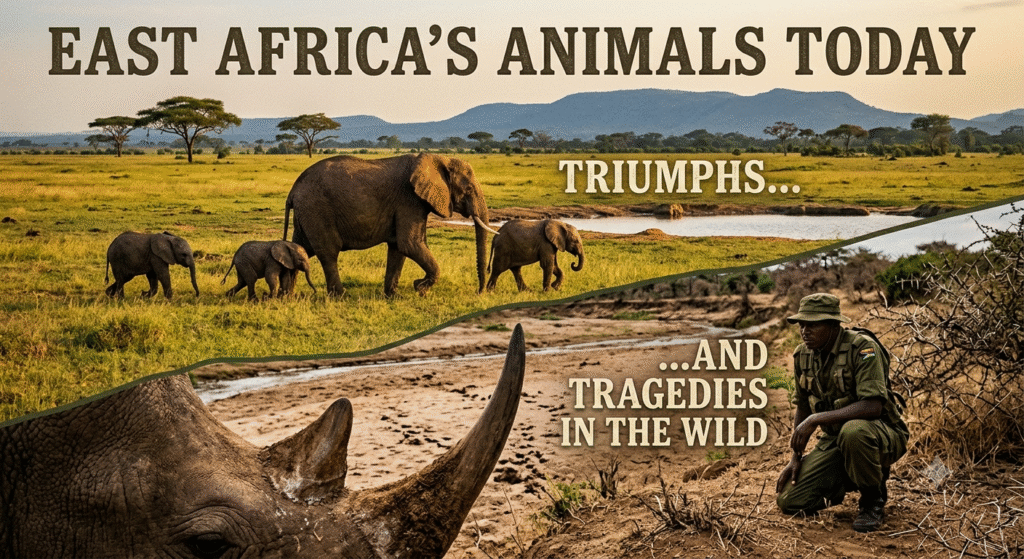
September 2026 brings a starkly mixed picture for East Africa’s world-renowned wildlife, as conservation triumphs coincide with alarming environmental threats. While historic reintroductions and recovering populations offer hope, incidents of poisoning, devastating fires, and escalating human-wildlife conflict paint a sobering picture of the challenges facing the region’s iconic species .
🦁 Conservation Success Stories
A $2 Million Boost for Uganda’s Wildlife:
A major victory for conservation is the announcement of a $2 million, five-year grant by Global Conservation and the Busch Gardens Conservation Fund. This landmark initiative will fund the recovery of lions, rhinos, elephants, hippos, hyenas, and giraffes across Uganda’s Kidepo Valley, Murchison Falls, and Queen Elizabeth National Parks. The grant builds on the recent recruitment of 600 new park rangers and will integrate species recovery plans into the EarthRanger platform for data-driven protection .
Rhinos and Lions Returning to Kidepo:
A key outcome of this funding is the continued reintroduction of rhinos and lions to Kidepo Valley National Park—a milestone for East African conservation. Rhinos were successfully reintroduced in March 2026 after being wiped out from the park in 1983 due to poaching and conflict. The new funding enables around-the-clock surveillance and protection for these vulnerable populations .
Elephants Return to Mount Elgon:
In another encouraging sign, elephants have returned to the Ugandan side of Mount Elgon for the first time in over four decades. At least 60 elephants crossed from Kenya into the Mount Elgon National Park, a positive sign that efforts to restore degraded forest habitats are succeeding. The elephants had largely abandoned this area since the 1970s due to habitat degradation and poaching .
The Mountain Bongo’s Return:
In May, four rare mountain bongos were returned to Kenya from a zoo in the Czech Republic as part of a national recovery plan. With fewer than 100 of these critically endangered antelope believed to remain in the wild, the addition of genetically diverse males is a significant boost to breeding programs at the Mount Kenya Wildlife Conservancy .
⚠️ Tragedies and Emerging Threats
The Amboseli Elephant Poisoning:
A dark cloud hangs over these successes. In July, the deaths of 15 elephants in Kenya’s Amboseli ecosystem were linked to suspected cyanide poisoning. The International Fund for Animal Welfare (IFAW) has called for a thorough investigation, with East Africa Director Ben Wandago stating, “This tragedy also underscores the urgent need for the strict control and responsible handling of highly toxic substances” .
Bush Fire in Tsavo:
On September 7, a bush fire broke out along the Voi-Taveta Road in Taita-Taveta County, prompting a joint response from the Kenya Red Cross, the Kenya Wildlife Service (KWS), and the county fire brigade. The Tsavo ecosystem, covering nearly 50,000 square kilometres and supporting large elephant, zebra, and buffalo populations, is particularly vulnerable to fires. KWS has established 1,160 kilometres of firebreaks to mitigate the threat .
Rising Lakes and Crocodile Conflict:
Climate change is creating new challenges. Lake Baringo in Kenya’s Rift Valley has expanded by 70% since 2010, displacing tens of thousands of people and bringing wildlife, including crocodiles, into dangerously close proximity with human settlements. Kenya Wildlife Service officers have launched an operation to trap and relocate large crocodiles, with at least 13 captured so far .
Human-Wildlife Conflict Compensation:
In Tana River County, 225 victims of human-wildlife conflict received Sh172 million in compensation from KWS. The payments, covering claims dating back 10 years, include up to Sh5 million for loss of life and Sh3 million for injuries. A new digital system is being piloted to speed up the process, aiming to settle claims within three months .
The Great Migration and Mara Day:
As the spectacular annual wildebeest migration—involving over 1.5 million animals—continues, Kenya and Tanzania are preparing for the 15th anniversary of Mara Day celebrations in Bomet County. The event will focus on the sustainable management of the 395-kilometre Mara River, a lifeline for the Maasai Mara and Serengeti ecosystems .
🔮 Conclusion: A Delicate Balance
East Africa’s wildlife is caught in a precarious balance between recovery and risk. The historic reintroductions and habitat restoration efforts demonstrate that conservation can succeed. However, the Amboseli elephant deaths, the Tsavo fires, and the escalating human-wildlife conflict reveal the fragility of these gains. The region’s future will depend on continued investment in technology, community engagement, and sustainable land management to ensure people and wildlife can coexist .
