

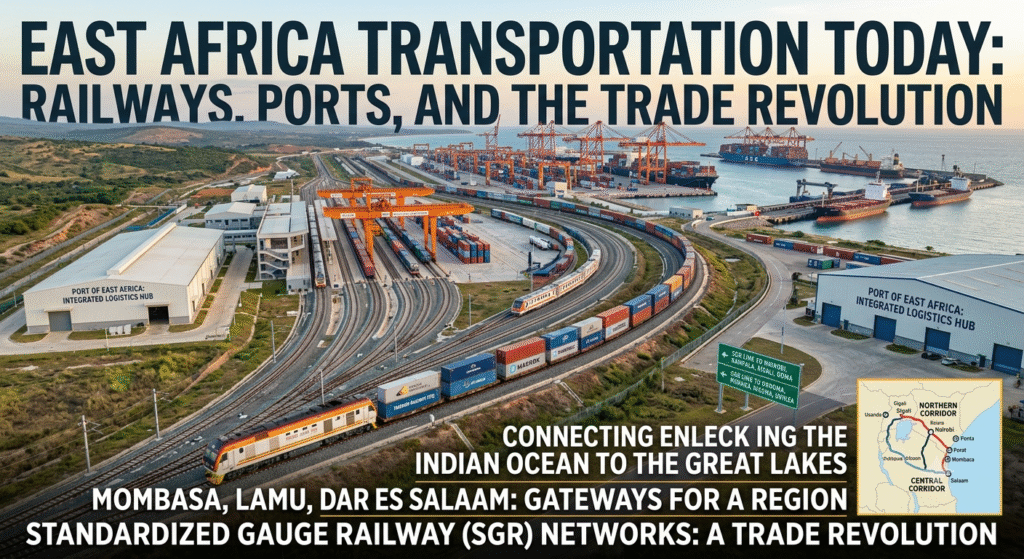
East Africa’s transportation sector is undergoing a dramatic transformation, driven by major infrastructure projects and new trade policies that are reshaping regional connectivity. In just the past week, a major railway expansion was launched in Tanzania, while Kenya’s trade corridor has been supercharged by new tariff agreements, signaling a new era of economic integration for the region.
Tanzania’s Railway Expansion: Linking the Region
On July 20, 2026, a major milestone was achieved in East Africa’s infrastructure development. Tanzanian President Samia Suluhu Hassan presided over the groundbreaking ceremony for the sixth section of the Standard Gauge Railway (SGR), connecting Tabora to Kigoma in the western part of the country . The 450-kilometer section is being constructed by a joint venture of Chinese companies and is a core part of the Central Development Corridor .
President Hassan hailed the project as a testament to the vital role Chinese enterprises play in developing Tanzania’s transport and logistics infrastructure . She emphasized that the railway will be a game-changer for the region: “This project demonstrates our commitment to expanding modern transport infrastructure to open up trade, reduce costs and connect our people and businesses to domestic and international markets” .
The strategic importance of this project cannot be overstated. Once completed, the SGR will seamlessly connect Tanzania’s inland regions to key export channels . More importantly, it is designed to unlock vital trade corridors for landlocked neighbors, providing Uganda, Rwanda, and Burundi with efficient logistics routes and unlocking new economic opportunities . As Zhang Junle, deputy general manager of the Chinese contractor CCECC, noted, the project will “drive the coordinated development of industries such as agriculture, trade, and tourism along the line, injecting strong momentum into regional economic integration in East Africa” .
In a complementary move, President Hassan also inaugurated new cargo ships at the Kigoma port, the region’s key water gateway to the Democratic Republic of the Congo and Burundi .
Kenya’s Transport Corridor: Supercharged by Zero-Tariff Trade
While Tanzania lays new track, Kenya’s established transport artery is experiencing a surge in activity thanks to a major trade policy shift. The Mombasa-Nairobi Standard Gauge Railway, also known as the Mombasa-Nairobi Railway, is a 472-kilometer route that serves as a crucial link between the coast and the interior . The entire Kenya Railways network is recording significant growth.
According to the latest data, in the first half of 2026, the line operated 3,931 freight trains and handled 4.278 million tons of cargo, representing a 12.3% year-on-year increase in average daily freight volume . This growth has been supercharged by China’s May 1, 2026 decision to implement zero tariffs on goods from 53 African countries .
The impact of the trade policy shift is immediate. A local railway official noted, “Freight volume has increased significantly. Before, we had trains waiting for cargo; now, we have cargo waiting for trains” . The move has opened a “window of opportunity” for African exports, leading to a sharp increase in goods like tea, avocados, and leather being sent to China, while imports of electronics and household goods have similarly surged .
Regional Integration: A Multi-Pronged Strategy
These simultaneous developments in Tanzania and Kenya reflect a broader regional vision. The Tanzanian SGR project will provide an alternative to the heavily used northern corridor, while the Kenyan route’s success demonstrates the powerful impact that trade policy can have on physical infrastructure.
As one analyst put it, the new zero-tariff initiative has turned the existing transport line into a “testament to China-Africa collaboration, jointly advancing modernization and sharing development dividends” . The growth in trade is not just benefiting the Kenyan coastal cities but is extending to landlocked partners, with goods from Uganda and Rwanda now more easily moving through Kenya to access Chinese markets .
In addition to these rail projects, the East African Commercial and Logistics Center in Dar es Salaam is being developed as a “natural bridge between China and Africa,” facilitating wholesale trade in products from construction materials to electronics and reducing logistical bottlenecks . This is part of a wider strategy to create a more organized and efficient trade platform . The revitalization of the historic Tanzania-Zambia Railway is also part of the effort to open new economic opportunities along the route .
Conclusion
Today, East Africa is witnessing the benefits of a dual approach: investing in major new rail infrastructure to physically connect the region and leveraging trade agreements to ensure these connections are economically active. The railway groundbreaking in Tanzania and the surging freight volumes in Kenya are clear indicators that transportation is no longer just about moving goods—it is about forging a more integrated and prosperous East Africa.
