

ARUSHA — June 13, 2026
Across East Africa today, a transportation revolution is underway—but it is a revolution of contrasts. On one hand, gleaming new railway lines are stretching from the Indian Ocean to the Great Lakes, promising to slash freight costs and transform regional trade. On the other, truckers are parked at border crossings, refusing to drive into South Sudan over security fears. Shipping surcharges from China are climbing, and Ebola-related travel restrictions are grounding flights .
From the Standard Gauge Railway extension linking Mombasa to Uganda, to a new DP World shipping route connecting Dubai to Somaliland’s Berbera Port, East Africa is betting big on infrastructure. But as costs rise and security challenges persist, the question is whether these investments can deliver their promised benefits to ordinary citizens .
Here is a comprehensive look at East Africa’s transportation landscape today.
Part 1: The Railway Revolution — SGR Reaches Malaba
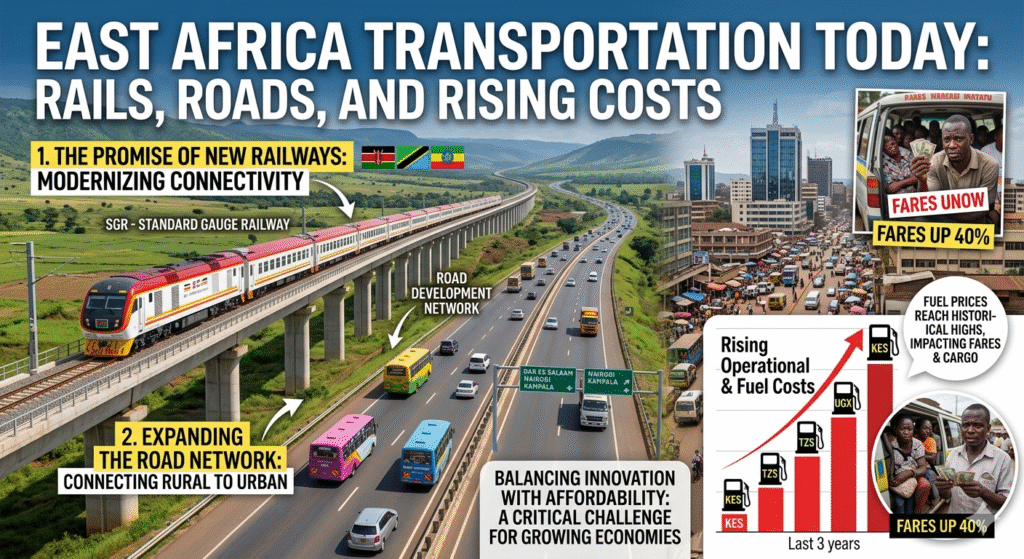
The most significant development in East African transport is the near-completion of Kenya’s Standard Gauge Railway (SGR) extension from Naivasha to the Ugandan border at Malaba .
On March 21, 2026, Kenyan President William Ruto presided over the groundbreaking for the 107-kilometer Kisumu–Malaba section, marking the final phase of a nearly 1,000-kilometer continuous corridor from the Port of Mombasa to the Kenya-Uganda border . The event was attended by Ugandan President Yoweri Museveni, underscoring the project’s regional significance.
The numbers are transformative. Transit from Mombasa to Malaba currently averages 80 hours by road, and onward transit to Kampala takes over 100 hours. The SGR is projected to reduce freight costs by at least 40 percent, shorten transit times by nearly 30 percent, and relieve congestion on the overloaded Northern Corridor highway .
Since its launch in 2014, the SGR has already carried more than 15 million passengers and 45 million tons of freight over eight years . The extensions will further support farmers and producers by moving livestock, tea, dairy, grains, and fish more efficiently, while creating jobs in construction, logistics, manufacturing, and services.
President Museveni, speaking at the groundbreaking ceremony, emphasized the strategic importance of shifting cargo from roads to rail. “Strategic investments like these are essential for lowering the cost of doing business, supporting industrialization, and advancing the economic transformation of our region and Africa,” he said .
President Ruto reflected on the project’s legacy: “If the railway of the past century shaped our region, the railway we build today must define its future” .
Part 2: The Final Link — Chavakali–Kapsabet–Eldoret Airport Road
While the SGR grabs headlines, road infrastructure is also advancing. The proposed Chavakali–Kapsabet–Eldoret Airport Road has been identified as a priority infrastructure project under the Lake Victoria Basin Development Project, a joint initiative of the Kenyan government and the World Bank .
During a stakeholder engagement meeting in Vihiga County on June 12, Kenya National Highways Authority (KeNHA) representative Rose Oloo explained that the road will serve as a strategic transport corridor linking Vihiga, Nandi, and Uasin Gishu counties . The project aims to enhance mobility, facilitate trade, and improve access to essential services for residents and businesses along the route.
KeNHA is currently undertaking stakeholder consultations on preliminary planning and implementation arrangements to ensure that all relevant interests and concerns are captured before the project progresses .
Once completed, the road is expected to significantly improve regional connectivity, reduce travel time, enhance access to markets, educational institutions, health facilities, and other social amenities, while creating opportunities for investment and socio-economic growth across the Lake Victoria Basin region .
Part 3: Maritime Momentum — DP World Launches Jebel Ali-Berbera Route
On the maritime front, a major strategic shift is underway in the Horn of Africa. DP World has launched a new shipping route connecting Jebel Ali Port in the UAE with Berbera Port in Somaliland, operating every nine days .
The new service is designed to strengthen trade links between the Gulf and East Africa, offering a faster maritime route into Somaliland and providing an essential alternative to traditional logistics chains that often rely on Djibouti Port. With scheduled stops at Aden and Djibouti, the route offers better access to markets across the Horn of Africa, with cargo from Berbera able to connect onwards to inland destinations, particularly Ethiopia .
Since DP World began operations in Berbera in 2017, the port has seen vessel productivity increase by 450 percent, with container volumes rising by 30 percent . The port now handles over 14 container vessels per month, with plans to quadruple its annual capacity to 2 million TEUs.
The Berbera Port’s enhanced infrastructure includes a 1,050-meter quay, a 400-meter section capable of handling Triple E vessels, and the Berbera Special Economic Zone (BSEZ), designed to attract foreign investment .
Ganesh Raj, Group Chief Operating Officer, Marine Services at DP World, noted that the service “further complements DP World’s investment drive into Africa,” enhancing connectivity and boosting trade links between the Middle East and East Africa .
Part 4: Uganda’s Push for Faster Integration
At a high-level meeting on June 9, President Museveni — who currently chairs the East African Community — called for faster economic integration across the bloc, with transport infrastructure at the top of his agenda .
“We must rationalise the transport system,” Museveni told EAC Secretary-General Stephen Patrick Mbundi at State Lodge in Nakasero. “The railway transport should carry heavy goods and petroleum products, while roads remain for passengers and light cargo” .
The President argued that transport officials should work together to develop practical regional connections, warning that high transport costs undermine the competitiveness of East African goods in global markets.
Museveni also welcomed a proposal from the EAC Secretariat that would require non-member countries exporting goods into the East African market to make financial contributions to the regional bloc — a measure he described as “a new idea and a very good idea” .
Part 5: The Common Currency Connection
The push for better transport infrastructure is closely linked to the EAC’s broader integration agenda, including the proposed East African Monetary Union — a shared currency for member states .
Supporters argue that a common currency would reduce exchange rate fluctuations that complicate cross-border trade and increase business costs. Combined with improved transport links, the currency union could fundamentally reshape regional commerce.
For businesses, traders, and consumers across East Africa, the discussions signal renewed political momentum behind projects that could reduce transport costs and eventually simplify transactions through a shared currency .
Part 6: Security Crisis — Truckers Strike at South Sudan Border
While new infrastructure projects offer hope for the future, present-day realities are far more challenging. Since early May 2026, hundreds of cargo trucks have been parked at the Uganda-South Sudan border as drivers refuse to operate along the increasingly dangerous Nimule-Juba highway .
William Busuulwa, chairman of the Uganda National Transporters Alliance, described conditions inside South Sudan as having worsened sharply. “Once you cross into South Sudan, there is no assurance of safety,” Busuulwa said. “Drivers are routinely attacked at gunpoint. Cargo is looted. And tragically, we lost a colleague just last month” .
The strike has effectively choked one of East Africa’s key trade routes, threatening supplies of essential goods including food, fuel, and construction materials to landlocked South Sudan, which is heavily dependent on imports via Uganda.
Transporters are demanding the urgent reinstatement of joint Uganda-South Sudan highway security patrols, which previously offered some protection along the volatile route but have weakened in recent years due to political changes that disrupted coordination and enforcement .
Geoffrey Osborn Oceng, resident district commissioner of Amuru District, acknowledged the economic impact and said authorities are working to resolve the situation, including plans to involve South Sudanese officials in restoring confidence along the corridor .
Part 7: Shipping Cost Shock — Maersk Raises Surcharges
Adding to the economic pressure on East African businesses, Maersk has announced significant increases to its Peak Season Surcharge (PSS) rates on cargo moving from China and Hong Kong to East African ports, effective June 15, 2026 .
For cargo destined for Mombasa, the surcharge for a 20-foot container rises from $900 to $1,000. A 40-foot container increases from $1,100 to $2,000 — a staggering 82 percent jump. For Dar es Salaam, a 20-foot container rises from $750 to $1,000, while a 40-foot container increases from $1,050 to $1,400 .
The increases come as East African economies remain heavily dependent on imports from China, including industrial equipment, electronics, construction materials, vehicles, and consumer goods. Kenya imported goods worth $4.3 billion from China in 2025, while Tanzania’s trade with China reached approximately $11.28 billion over the same period .
Economist James Mwangi said shipping costs are a “critical component” of import expenses and that higher freight rates have a direct impact on prices across multiple sectors. While some products qualify for tax exemptions or reduced duties under government incentive programmes, analysts note that higher freight charges could offset part of those benefits .
Concerns are growing that other carriers could introduce similar adjustments in the coming months, further squeezing East African importers .
Part 8: Air Travel Disrupted — Ebola Restrictions Hit Uganda
The transportation sector is also facing headwinds in the air. Uganda has criticized travel restrictions imposed by the United States, Canada, and the United Arab Emirates over an Ebola outbreak that has spilled over from the Democratic Republic of Congo .
The restrictions include entry bans on travelers from Uganda, the DRC, and neighboring South Sudan — measures that Uganda’s Health Ministry describes as “unfair” and not commensurate with the actual risk.
“The blanket restrictions undermine confidence in countries that report outbreaks openly, and are not commensurate with the actual risk,” said Diana Atwine, permanent secretary for the health ministry .
Uganda’s response to the outbreak has been broadly praised by public health officials, with only two deaths out of 19 confirmed cases since the alarm was sounded in the DRC in mid-May. Almost all cases were Congolese nationals who had crossed the border from their home country, where more than 676 cases have been confirmed and 136 people have died .
The restrictions are affecting Uganda’s aviation sector and could have broader economic implications if they persist.
Part 9: Kenya-Uganda Rail Cooperation — Strengthening Freight Connectivity
Despite the challenges, rail cooperation between Kenya and Uganda continues to deepen. Kenya Railways (KR) and Uganda Railways Corporation (URC) recently reaffirmed their commitment to strengthening regional rail freight connectivity and enhancing cargo movement between the two countries .
During a bilateral engagement meeting, the Ugandan delegation — headed by URC Board Chairman Daudi Migereko and Managing Director Benon Kajuna — conducted a familiarization tour of rail freight operations along the Northern Corridor linking the Port of Mombasa and Uganda .
The discussions focused on enhancing regional railway connectivity, improving cargo handling efficiency, strengthening SGR-MGR connectivity, and positioning rail transport as a more efficient and competitive logistics solution for cargo movement within East Africa .
Kenya Railways Board Chairman Abdi Bare Duale reaffirmed Kenya’s commitment to ensuring seamless movement of transit cargo destined for Uganda between the Port of Mombasa and the Malaba border through efficient rail operations .
Part 10: The Northern Corridor — A Vital Artery Under Pressure
The Northern Corridor — stretching from the Port of Mombasa through Kenya, Uganda, Rwanda, Burundi, and into the Democratic Republic of Congo and South Sudan — remains the region’s most important trade artery. Thousands of trucks ply this route daily, carrying everything from food and fuel to construction materials and manufactured goods .
But the corridor is under immense pressure. Road congestion, border delays, security incidents, and now rising shipping costs are all taking their toll. The SGR is designed to relieve some of this pressure by shifting freight from road to rail, but the transition will take years.
As Kenya’s Transport CS Davis Chirchir noted during an inspection of SGR preparation works, “This project is a game changer for Kenya’s economy. It will open up markets, reduce transport costs, and provide opportunities for our young people to secure meaningful employment” .
Part 11: The Cost of Doing Business — What It Means for Consumers
For ordinary East Africans, the transportation headlines translate into real economic impacts. Higher shipping surcharges from China will eventually filter through to consumer prices — making electronics, vehicles, construction materials, and manufactured goods more expensive .
Security disruptions on the South Sudan border threaten food and fuel supplies in that country, where prices are already elevated due to conflict and displacement .
And while the SGR promises lower freight costs in the long term, the upfront investment is massive, and the benefits will be phased in over years rather than months.
As James Mwangi, the economist, noted: “Shipping costs are a critical component of import expenses. Higher freight rates have a direct impact on prices across multiple sectors” .
Part 12: The Path Forward — Integration as the Answer
The common thread running through all these stories is that East Africa’s transportation challenges cannot be solved by any single country alone. The SGR is a joint Kenya-Uganda project. The Northern Corridor serves six countries. The security crisis on the South Sudan border requires bilateral cooperation. Even the shipping surcharges reflect global supply chain dynamics beyond any one nation’s control.
President Museveni’s call for faster integration — including a common currency and rationalized transport systems — reflects a growing recognition that East Africa’s future prosperity depends on working together .
“The railway transport should carry heavy goods and petroleum products, while roads remain for passengers and light cargo,” Museveni said . It is a simple vision, but one that requires coordination, investment, and political will to achieve.
Conclusion
East Africa’s transportation sector today is a study in contrasts. The new SGR extension to Malaba represents a transformative investment that will reshape regional trade for decades. The new DP World shipping route to Berbera offers an alternative to congested ports and opens new trade corridors to Ethiopia. The proposed Chavakali–Kapsabet–Eldoret road will improve connectivity across Kenya’s Lake Victoria Basin .
Yet alongside these positive developments, significant challenges persist. The truckers’ strike at the South Sudan border highlights security vulnerabilities that disrupt trade and threaten essential supplies . The Maersk surcharge increases remind East African businesses of their dependence on global supply chains and vulnerability to external shocks . The Ebola travel restrictions demonstrate how public health crises can quickly disrupt aviation and movement .
For the region to realize the full potential of its infrastructure investments, it must also address these underlying challenges: security along transport corridors, vulnerability to global shipping volatility, and the need for coordinated health and transport policies.
The foundations are being laid. The question is whether the superstructure will follow. As President Ruto said at the SGR groundbreaking: “If the railway of the past century shaped our region, the railway we build today must define its future” . The same could be said of East Africa’s entire transportation network — a network that will define the region’s economic future for generations to come.