

For decades, East Africa has been heralded as the continent’s rising aviation hub. With the vast airspace over Kenya, Uganda, Tanzania, Rwanda, and Ethiopia, the region sits at a geographic crossroads between the Middle East, Asia, and Southern Africa. In theory, the skies should be a goldmine—facilitating tourism, cargo, and connectivity for a rapidly growing population. Yet, in 2026, travelers and logistics experts paint a starkly different picture: one of decaying tarmacs, overwhelmed terminals, opaque security procedures, and a growing chasm between regional ambition and on-the-ground reality.
From the humid coast of Dar es Salaam to the high-altitude runway of Addis Ababa, East Africa’s airports are groaning under the weight of success and neglect. While some challenges are global—fuel prices and post-pandemic staffing—many are uniquely regional, rooted in infrastructure decay, regulatory fragmentation, and a failure to modernize at the pace of demand.
The Capacity Crunch: Terminals at Breaking Point
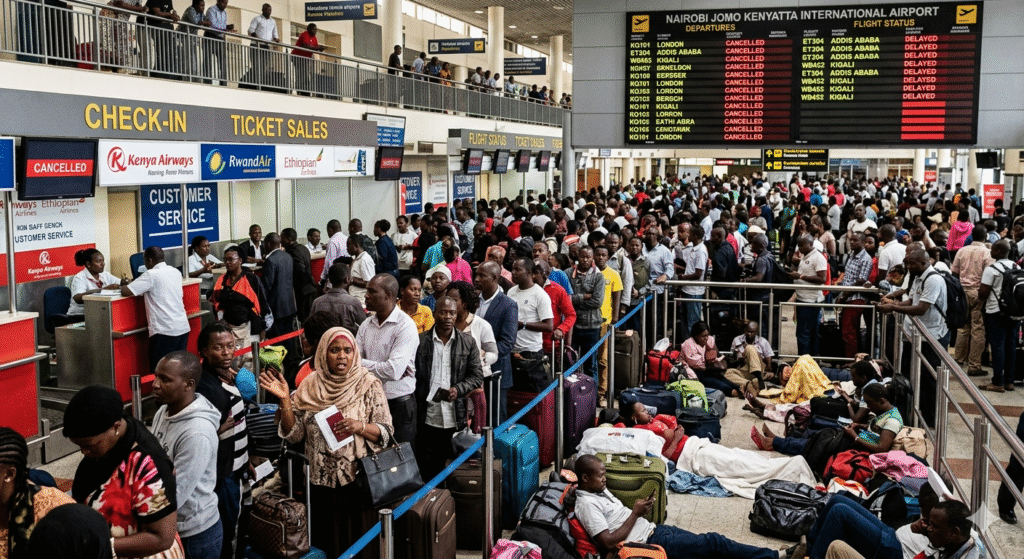
The most visible problem is physical space. Airports built for a fraction of today’s passengers are now handling record numbers. Jomo Kenyatta International Airport (JKIA) in Nairobi, the region’s busiest hub after Addis, was originally designed for roughly 7 million passengers annually. In 2025, it handled over 10 million. The result is a daily ballet of chaos.
Passengers arriving at JKIA’s immigration halls at 3 AM—when long-haul flights from Europe and Asia converge—often face queues exceeding two hours. The terminal’s boarding gates, many of which lack sufficient seating or air conditioning, become suffocating bottlenecks. The situation is so dire that in late 2025, the Kenya Airports Authority admitted that the airport had “exceeded its functional lifespan.” A planned Greenfield Terminal has been delayed for a decade due to funding disputes and legal battles.
Across the border, Julius Nyerere International Airport (JNIA) in Dar es Salaam tells a similar story. Despite a new terminal opened in 2019, the airport is already facing capacity issues due to explosive growth in Tanzania’s tourism and trade sectors. The old terminal, meanwhile, suffers from chronic flooding during the March-to-May rains, forcing flights to divert to Zanzibar or Mombasa. In Uganda, Entebbe International Airport is so overcrowded that departure lounges often see passengers sitting on the floor, while construction dust from a slow-moving upgrade project coats luggage and suits alike.
The Runway Rupture: Safety and Weather Delays
Beyond the terminals, the very surfaces on which planes land and take off are deteriorating. East Africa’s tropical climate and heavy monsoon seasons are brutal on asphalt. Moi International Airport (Mombasa) has experienced repeated runway closures for emergency repairs in 2025 and early 2026, each time stranding thousands of tourists bound for the coast.
Even the pride of the region, Addis Ababa Bole International Airport—home to Ethiopian Airlines, Africa’s largest carrier—is not immune. While Bole remains the most efficient major airport in East Africa, its single runway operates at 98% capacity during peak hours. One rejected takeoff, one flat tire, and the entire schedule for the continent’s busiest airline cascades into hours of delays.
Smaller airports are in worse shape. Kisumu International Airport in western Kenya, a vital gateway for agricultural exports, has a runway surface so cracked that some cargo airlines have imposed weight restrictions. In Rwanda, Bugesera International Airport—a gleaming new $400 million project—remains partially operational, but its unfinished connecting roads and lack of ground support equipment have prevented it from fully relieving pressure on the aging Kigali airport.
Technology Troubles and Security Gridlock
Modern air travel depends on seamless technology, yet East African airports often resemble a patchwork of the 20th and 21st centuries. Baggage handling systems are notorious for breakdowns. At JKIA, it is not uncommon for arriving passengers to wait 45 minutes for luggage, only to find that bags have been loaded onto the wrong carousel.
More concerning is the state of security and customs technology. While major airports have modern scanners, frequent power fluctuations (despite backup generators) cause systems to reboot mid-operation. Many regional airports still rely on manual checks for hold luggage, slowing processing to a crawl.
The introduction of electronic travel authorization systems has paradoxically worsened delays. Kenya’s “eTA” system, launched in 2024, was meant to replace visas and speed entry. Instead, poorly networked verification systems at immigration desks mean officers often ask travelers to show proof of approval on their phones—paperwork already submitted online. In Tanzania and Uganda, separate digital systems that do not communicate with each other force travelers to re-enter the same data multiple times.
The Cost of Flying: Taxes, Fees, and Extortionate Parking
For airlines operating in East Africa, airport problems are not just about passenger comfort—they are about the bottom line. Airport charges in the region have skyrocketed. Kenya, for example, increased aeronautical fees by 25% in 2025 to fund infrastructure repairs. Tanzania followed with a new “infrastructure development levy” on every departing seat.
The result is that East Africa now has some of the highest per-passenger airport costs outside of Europe. Budget carriers like Jambojet and Fastjet have publicly warned that these fees are making short-haul flights (e.g., Nairobi to Mombasa or Dar to Zanzibar) commercially unsustainable. Higher fares, in turn, push passengers back onto unreliable road networks.
Cargo operations face a separate ordeal: the “informal levy.” At several airports, freight forwarders report that customs and handling agents demand unofficial cash payments to expedite perishable goods like flowers, vegetables, or fish. A consignment of Kenyan roses bound for Amsterdam might sit on a hot tarmac for six hours because the paperwork is “stuck” until a fee is paid. This is not just corruption; it is a direct threat to East Africa’s export economy.
Regulatory Fragmentation: The Single Sky That Isn’t
Perhaps the deepest structural problem is political. The East African Community (EAC) has promised a “Single Aviation Market” for years—a deal that would allow any licensed EAC airline to fly freely between member states without bilateral restrictions. That deal remains largely unimplemented.
Instead, each country protects its national carrier. Kenya Airways, Ethiopian Airlines, Uganda Airlines, and Air Tanzania compete fiercely, often flying parallel routes half-empty because bilateral agreements limit frequencies. This fragmentation clogs airports with redundant flights. At any given time, three different regional airlines might depart for the same destination within 30 minutes of each other, each burning fuel and each using a precious takeoff slot.
Air traffic control is another mess. While Ethiopia uses modern satellite-based systems, Kenya and Tanzania still rely on ground-based radar with blind spots over Lake Victoria and the Indian Ocean. Handoffs between control centers are manual and prone to radio failure. In 2025, a near-miss between a passenger jet and a cargo plane near the Kenya-Uganda border was blamed on conflicting instructions from two separate control towers.
Human Factors: Burnout and Brain Drain
Behind the scanners and check-in desks, the human infrastructure is collapsing. Airport workers across East Africa are underpaid and overworked. In Uganda, baggage handlers went on strike for three days in January 2026, leading to a backlog of 4,000 unclaimed suitcases at Entebbe. In Kenya, immigration officers have repeatedly complained of 16-hour shifts without adequate breaks, leading to slower processing and irritable interactions with travelers.
The best talent—air traffic controllers, engineers, and IT specialists—is leaving. Saudi Arabia, the UAE, and Qatar have aggressively recruited East African aviation professionals, offering triple the salary and modern working conditions. This brain drain means that when a runway light fails at Kilimanjaro International Airport at midnight, there may be no one qualified to fix it until morning.
Glimmers of Hope and the Road Ahead
It would be dishonest to paint only a bleak picture. There are genuine efforts underway. Rwanda continues to punch above its weight, using disciplined management to keep Kigali’s airport remarkably efficient despite its small size. Ethiopia’s aviation academy trains some of the continent’s best pilots and technicians. And private investors are eyeing the region—a Chinese consortium recently signed a deal to modernize Zanzibar’s Abeid Amani Karume International Airport.
But these are patches on a gaping wound. For East Africa to realize its aviation potential, governments must do three things immediately: First, implement the Single Aviation Market without further delay. Second, create independent airports authorities insulated from political patronage, with clear funding for maintenance. Third, invest in basic resilience—backup power, drainage, and staff training—before glamorous new terminals.
Until then, the traveler arriving in East Africa will continue to experience the same frustrating paradox: a region that soars economically but cannot seem to get its airports off the ground. The planes are modern. The passengers are ready. But on the tarmac, amid the heat haze and the broken luggage carousels, East Africa remains stubbornly, expensively, grounded.
