

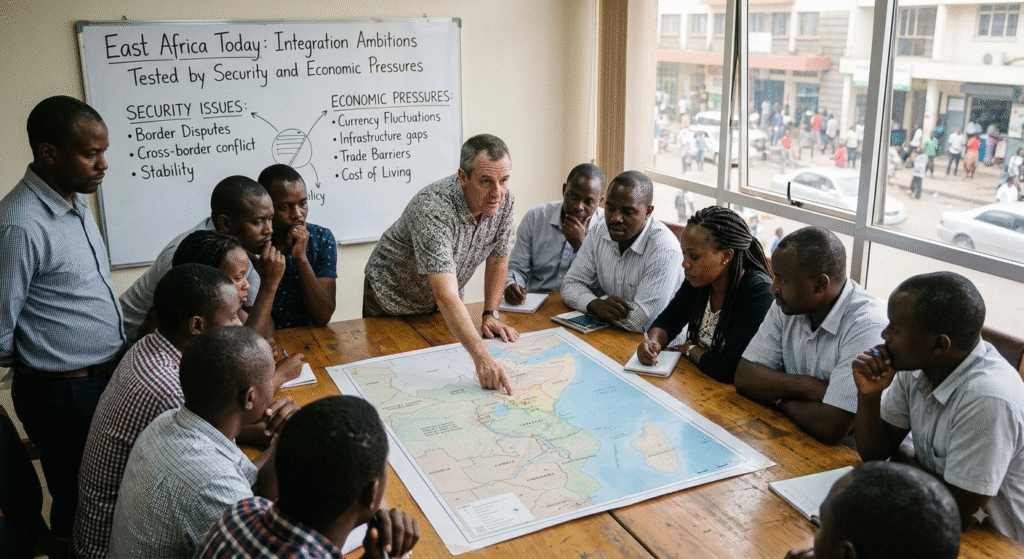
East Africa enters mid-August 2026 with significant momentum toward regional integration and security cooperation, yet persistent trade barriers, security threats to critical trade corridors, and domestic economic grievances threaten to undermine progress. As the region prepares for the upcoming El Niño season, which is expected to bring severe flooding and worsen an already dire humanitarian situation, the gap between regional ambition and reality remains stark.
Bolstering Regional Security: EASF and EAC Cooperation
A major step forward this week is Uganda’s commitment, as current Chair of the East African Community (EAC), to rally regional leaders to strengthen the Eastern Africa Standby Force (EASF). President Yoweri Museveni pledged to engage fellow Heads of State on the matter and support efforts to convene the EASF Summit, which has not been held since 2014.
The 36th Ordinary Policy Organs Meeting of the EASF, underway in Kampala from August 10 to 15, has brought together representatives and senior officials from nine member states—Burundi, Comoros, Djibouti, Ethiopia, Kenya, Rwanda, Somalia, Sudan, and Uganda—to discuss strengthening the regional security mechanism.
The push for EASF strengthening comes at a time of declining international financial support for peace operations in Africa. EASF Director Brig Gen Ronald Rwivanga noted that reduced donor financing for the African Union Transition Mission in Somalia (AUSSOM) is a significant concern, warning that “Africa must increasingly be prepared to finance, manage, and sustain its own peace support operations”.
Uganda has pledged search and rescue capabilities, Ethiopia has pledged strategic airlift capacity, Kenya has pledged reconnaissance capabilities, and Rwanda has pledged medical evacuation helicopters—all critical assets for rapid response to regional crises. The meeting is expected to culminate in the adoption of recommendations and pave the way for a long-awaited EASF Heads of State Summit later this year.
Trade Corridors Under Threat: The DRC and South Sudan Crisis
While regional security mechanisms are being strengthened, critical trade routes are under severe strain. Kenyan truckers have grounded vehicles destined for the Democratic Republic of Congo following the killing of four of their colleagues by suspected rebels along the Beni-Kisangani route. Dozens of Kenyan drivers have parked their trucks in Mambasa, Ituri Province, rather than risk proceeding into unsafe areas.
The disruption threatens cargo flows from the Port of Mombasa to the landlocked DRC, the third-largest transit destination for cargo handled at the Kenyan port, accounting for 7.2 percent of total transit volumes. Prolonged insecurity, combined with DRC’s poor road network, is making the Northern Corridor increasingly expensive and unpredictable. A truck stuck on the route costs a transporter at least $247 (about Sh31,951) per day, with losses running into tens of millions of shillings.
The crisis is not confined to DRC. Kenyan truckers are also reporting continued harassment, extortion, and attacks in South Sudan. More than 60 cases involving assaults and other abuses have been recorded this year, with drivers forced to make illegal payments at roadblocks. At least 10 foreign truckers have been killed in South Sudan since 2021.
Trade Barriers and the Call for Faster Integration
East African business leaders are increasingly vocal about the need to remove persistent trade barriers that are limiting the region’s growth potential. At the CEOs-Trade and Investment Roundtable in Nairobi, East African Business Council (EABC) Executive Director Ahmed Farah emphasized that intra-EAC trade stands at USD 19.7 billion against a regional economy valued at USD 357 billion, pointing to significant room for expansion.
RSM Eastern Africa Executive Chairman Ashif Kassam highlighted that with eight member states and a population of more than 360 million, only about 15 percent of total EAC trade is intra-regional. While regional trade grew by 28 percent in 2025, an estimated 30 to 50 percent of potential trade remains unrealized. Major obstacles identified include non-tariff barriers, regulatory fragmentation, border delays, high logistics and electricity costs, weak digital systems, and cross-border payment challenges.
Kenya Investment Authority representative John Mwendwa noted that East Africa attracted about $14.6 billion in foreign direct investment, accounting for approximately 21 percent of Africa’s total FDI inflows. However, he stressed that investors are primarily looking for scale, predictability, and opportunities to participate in regional value chains.
Climate Threat Looms: El Niño and Humanitarian Crisis
The challenges of regional integration are compounded by a looming climate crisis. The UN Office for the Coordination of Humanitarian Affairs has issued an El Niño preparedness alert for August 2026, warning that the weather phenomenon is intensifying, with a very strong event expected during the October-December rainy season, potentially amplified by a positive Indian Ocean Dipole.
Eastern Africa currently faces both drought and flooding risks, with severe flooding expected to increase from October. The humanitarian situation is already dire: 48.5 million people need assistance, more than 40 million face acute food insecurity, and 8.3 million children are acutely malnourished. The impacts will extend beyond food security, increasing disease outbreaks, displacement, protection risks, and pressure on already stretched health and water systems.
Domestic Pressures: Rising Cost of Living in Kenya
The regional integration agenda unfolds against a backdrop of domestic economic grievances. A new Kenya Freedom Index by Odipo Dev and Amnesty International Kenya documents 1,292 protests between January 2025 and June 2026, with economic grievances emerging as the leading cause. In the first half of 2026, 453 protests were recorded, a 29 percent increase from the same period last year.
The National Nurses Union strike, ongoing since July 29, 2026, underscores the disconnect between government economic claims and household realities. The government’s defense of its economic record, with Treasury Cabinet Secretary John Mbadi citing increased soft drink consumption as evidence of recovery, has drawn sharp criticism from the opposition. The Democratic Change Party-allied MPs have challenged the government to provide figures on household disposable income and purchasing power rather than “speeches”.
The regional integration agenda also includes fiscal discipline measures. The EAC has barred partner states from relying on central bank overdrafts to plug budget shortfalls, appointing Kenya to lead a study on alternative financing mechanisms. The decision is aimed at forcing tighter fiscal discipline ahead of the planned single currency regime in 2031.
Conclusion
East Africa stands at a critical juncture in August 2026. The commitment to strengthen the Eastern Africa Standby Force reflects recognition that regional security must be collectively owned and financed. Yet persistent insecurity on critical trade corridors like the Northern Corridor threatens to undermine the very economic integration that the region seeks to deepen. Business leaders are calling for urgent removal of trade barriers and faster implementation of regional agreements. Meanwhile, the looming El Niño season threatens to overwhelm already strained humanitarian systems.
As East Africa’s leaders prepare for the EASF Summit and the second EAC Regional Conference on Education in Nairobi from August 24-28, the challenge is clear: translate regional commitments into tangible security, economic, and development outcomes for the region’s 360 million citizens.
