

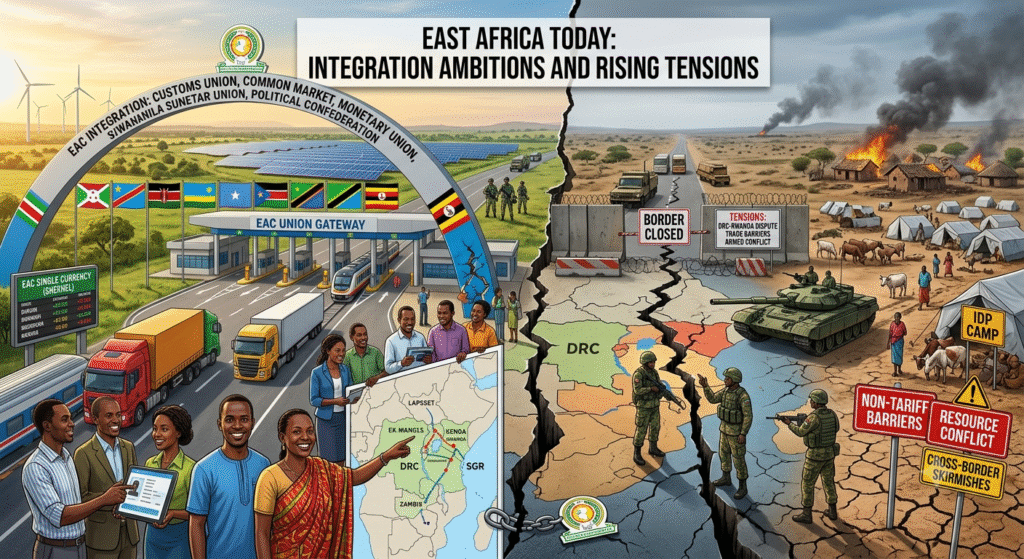
September 2026 finds East Africa in a state of profound transformation. The region is pushing forward with bold political integration and deepening economic ties, yet this momentum is being severely tested by growing trade tensions, renewed security threats, and the relentless climate crisis that continues to push millions toward the brink of famine.
🏛️ Political Integration: The Bold Push for a Confederation
A landmark development this week is Tanzania’s launch of a nationwide public education campaign on the proposed East African Community (EAC) Political Confederation . This represents the most significant step toward deeper political integration since the EAC’s founding, potentially transforming the bloc from an economic community into a political union.
Charles Kadonya, Permanent Secretary in Tanzania’s Ministry of Foreign Affairs and East African Cooperation, opened a five-day meeting in Morogoro to develop strategies for informing citizens about the proposed confederation and its implications . The initiative comes as the EAC envisages four stages of regional integration: the Customs Union, Common Market, Monetary Union, and ultimately Political Federation .
The proposed confederation would strengthen the EAC’s collective capacity in key areas including economic development, trade, security, and social services, while strengthening the Community’s position in international forums . Public understanding and participation are seen as critical to the process, with Tanzania planning a two-phase exercise: first public education, then collecting citizens’ views on the draft constitution.
In parallel, EAC Attorneys General convened from August 24 to 29 to advance key legal matters, including amendments to the EAC Elimination of Non-Tariff Barriers Act and the EAC Metrology Bill . These legal instruments are essential for removing the persistent trade barriers that continue to fragment the regional market.
⚡ Growing Tensions: The Kenya Trader Directive
While political integration moves forward, a directive from Kenyan President William Ruto has exposed the fragility of the Common Market’s commitment to free movement. Ruto ordered the withdrawal of foreign nationals from petty trade, including hawking, vending, and roadside food sales—a move that has sparked panic and fears of xenophobic attacks .
Hundreds of Burundian nationals gathered at their embassy in Nairobi, seeking emergency travel documents to return home . Ugandan and other East African traders reportedly closed their businesses amid fears of enforcement . Images circulated online showing hundreds of Burundians and Congolese gathering at bus terminals, preparing to leave the country .
The directive has raised fundamental questions about the future of EAC integration. As Ugandan lawyer Eyobu Mordecai observed: “If Partner States can reserve parts of domestic commerce for citizens, what happens to the Common Market’s guarantees of free movement, establishment and non-discrimination among EAC nationals?”
The government has since sought to clarify the position. Cabinet Secretary Lee Kinyanjui stated the directive was not intended to prevent foreigners from engaging in small businesses, but to ensure compliance with immigration, work permit, and business licensing requirements . Foreign Affairs PS Korir Sing’oei went further, apologising to Burundi nationals for the harassment they faced and assuring them of government support to facilitate documentation .
But the damage may already be done. Critics argue the directive, coming ahead of next year’s elections, is scapegoating foreigners for Kenya’s economic difficulties . As activist Hanifa Adan wrote in the Daily Nation: “When a state runs out of answers for a collapsing economy, it invariably seeks an enemy” .
🛡️ Security and Climate: The Dual Threat
The region’s integration ambitions are unfolding against a backdrop of persistent security threats. Heavily armed militants launched a Sunday evening attack on Arabia town in Mandera County, sparking a fierce shootout with security forces who successfully repelled the invaders . While the identity of the gunmen has not been officially confirmed, officers suspect Al-Shabaab militants, who have historically targeted towns along the volatile Kenya-Somalia border .
Meanwhile, the climate crisis continues to deepen. The strengthening El Niño threatens severe flooding across Kenya, Somalia, and Ethiopia . For Somalia, this is particularly devastating: only about one-fifth of the usual harvest has been realised due to drought, and the number of severely malnourished children has reached alarming proportions .
UNICEF reports that over 162 million children in Eastern and Southern Africa are exposed to the impacts of El Niño . The organisation is urgently appealing for $173 million for its humanitarian action plan, warning that severe floods threaten 2.5 million people in Somalia alone . Yet humanitarian funding has collapsed: CARE International has been forced to close 50 health centres in Somalia, while 88 percent fewer aid funds from the international community are now available compared to previous crises .
🔮 Conclusion
East Africa today is a region at a crossroads. The bold vision of political confederation and deeper integration is advancing, yet the practical reality of the Common Market is being tested by nationalist directives and growing tensions. The security threat from Al-Shabaab remains undiminished, and the climate crisis—compounded by a catastrophic collapse in humanitarian funding—threatens to push millions to the brink. The coming months will determine whether the region’s integration ambitions can survive the weight of these converging crises.
