

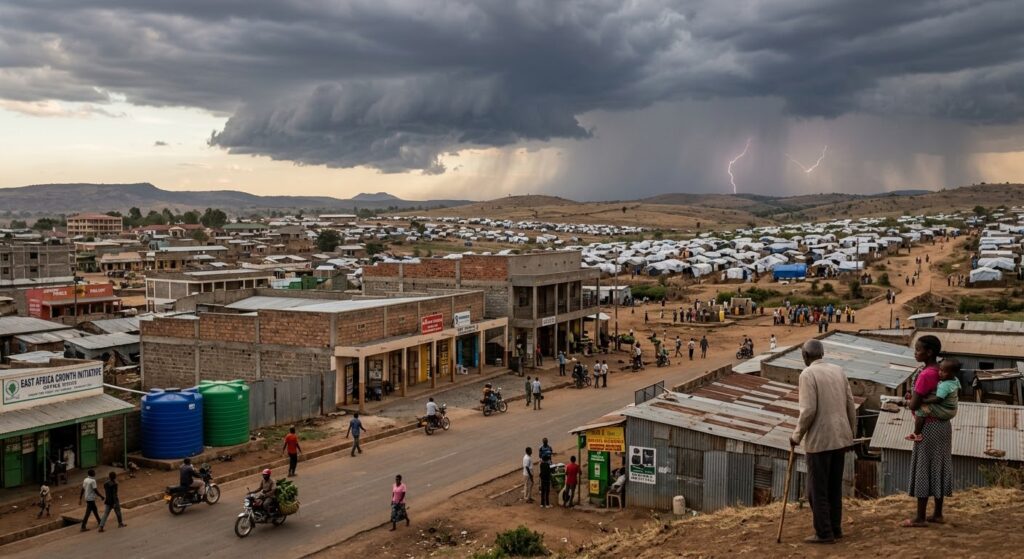
Nairobi/Addis Ababa — East Africa stands at a precarious crossroads in October 2026. The region remains the fastest-growing economic bloc on the African continent, with the African Development Bank confirming growth accelerated to 6.6 per cent in 2025 and projecting 5.9 per cent for 2026. Yet beneath these headline figures lies a more troubling reality: more than 40 million people across six IGAD member states are facing high levels of acute food insecurity, nearly 19 million are living in forced displacement, and a powerful El Niño event is threatening to supercharge floods that could displace up to three million more by year’s end.
A Region Bracing for El Niño’s Wrath
The most urgent threat facing East Africa today is the rapidly strengthening El Niño, which scientists warn could be the strongest since 1950. The Famine Early Warning Systems Network (FEWS NET) reports that the 2026/27 El Niño has already driven below-average rainfall across unimodal areas of East Africa, with the most severe food security impacts expected to emerge during the 2027 lean season.
The Danish Refugee Council’s modeling paints a stark picture: flood-related displacement across Somalia, Kenya, South Sudan, and Uganda could range from 750,000 in a less severe scenario to three million in the worst case—potentially surpassing the 2023 floods that displaced over two million people. Somalia and Kenya would account for the largest share, with 60 per cent and 33 per cent of projected displacements respectively.
The human stakes are immense. “In Beledweyne, I met families still rebuilding after the devastating 2023 El Niño floods,” said James Curtis, DRC Executive Director for East Africa. “Now they are watching the river rise again, wondering whether they will be forced to flee for a second time”.
DRC’s rapid needs assessment from March 2026 found that 74 per cent of surveyed IDPs in Beledweyne and Baidoa were living in shelters made from sticks, plastic sheeting, and corrugated iron, and that 92 per cent were already struggling to access enough food before the rains had even begun.
Economic Growth Under Strain
The African Development Bank’s 2026 East Africa Economic Outlook confirms that regional growth remains robust, driven by resilient private consumption, increased investment, and a growing services sector. Rwanda grew by 10 per cent in early 2026, while Tanzania, Uganda, and Kenya posted growth rates of 5.7, 5.8, and 5.3 per cent respectively.
Yet the region faces an annual development financing gap of $119 billion, and the World Bank warns that geopolitical tensions—particularly the conflict in the Middle East and disruptions to Red Sea shipping—could push up global fuel prices and increase import bills across East Africa. In Kenya, the World Bank projects growth of 4.3 per cent in 2026, below the government’s target of 5-5.3 per cent, with inflation rising to 6.8 per cent in September, driven by higher food and transport costs.
The economic strain is compounded by El Niño’s agricultural impacts. A modeling exercise by the International Food Policy Research Institute (IFPRI) suggests that El Niño-driven drought could cost Kenya as much as 1.5 per cent of GDP, with agricultural GDP losses reaching 6.1 per cent in severe scenarios. More than 750,000 additional people could fall into poverty, and nearly 5 million more could become undernourished.
“Almost all of the simulated national and agricultural GDP losses arise from the assumed weather-related productivity shocks,” the IFPRI analysis found, noting that the effects of fuel prices were “vastly outweighed by El Niño’s negative effect”.
Food Insecurity Deepens
The 2026 Global Report on Food Crises for IGAD member states reveals the scale of the hunger crisis. More than 40.3 million people across Djibouti, Kenya, Somalia, South Sudan, Sudan, and Uganda are facing high levels of acute food insecurity—34 per cent of the analysed population.
Sudan remains the region’s largest food crisis, with 19.5 million people affected. South Sudan has the highest proportion, at 55 per cent of its population. More than 10 million people across the six countries face emergency levels of acute food insecurity (IPC Phase 4), while over 208,000 in Sudan and South Sudan are experiencing catastrophe (IPC Phase 5).
Acute malnutrition is equally alarming: more than nine million children aged 6-59 months require treatment, including about 2.3 million suffering from severe acute malnutrition—a condition that can be fatal without immediate intervention.
“Hunger crosses borders with people, livestock, pests, and prices, and our answers must do the same,” said IGAD Executive Secretary Dr. Workneh Gebeyehu, calling for a shift from emergency response towards anticipation and investment in resilient food systems.
IGAD has issued a high-level Call to Action on El Niño preparedness, urging member states to activate contingency plans before the rains, pre-position supplies, and release financing based on pre-agreed triggers. The window for action, the organization warned, “is now a matter of weeks”.
Ethiopia’s Escalating Conflict
Beyond climate and food crises, East Africa faces a resurgent security threat in Ethiopia, where fighting between federal forces and the Tigray People’s Liberation Front (TPLF) erupted again on September 23. A drone strike on an IDP camp in Sheraro, western Tigray, killed at least eight people, including a mother and four children, on October 4.
The conflict has sparked fears of a wider regional war. Federal forces have pushed north to seize control of Mekelle, and Ethiopia accuses Eritrea of supporting the TPLF. The leaders of Eritrea, Egypt, Somalia, and Sudan met in El-Alamein, Egypt, to discuss the crisis. “The continued northward advance of Ethiopian troops and drone strikes in northern Tigray suggest that Ethiopian forces are preparing conditions for a conflict with Eritrea,” warned Edward Bach of risk intelligence firm Verisk Maplecroft.
Integration and Partnership: Signs of Resilience
Amid these challenges, the East African Community continues to advance its integration agenda. In early October, EAC Secretary General Amb. Stephen Mbundi signed a Certificate of Donation with China’s Ambassador to Tanzania, reaffirming China’s annual contribution of $180,000 to the EAC budget and exploring expanded cooperation in infrastructure, digital trade, and green energy.
The Commonwealth Association of Tax Administrators commended the EAC for its achievements in digital revenue administration, highlighting initiatives such as the Single Customs Territory and the Electronic Cargo Tracking System that have simplified customs procedures and strengthened revenue assurance.
South Sudan became the fifth EAC Partner State to launch national consultations on drafting a constitution for the EAC Political Confederation, a transitional step toward eventual political federation. “The Constitution belongs to the people of East Africa,” said Rt. Hon. Benjamin Odoki, Chairperson of the Constitutional Experts Team.
Security Challenges Persist
In Kenya, the government has admitted that security forces lack the resources to sustain operations against banditry in Samburu, Meru, and Isiolo counties, where 14 people were killed and 17 injured between June and September. Interior Cabinet Secretary Kipchumba Murkomen told Parliament that “current resources in terms of personnel and equipment are not adequate for sustained security coverage,” citing difficult terrain and long distances between installations.
On the Kenya-Somalia border, the Officer Commanding Police Division in Hagadera and his driver were killed when their vehicle struck an improvised explosive device along the Saretho-Dadaab road on October 9—a suspected Al-Shabaab attack.
A Region at a Crossroads
East Africa today presents a study in contrasts. Its economies are growing faster than almost anywhere else on the continent, its institutions are deepening integration, and its partnerships with global powers are expanding. Yet the region’s most vulnerable populations face a convergence of threats—climate shocks, conflict, displacement, and hunger—that could undo years of development gains.
The El Niño event now strengthening in the Pacific is not a surprise. Forecasts have been available for months. IGAD has issued its call to action. The question, as DRC’s James Curtis put it, is whether the world will “act before the river breaks its banks, or respond only after people have lost everything once more”. For the 40 million East Africans already facing acute food insecurity, and the millions more at risk of displacement, the answer will determine whether the region’s impressive economic trajectory translates into genuine human progress—or leaves millions behind.