

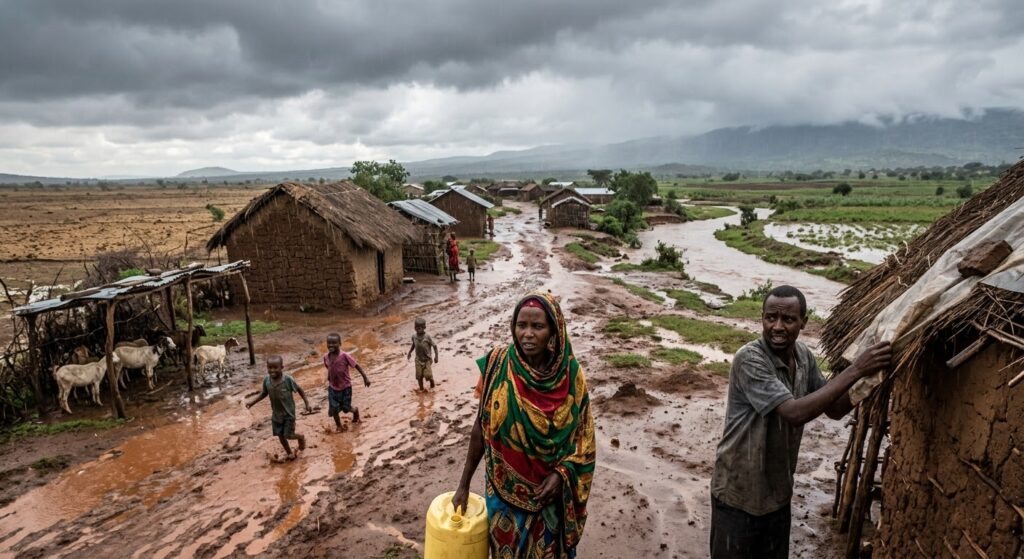
NAIROBI — The rains have come. After a year of devastating drought that parched pastures from Somalia to Kenya’s northern frontier, the October-to-December season has arrived across East Africa, driven by an El Niño event that the World Meteorological Organization warns could be “unprecedented in strength, off the monitoring charts used for the past four decades” . The rains offer salvation for farmers and pastoralists who have watched their livelihoods wither. But they also bring the threat of floods that could displace hundreds of thousands, destroy crops, and wash away the fragile gains of a region already stretched to its limits.
A Season Unlike Any Other
The Greater Horn of Africa Climate Outlook Forum, convened by ICPAC, gives a 90 percent chance of enhanced rainfall over southern Ethiopia, central and southern Somalia, and northeastern Kenya, with seasonal totals above 400 millimeters expected across central Kenya, the Lake Victoria Basin, Burundi, western Rwanda, and western Tanzania. In parts of Ethiopia, Kenya, and Somalia, this single season supplies up to 70 percent of the year’s rain .
ICPAC named 1997 and 2023 as the closest analogue years. Both are remembered for what they cost. The 1997 floods across Ethiopia, Kenya, Somalia, and Uganda killed 2,823 people—the deadliest El Niño-linked flooding on record. In 2023, floods killed 705 people and displaced about 1.3 million in Somalia, 633,000 in Ethiopia, and 546,000 in Kenya .
What makes this season particularly dangerous is what came before it. The October-to-December 2025 short rains were among the driest on record in the eastern Horn, and the March-to-May 2026 rains brought little relief to many of the worst-hit areas. Somalia’s Gu rains came late and below average, and poor rainfall destroyed roughly 50 to 70 percent of crops across most of Uganda’s Karamoja region . FEWS NET expects Ethiopia’s June-to-September kiremt rains to rank as the driest in the historical record, with deficits above 50 percent across much of the country .
The ground itself is now a liability. Soil baked hard and stripped of vegetation absorbs water poorly, so heavy storms run off faster and carry more topsoil with them. The scientists who studied the 2023 floods pointed to the preceding drought and unsustainable land management as part of why its impacts were so severe .
Somalia: The Sharp End
Somalia is expected to bear the heaviest burden. The International Organization for Migration, in projections developed with the Danish Refugee Council, estimates that 874,319 people could be displaced between October and December, with flooding driving 92 percent of that total . Beletweyne faces the greatest threat, with approximately 229,000 people at risk, followed by Gaalkacyo with 82,000 .
The signs are already visible. The Jubba River at Dollow is approaching flood levels, while the Shabelle River at Jowhar is rising toward the top of its banks. Heavy rainfall in Baidoa has already damaged homes and forced families to flee several neighborhoods . Recent heavy rainfall has caused flooding in southern Ethiopia and parts of Somalia, with many gauges along the Shabelle River exceeding the high flood risk level .
“We are looking at the possibility of hundreds of thousands of people losing their homes in just a matter of weeks,” said Manuel Marques Pereira, IOM Somalia Chief of Mission. “Many of these families have already been displaced before and have very little left to fall back on” .
The response is severely underfunded. IOM has secured only 14.4 percent of the $16.62 million needed to prepare for and respond to El Niño-related flooding—funding intended to support more than 517,000 people in flood-prone communities . “There is still time to reduce the impact, but that window is closing,” Pereira said .
Kenya: Preparing for the Worst
Kenya has activated its preparedness machinery. The National Disaster Operations Centre has identified Nairobi, Mombasa, and Kisumu as high-risk urban hotspots, with El Niño set to peak in December . The Kenya Meteorological Service has forecast above-average rainfall across more than 80 percent of the country .
In Mombasa, Governor Abdulswamad Nassir has directed a multi-site drainage clearing exercise across all six sub-counties, with 300 officers trained in rescue and emergency response. “This will be no ordinary rainy season, and our response cannot be ordinary,” Nassir said. “Mombasa is preparing early, mobilizing every available resource and working across agencies to protect lives, livelihoods and property” . The memory of the 2023 El Niño rains, when nearly 3,900 households were affected in Mombasa, looms large .
In Kitui County, the Tana and Athi Rivers Development Authority has warned of flood risks from seasonal rivers that remain dry for much of the year but can fill rapidly following heavy rainfall upstream. The authority cited the December 2021 Enziu River tragedy, in which 32 people drowned after a bus carrying a church choir was swept away while attempting to cross a flooded river .
In Uganda, the rains have already claimed lives. Two people died in the Kampala metropolitan area on October 11: a man whose body was recovered from a drainage trench in Bulabira Zone, and 25-year-old Jalia Nameere, who died when a perimeter wall collapsed onto her rented room in Kyanja Parish . Police urged the public to avoid flooded roads and drainage channels and to inspect structures for signs of weakness .
Ethiopia: Anticipatory Action, Limited Resources
Ethiopia’s National Anticipatory Action Technical Working Group has reviewed forecast and risk information and initiated partner mapping to support coordinated anticipatory action. Key actions include pre-positioning critical supplies, disseminating community preparedness messages, reducing risks at facility level through drainage clearance, and mapping safe locations .
ACF Ethiopia has activated anticipatory action under the IMPAACT program, allocating EUR 87,542 to support 86,623 people across the Somali and Oromia regions, targeting Gode and Adadle woredas in the Somali Region and Moyale and Miyo woredas in Oromia .
But the gaps are significant. A national flood anticipatory action framework has not yet been formally finalized, and resources remain “limited relative to the scale of identified flood risks” . The forecast-to-action link is being strengthened but requires further work to translate information into agreed triggers and early actions. Financing for preparedness “remains a significant gap” .
Tanzania: Infrastructure and Crops at Risk
Tanzania’s Meteorological Authority has warned that heavy rainfall, strong winds, and flooding could affect roads, railways, ports, and airports, with road embankments at risk of collapse and railway infrastructure vulnerable to damage. Port operations could be delayed, particularly for goods requiring protection from moisture .
The outlook warns that excessive soil moisture and flooding could affect crop growth, with potatoes, sunflower, beans, sesame, fruits, and vegetables particularly vulnerable. Livestock could face outbreaks of Rift Valley fever and foot rot, while seaweed farmers could see reduced production due to lower seawater salinity .
A Choice Between Action and Reaction
The rains will bring real benefits. Pasture will regrow, water pans will fill, and farmers who plant on time could bring in a good harvest. But the past year has shaped this flood season in ways that make the familiar rhythms of rain and renewal far more dangerous. Drought has moved people into flood-prone areas. It has hardened the soil and stripped the vegetation that would otherwise slow the water. It has depleted the resources that families would use to protect their homes and livestock.
For the millions of East Africans living in flood-prone areas—from the riverbanks of Beletweyne to the crowded settlements of Kampala and Mombasa—the coming weeks will determine whether this El Niño season brings a manageable challenge or a repeat of the devastation that has become all too familiar. The forecasts are clear. The preparations are underway. What remains uncertain is whether the resources and political will exist to prevent the worst. As IOM’s Pereira put it: “There is still time to reduce the impact, but that window is closing” .