

ARUSHA — June 12, 2026
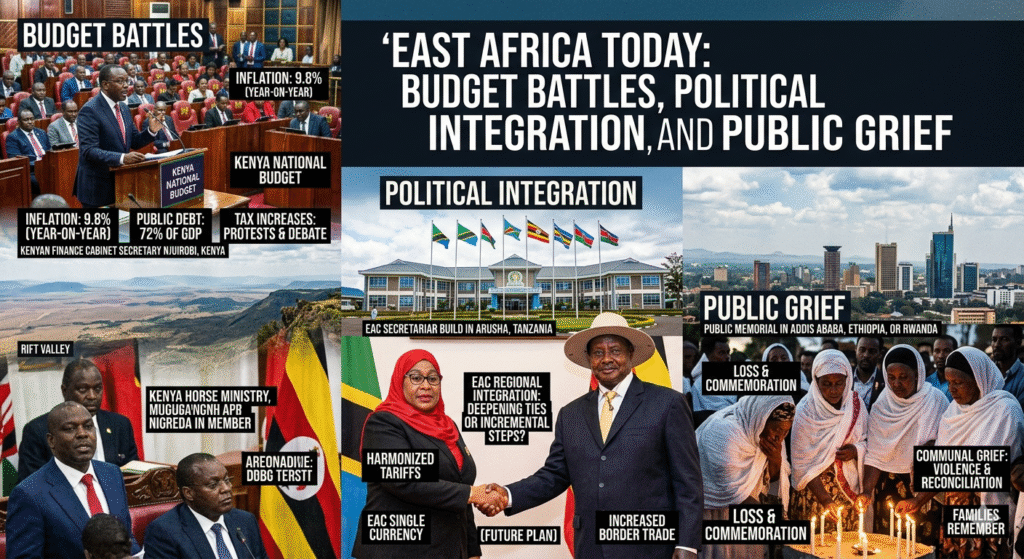
The past 72 hours have captured East Africa in all its complexity—a region striving for deeper unity while grappling with domestic crises, economic shocks, and public grief. On Thursday, finance ministers across Kenya, Uganda, and Tanzania unveiled their 2026/27 budgets to parliaments, each addressing the same external threat: the economic fallout from the Middle East war. Simultaneously, the East African Community pressed forward with its ambitious political integration agenda, while Kenya mourned the loss of 16 schoolgirls in a devastating fire and faced mounting protests over a controversial US Ebola facility.
Here is a comprehensive look at East Africa today.
Part 1: Budget Day Across the Region
June 11, 2026, was a critical day for East Africa’s economies. Finance ministers in Kenya, Uganda, and Tanzania presented their spending plans for the 2026/27 fiscal year, each navigating a treacherous landscape of geopolitical shocks, debt pressures, and slowing growth forecasts.
The African Development Bank has cut the region’s growth forecast for this year by half a percentage point, citing vulnerability to trade turmoil from the Middle East conflict. East Africa relies heavily on fuel and fertilizer imports—both of which have been disrupted by the ongoing war involving Iran.
Part 2: Kenya’s Fiscal Balancing Act
Kenya, the region’s largest economy, unveiled a KSh4.78 trillion (approximately US$37 billion) budget. Finance Minister John Mbadi set a budget deficit target of 5.5% of GDP for the coming fiscal year, with plans to gradually reduce it to 3% by the 2028/29 year.
But Mbadi struck a cautious note, acknowledging significant downside risks. “Domestically, climate-related shocks could disrupt agricultural production and infrastructure, while externally, geopolitical tensions, commodity price volatility, weaker global growth, and tighter financial conditions continue to adversely affect inflation, exports and capital flows,” he told parliament.
Investors remain skeptical. Andrew Matheny, senior economist at Goldman Sachs, noted that Kenya’s treasury “has consistently underperformed budget targets in recent years” and that markets will look for “evidence of a more credible fiscal path forward, consisting of either spending cuts or genuine revenue measures that narrow the deficit”.
President William Ruto, who faces re-election in August 2027, has pushed to boost revenue through tougher tax enforcement. But government agencies complain of delayed funding, and households say higher taxes have squeezed incomes—a tension that exploded into deadly protests against high fuel prices last year.
Part 3: Uganda’s Oil-Fueled Optimism
Uganda presented a dramatically different picture. Finance Minister Henry Musasizi raised the total budget by 3.5% and projected that the country is set to resume double-digit growth for the first time since the 1990s.
The driver? Oil. “With commercial oil production commencing later this calendar year, growth is projected to accelerate to 10.2%,” Musasizi told parliament. He outlined a vision of job creation, rising household incomes, expanded business opportunities, and resources for quality education, healthcare, and infrastructure.
Yet analysts warn that the Iran war shock on fuel prices—paradoxically, while Uganda prepares to become an oil exporter—could strain government spending plans. “We should not assume a back-to-normal trend, so it’s important that we have a shock mitigation measure,” said Enock Nyorekwa Twinoburyo, an economics lecturer at Makerere University.
Part 4: Tanzania’s Self-Reliance Push
Tanzania’s budget stands at Sh62.334 trillion (approximately US$24.2 billion), marking a 10.3% increase from the previous year. The government expects the economy to grow at 6.3% this year, up from 5.9% last year.
Finance Minister Mussa Omar struck a theme of self-reliance, noting a drop in financing from wealthier foreign nations and rising pressure from debt. “This situation necessitates the need to accelerate our efforts toward self-reliance,” he said.
Remarkably, Tanzania sees the Middle East war as an opportunity. Planning Minister Kitila Mkumbo told parliament that the conflict creates openings for Tanzania to provide transshipment services for ships unable to deliver to Middle Eastern ports and to attract investors seeking safer havens than the Gulf region.
Part 5: The EAC’s Political Integration Push
Beyond national budgets, the East African Community is accelerating its long-term integration agenda. Uganda’s President Yoweri Museveni, who currently serves as EAC chairperson, met with Secretary General Stephen Patrick Mbundi on Tuesday to push for faster integration.
Museveni emphasized the need for improved infrastructure, enhanced trade cooperation, and the fast-tracking of plans for a common currency. He specifically argued for rationalizing transport systems: “The railway transport should carry heavy goods and petroleum products, while roads remain for passengers and light cargo”.
The most significant development came from Rwanda. The EAC is set to resume national consultations on drafting the constitution for the proposed EAC Political Confederation, with stakeholder engagements launching in Kigali on June 15. The consultations will move to Rubavu, Huye, and Nyagatare, concluding on June 27.
This exercise represents the fourth and final pillar of regional integration—the transitional stage toward a full Political Federation of East African States. The process, headed by constitutional experts and coordinated by the EAC Secretariat alongside the Rwandan government, aims to gather public consensus on governance structures.
EAC Deputy Secretary General Andrea Aguer Ariik Malueth emphasized that the process is designed to create widespread awareness and ensure the integration framework directly reflects the aspirations of East African citizens.
Part 6: The Common Currency Debate
One of the most concrete outcomes of the Museveni-Mbundi meeting was a push to expedite the East African Monetary Union. Secretary General Mbundi urged Museveni to engage regional central bank governors to accelerate progress toward a common currency.
“Our citizens are really suffering because of fluctuations in currency. It is a big hindrance to business,” Mbundi said.
Mbundi proposed a phased approach: “I wanted to propose that countries which are able should move ahead. Eight countries cannot converge at the same time. If we could start with three or four countries, then the others can join later. Otherwise, we are not doing a good service to the population on the issue of the monetary union”.
Rebecca Kadaga, Uganda’s First Deputy Prime Minister and Minister for East African Community Affairs, expressed optimism that significant progress could be achieved during Museveni’s tenure, particularly regarding the remaining pillars of integration.
Part 7: Singapore FTA—A New Trade Horizon
In a significant external development, Singapore announced on June 9 that it will commence negotiations on a free trade agreement with the EAC—the city-state’s first such agreement with an African partner.
Singaporean President Tharman Shanmugaratnam made the announcement during his state visit to Tanzania, speaking alongside President Samia Suluhu Hassan. He emphasized that the FTA would connect Singapore not only with Tanzania but also with the other seven EAC members: Burundi, the DRC, Kenya, Rwanda, Somalia, South Sudan, and Uganda.
“The FTA between the EAC and Singapore comes at a timely moment as countries seek to diversify trade networks amid current global geopolitical tensions,” Shanmugaratnam said.
The agreement will facilitate market access, boost goods and services exchange, and help East African exporters gain deeper access to the ASEAN market through Singapore. Beyond traditional sectors, the FTA could open opportunities in the digital economy and emerging technologies.
Part 8: The Utumishi Tragedy—A Nation Mourns
While economic and political developments dominated headlines, a human tragedy has shaken Kenya to its core. On Friday, June 11, hundreds of mourners gathered in the central town of Gilgil for a memorial service honoring 16 students who died in a fire at Utumishi Girls Academy on May 28.
The remains of the girls were placed in white coffins adorned with flowers and topped with their portraits. The coffins were lined up in front of families, schoolmates, community members, and local leaders who called for justice.
Police have arrested nine suspects—all fellow students. Interrogations revealed that the blaze was started by lighting a mattress at the dormitory’s exit using a matchstick and paraffin. No motive has been disclosed.
The memorial service was attended by Kenyan First Lady Rachel Ruto. The presiding bishop, who himself survived Kenya’s deadliest school fire in 2001 when 67 boys died in Machakos County, questioned how much longer Kenyan children and families would continue to suffer from school fires.
The school captain, Abigael Wanjiku, eulogized the girls as “friends, study partners, teammates and companions.” A mother representing the parents broke down in tears during her speech.
The tragedy is not isolated. The Kenya Red Cross reported that it has responded to 37 school fires since the beginning of the year. Last month, Kenya’s Education Ministry suspended the principal of Utumishi Girls Academy for failing to comply with fire safety regulations. The ministry has closed more than 300 schools following a 2024 fire tragedy that killed 21 boys.
Part 9: The US Ebola Facility Controversy
Another crisis is unfolding in Nanyuki, central Kenya, where a proposed US Ebola quarantine facility has sparked deadly protests. On Tuesday, a 17-year-old boy, Sylvester Muigai, was killed during demonstrations against the facility at the Laikipia Air Base.
Muigai’s grandmother told Reuters that police claimed he was killed by a tear-gas canister, not a bullet—contradicting eyewitness accounts. Two Reuters reporters saw a body with a large head wound in a police van.
The facility is designated for Americans who have been exposed to the Ebola virus but do not show symptoms. Kenyan officials have said it would also serve Kenyans and foreign nationals, but US officials have not confirmed this.
Protesters argue that the US is offloading the risk of caring for those exposed to the Ebola outbreak in eastern DRC and Uganda. The Trump administration has said it will not allow any Ebola cases to enter the US.
A court has ordered a stop to work on the proposed 50-bed unit, but US military planes have continued to ferry in staff and equipment since the court’s rulings, according to diplomatic sources and flight tracking data.
Many protesters have directed their anger at President Ruto, who last week said his government was doing “the right thing” by allowing the US to build the centre.
Part 10: The Ebola Response—Regional Coordination
The Nanyuki controversy is unfolding against the backdrop of a very real Ebola threat. On June 4, EAC Ministers of Health agreed to harmonize Ebola surveillance and protective measures at all airports, ports, and land border crossings across the region.
The ministers established a dedicated Regional Technical Taskforce to coordinate the response to the ongoing Ebola Virus Disease outbreak, which is caused by the Bundibugyo virus strain.
The measures include:
- Harmonized border screening protocols
- A regional technical taskforce for coordination
- Real-time information sharing among partner states
- Deployment of mobile laboratories at strategic border points
Part 11: The Geopolitical Pressure—Iran War Fallout
The thread connecting many of these stories is the ongoing Middle East war involving Iran. The conflict has sent fuel prices soaring, disrupted fertilizer supplies, and created global economic uncertainty—all of which East Africa, as a net importer of these commodities, feels acutely.
Kenya’s budget acknowledged that “geopolitical tensions, commodity price volatility, weaker global growth, and tighter financial conditions continue to adversely affect inflation, exports and capital flows”.
Uganda faces similar pressures, though its impending oil production offers a hedge. Tanzania, uniquely, sees opportunity in the crisis, positioning itself as an alternative investment destination and transshipment hub.
Part 12: The Path Forward
As June 12, 2026, draws to a close, East Africa stands at a complex crossroads.
The economic picture is mixed: Kenya faces a difficult fiscal consolidation, Uganda is betting on oil to transform its economy, and Tanzania is positioning itself as a regional safe haven for investment. All three must navigate the same external shocks from the Middle East.
The political integration agenda is moving forward, with constitutional consultations resuming in Rwanda and renewed momentum on the monetary union. But the EAC’s ambitions face the usual challenges: coordinating eight sovereign states with different interests, capacities, and political systems.
The human toll is impossible to ignore. Sixteen girls are dead from a preventable fire. A teenager is dead from a protest over a foreign military facility. Families across Kenya are grieving, and the region’s leaders face mounting pressure to deliver not just economic growth, but safety, security, and accountability.
President Museveni, speaking at his meeting with the EAC Secretary General, captured the stakes: integration must “improve the livelihoods of East Africans”. For the families in Gilgil, the protesters in Nanyuki, and the students in crowded dormitories across the region, those are not abstract words. They are the measure of whether East Africa today is moving forward—or standing still.
As Mbundi told Museveni: “I am ready to shoulder this obligation of steering our community to the destiny which the people of East Africa really wish”. The coming months will test whether that destiny remains within reach.