

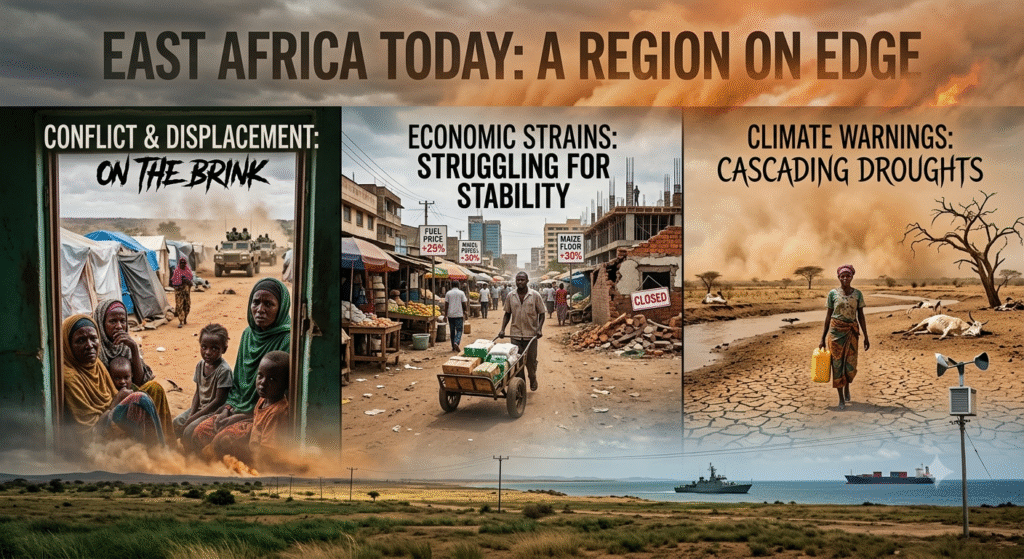
As of early August 2026, East Africa presents a picture of deepening fragility, where the promise of economic growth is overshadowed by renewed geopolitical tensions, persistent trade barriers, and an escalating climate emergency. The region stands at a crossroads, with its leaders grappling to contain immediate crises while attempting to salvage long-term integration and development ambitions.
A Glimmer of Progress Shadowed by Conflict
The region has demonstrated notable economic resilience in recent years. Rwanda entered 2026 with strong momentum, posting real GDP growth of 9.4 percent in 2025, driven by robust performance across services, construction, tourism, and agriculture . Tanzania also maintained a solid growth trajectory, with its economy expanding by 6.0 percent in 2025, supported by agriculture, mining, and construction . A major infrastructure boost was also announced in Kenya, where businessman Suleiman Shahbal secured a landmark Special Economic Zone investment deal exceeding $100 million with global logistics giant DP World, projected to create nearly 8,000 direct jobs in Mombasa and position the port city as a major regional industrial hub .
However, this economic headway is being severely tested. The most serious threat to regional stability is the unraveling of the Pretoria Peace Agreement in Ethiopia. The peace treaty, signed in November 2022 to end a two-year civil war that claimed an estimated 600,000 lives, is now in jeopardy . In late July and early August, fighting erupted between Ethiopian federal forces and the Tigray People’s Liberation Front (TPLF) in western Tigray, near the Sudanese border . Reports indicate the involvement of heavy artillery and drones .
The Tigray interim administration has accused the federal government of launching a “large-scale ground offensive,” alleging violations of the peace deal, including a blockade on the region and failure to resolve the disputed status of western Tigray . While the Ethiopian government has not publicly confirmed the offensive, it has accused the TPLF of initiating the clashes . Tigray authorities have called on residents and security forces to prepare to defend the region, warning that the conflict could trigger fresh displacement and a worsening humanitarian crisis . The United States, the African Union, and the UN have all urged restraint, but experts warn that the Pretoria Agreement failed to address the root causes of the conflict, leaving the peace process highly fragile .
Trade Integration Stalled by Bureaucratic Hurdles
While the specter of war looms, efforts to deepen regional economic integration within the East African Community (EAC) are hitting significant roadblocks. Trade barriers, despite high-level commitments to abolish them, remain a persistent obstacle. The East African Business Council reports that 27 non-tariff barriers (NTBs) continue to obstruct trade across the bloc, with Tanzania accounting for the highest number .
These barriers range from discriminatory taxes to excessive roadblocks. On the Northern Corridor, which handles 35 million tonnes of cargo annually, transporters face between 22 and 27 police checkpoints, costing an estimated $100 per stop in extortion and delays . Agricultural trade is particularly disrupted; Kenya, for instance, charges a discriminatory 10 percent excise duty on fish from Uganda, treating it as an import rather than a regional product . Similarly, Kenya’s Kajiado County charges a $15 transit fee on foreign trucks, and Rwanda imposes a 39 percent excise duty on Kenyan juice products . The EAC Council of Ministers has convened to address these issues, but the inconsistent enforcement and protectionist domestic policies continue to undermine the Common Market Protocol .
Adding to the economic frustration, the region continues to export raw materials and import finished goods, representing a massive loss of potential value. East African Community (EAC) partner states import approximately $1.5 billion worth of edible oils annually while exporting just $277 million . The leather industry presents a similar story, with the EAC importing $49 million in finished leather goods while capturing less than one percent of the $99 billion global market . The East African Business Council is collaborating with the African Development Bank to address this through a two-day trade clinic aimed at developing regional value chains .
Climate and Humanitarian Crises Deepen
Compounding the political and economic challenges, the region is facing an intensifying climate crisis. The African Union has called on member states to strengthen preparedness as forecasts predict a strong El Niño expected to intensify from August, raising the risk of extreme weather . The World Meteorological Organization warns this El Niño could be among the strongest in 30 years, with East Africa likely to experience more rain than usual between August and November . This threatens to bring severe floods that could destroy crops and livestock, much like the devastating 2023-2024 El Niño that pushed millions into hunger .
Kenya is already feeling the pressure. Former Deputy President Rigathi Gachagua has renewed his attacks on the government’s long-term “Vision 2060” development plan, urging immediate action on the high cost of living, declining agricultural earnings, and security threats . He cited farmers experiencing crop failures of up to 70 percent due to poor-quality fertiliser and called on the government to address the 0.8 percent levy on tea that he claims is discouraging buyers . His statements reflect a growing public impatience with government promises as families struggle to make ends meet.
The human toll is visible in everyday tragedies as well. On Sunday, August 2, a bus collision in central Tanzania’s Dodoma Region killed eight people and injured 66 others . Officials attributed the accident to a driver attempting to overtake without taking necessary precautions, highlighting the persistent challenges of road safety in the region .
Conclusion
East Africa today is navigating a treacherous path. The optimism of economic growth and infrastructure development, exemplified by Rwanda’s strong GDP figures and major investments in Kenya’s Mombasa SEZ, is being severely undermined by a confluence of crises. The renewal of conflict in Ethiopia threatens to plunge the region back into instability, while persistent trade barriers undercut the promise of regional integration. Meanwhile, an anticipated El Niño season could overwhelm already fragile communities with devastating floods. As the AU warns of the potential for extreme weather, and leaders in Kenya face increasing domestic criticism over the cost of living, the region’s ability to weather these converging storms remains uncertain.