

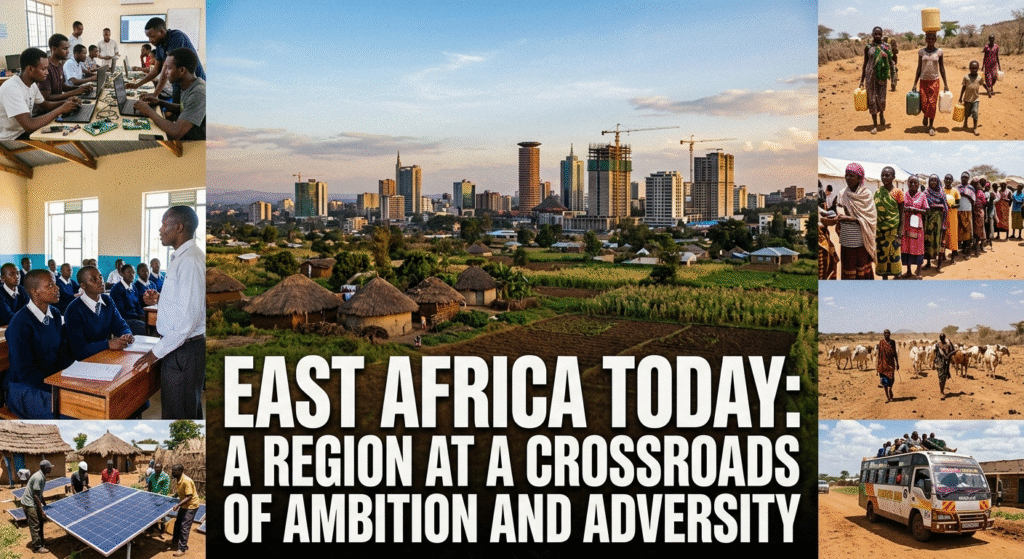
In September 2026, East Africa presents a complex picture of dynamic integration efforts alongside persistent security challenges and an escalating climate crisis. The region is demonstrating resilience and a collective ambition to reshape its economic future, even as it confronts threats that could undermine its stability. Today’s news reveals a region actively forging new alliances, strengthening security cooperation, and pushing for trade integration, all under the shadow of a looming humanitarian emergency for millions of its most vulnerable citizens.
🌍 Economic Ambition and Integration Drive Forward
A powerful undercurrent of the region’s recent activity is the determined push for deeper economic integration. Ethiopia, a key player in the Horn, has reaffirmed its commitment to regional integration as a central pillar of its development strategy. State Minister of Trade and Regional Integration Tazer Gebregziabher stated that the country is investing in strategic transport and logistics corridors that will serve not just Ethiopia, but the wider region. This commitment is a vital component of its “Homegrown Economic Reform Agenda,” designed to build a more open and competitive economy.
This economic drive is also visible in the bilateral efforts between neighbours. Kenya and Somalia are actively working to ease border trade and unlock investment. Their discussions in Addis Ababa focused on improving border and customs procedures to transform the border from a “choke point” into a “facilitation centre” for business. Sectors such as agriculture, livestock, fisheries, and logistics are seen as prime areas for deepening cooperation, signalling a move beyond mere survival towards shared prosperity.
This momentum will be on full display at the upcoming East Africa CEO & Investment Forum 2026 in Nairobi. The forum is positioned as a “CEO-led, results-oriented platform designed to shape East Africa’s trade, investment and competitiveness agenda.” It highlights the private sector’s central role in regional integration, reinforcing the critical partnership between governments and businesses. The EAC Secretary General has called for a significant increase in intra-EAC trade, setting a goal of 50% by 2030 to demonstrate the region’s potential for self-sustaining economic growth.
🛡️ Security Cooperation and Resilience in the Region
A key aspect of regional resilience is the growing cooperation in security and defence, which is being carefully cultivated alongside economic ties. The 6th EAC Armed Forces Civil-Military Cooperation (CIMIC) Week in Tanzania concluded with a clear demonstration of the military’s role in community building. Medical teams from six EAC partner states, including Rwanda, Kenya, and Uganda, treated 11,439 civilians, providing essential healthcare in orthopaedics, surgery, and paediatrics. This initiative, according to the Tanzania People’s Defence Force Chief, is about strengthening the bond between the military and civilian communities, embodying the spirit of “one people, one destiny.” The closing ceremony coincided with the TPDF’s 62nd anniversary, underscoring the region’s history of security partnership.
🥘 The Mounting Crisis: El Niño and Food Insecurity
However, this progress in integration and security is being threatened by a deepening humanitarian crisis driven by the strengthening El Niño weather pattern. A recent UNICEF report has issued a stark warning: more than 162 million children—over two-thirds of all children in Eastern and Southern Africa—are exposed to the impacts of the climate phenomenon.
The threat is multi-faceted and urgent:
- Direct Threats: Intensifying drought, extreme heat, and severe flooding are directly threatening children’s nutrition, health, and access to safe water and sanitation, as well as education and safety.
- Country-Specific Risks: In Somalia, up to 2.5 million people could be directly affected by flooding in the worst-case scenario, leading to massive displacement. In Ethiopia and South Sudan, tens of thousands of children are at risk in areas already experiencing severe food insecurity and vulnerability.
- The Funding Gap: UNICEF is urgently appealing for US$173 million for its Humanitarian Action for Children (HAC) programme to provide anticipatory assistance. The agency is frustrated that less than 1% of international humanitarian assistance is currently allocated for such preventative action. It stresses that every US$1 invested in disaster risk reduction can save up to US$15 in future recovery costs.
🔥 Conflict and Political Tensions
The region’s progress is further threatened by ongoing conflicts. In Somalia, recent clashes near Baidoa between government forces and militias linked to a former regional president, reportedly in coordination with al-Shabaab, underscore the volatile political and security situation. The fighting, which erupted in the city, a hub for humanitarian aid hosting hundreds of thousands of displaced people, serves as a stark reminder of the fragile security that continues to grip the region. Simultaneously, political tensions were visible in Nairobi, where a protest demanded the release of opposition figures Kizza Besigye (Uganda) and Tundu Lissu (Tanzania). Activists accused the Kenyan government of facilitating illegal renditions, adding another layer of complexity to regional relations and democratic accountability.
💡 Digital Health: A Glimpse of a Resilient Future
Amid these challenges, there are signs of a forward-looking approach. East Africa is working to overcome significant infrastructure gaps to realise its digital health ambitions. The upcoming World Health Expo (WHX) Nairobi in September will bring together healthcare providers, technology companies, and policymakers to discuss AI-supported diagnostics and telemedicine. While barriers like unreliable electricity and limited broadband remain, the push for digital health represents a strategic investment in a more resilient future.
Conclusion: A Delicate Balancing Act
East Africa today is a region performing a delicate balancing act. It is actively pursuing a vision of economic integration and strengthened security that could lead to unprecedented prosperity and stability. However, this ambition is severely tested by a rising tide of climate-related humanitarian needs and persistent political conflicts. The choices made by regional leaders in the coming weeks—from funding climate adaptation to facilitating open trade—will determine whether the region’s potential is unlocked or its people are left to bear the full weight of converging crises.