

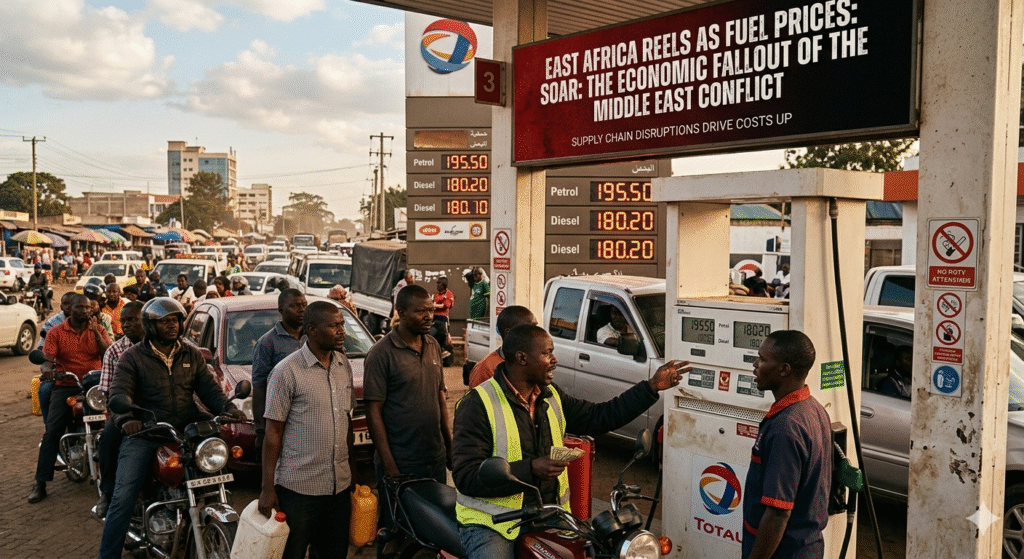
The cost of petrol has become a pressing concern across East Africa in recent weeks, with pump prices climbing to levels not seen since 2022. For millions of households, businesses, and transport operators, the financial strain is immediate and severe. In Kampala, petrol now retails between Shs4,900 and Shs5,200 per litre, while in Nairobi, industry projections suggest an increase of up to Sh10 per litre in the next pricing review . This surge is not the result of local market forces but rather the shockwaves of a conflict unfolding thousands of kilometres away.
The escalation began in late February 2026, when the United States and Israel launched military strikes against Iran, triggering retaliatory attacks on critical energy infrastructure across the Gulf region . What followed was a near-total disruption of shipping through the Strait of Hormuz, one of the world’s most vital oil transit corridors. Approximately 20 million barrels of oil—roughly 20 percent of global consumption—typically pass through this narrow waterway each day . With that flow reduced to a trickle, crude oil prices surged above $100 per barrel, and refined products such as diesel and jet fuel saw even sharper increases .
For East Africa, which depends heavily on imported petroleum from the Middle East, the consequences have been swift and severe. Kenya, Uganda, Tanzania, Rwanda, Burundi, and South Sudan all rely on fuel that arrives through the ports of Mombasa and Dar es Salaam. With shipments disrupted, supply chains have tightened, and prices have climbed steadily .
Shortages Begin to Bite
In Kenya, the Petroleum Outlets Association of Kenya has warned that approximately 20 percent of the country’s 3,100 retail outlets are already experiencing shortages . The situation, according to chairman Martin Chomba, could escalate into a full-blown crisis if the conflict persists. “In the next two weeks, it will be a total crisis with no fuel in most outlets if the tension in the Middle East continues,” he said . Panic buying has exacerbated the problem, with motorists rushing to fill their tanks in anticipation of further price hikes .
The Kenya Ports Authority shipping schedule for late March to early April showed 52 vessels expected to dock, but only two were carrying oil—both palm oil, not petroleum . This stark reality underscores the severity of the disruption. Despite assurances from Energy Cabinet Secretary Opiyo Wandayi that the country holds strategic reserves sufficient for short-term needs, the pressure on supply is mounting .
Uganda faces a similar predicament. The Uganda National Oil Company currently manages fuel imports under a government-led arrangement designed to stabilise the market. Officials have sought to reassure the public, with UNOC’s Tony Otoa stating that “there is no immediate cause for alarm” and that the company is sourcing globally . However, Uganda’s strategic storage at the Jinja terminal holds only about 30 million litres, enough for roughly five days of consumption at the country’s daily usage rate of 6.5 million litres .
Rwanda, entirely dependent on fuel transported through Kenya and Tanzania, is particularly vulnerable. The government has indicated it holds reserves for about a month, but any prolonged disruption would quickly translate into shortages .
Economic Ripple Effects
The impact of rising fuel prices extends far beyond the forecourt. Fuel is a key driver of inflation, influencing the cost of transport, electricity, food, and essential services . In Ethiopia, authorities have ordered fuel suppliers to prioritise security institutions, major government projects, and essential industries. Public transport has been given priority at petrol stations, and restrictions have been imposed to conserve fuel .
Transport operators across the region are grappling with difficult choices. In South Africa, the Road Freight Association warned that rising fuel costs would affect every link in the supply chain, from ports to factories to retail outlets . Transport companies face a stark decision: absorb the increased costs and risk their viability, or pass them on to consumers and risk dampening economic activity .
For households, the impact is already being felt. In Kampala, economist Julius Mukunda questioned the timing of a proposed excise duty increase on petrol and diesel, warning that it would compound the pain already inflicted by global price shocks . “Currently, there is a war in Iran and fuel costs are increasing. Is the measure to increase duty on fuel a way of telling us that the pain you are feeling is not enough?” he asked .
Vulnerability Exposed
The crisis has laid bare the structural vulnerabilities of East Africa’s energy system. The region receives about 75 percent of its fuel imports from the Middle East, leaving it acutely exposed to geopolitical shocks in the Gulf . The closure of local refineries and decades of underinvestment in domestic energy infrastructure have compounded the problem.
Kenya’s sole refinery in Mombasa has remained dormant for years, declared unprofitable and never revived . Uganda, despite discovering commercially viable oil reserves, has yet to begin domestic refining. Tanzania similarly lacks significant refining capacity. As a result, the region remains dependent on imported refined products, which are subject not only to the price of crude oil but also to transport costs, insurance premiums, and supply chain disruptions .
The longer shipping routes necessitated by the conflict have added to the burden. Oil tankers that normally transit the Suez Canal are instead sailing around the Cape of Good Hope, adding up to two weeks to delivery times and forcing vessels to burn an additional 200,000 barrels of fuel daily . Freight costs to Mombasa and Dar es Salaam could rise by as much as 50 percent if the disruption continues, according to regional market experts .
Governments Scramble for Solutions
In response to the crisis, governments across the region are exploring alternative supply arrangements. Uganda has secured commitments for deliveries totalling 283 million litres of petrol, 183 million litres of diesel, and 25 million litres of jet fuel—enough to cover 38 days of petrol demand and 51 days of diesel consumption . Energy Minister Ruth Nankabirwa assured the public that ships are already en route from various global suppliers, bypassing the problematic Strait of Hormuz .
Tanzanian authorities have moved to prevent market distortions, with Energy Minister Deogratius Ndejembi directing intensified surveillance of petroleum depots to guard against hoarding . A special monitoring team comprising the Petroleum Bulk Procurement Agency, the Energy and Water Utilities Regulatory Authority, and national security agencies has been established to track fuel imports from origin to delivery .
The International Energy Agency has urged governments to implement demand-side measures to reduce pressure on consumers. Recommendations include promoting remote work where possible, reducing speed limits on highways, encouraging public transport use, and implementing fuel conservation measures . Some countries have already taken such steps: Ethiopia has ordered fuel conservation measures, while Zimbabwe plans to increase the ethanol blend in petrol from 5 to 20 percent to stretch supplies .
Looking Ahead
The outlook remains uncertain. Shipping data shows that oil shipments around the Cape of Good Hope surged by about 45 percent in early 2025 as vessels avoided the Suez Canal route, and the current conflict has only intensified that trend . Experts warn that even if the Strait of Hormuz reopens soon, damaged infrastructure in the region will delay recovery .
For East African households and businesses, the immediate future holds more hardship. Dr. Fred Muhumuza, an economist at Makerere University Business School, noted that Ugandans have little choice but to adjust. “We cannot set the price of oil. Wherever it goes, we have to adjust,” he said . With global oil prices hovering around $107 per barrel and analysts projecting further volatility, the pressure on pump prices is unlikely to ease soon .
The crisis serves as a stark reminder of the region’s vulnerability to distant conflicts. As one Kenyan official acknowledged, the country’s fuel buffer has begun its countdown. Whether governments can secure alternative supplies and implement effective conservation measures before reserves run dry remains to be seen .
For now, East Africa watches and waits, hoping for a diplomatic resolution that would restore stability to global oil markets—and relief to household budgets already stretched to the breaking point.
