

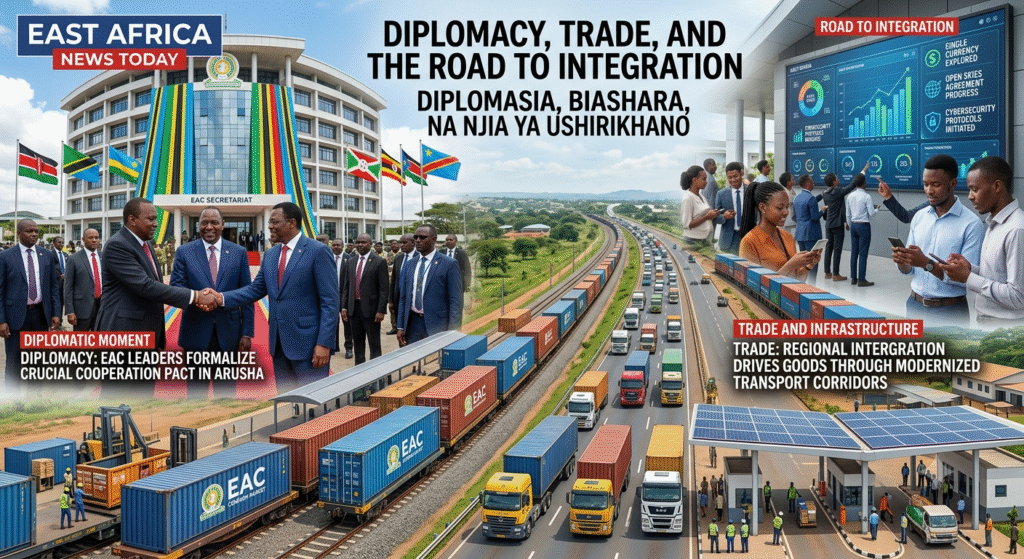
The news across East Africa today paints a picture of a region pushing forward with economic integration and infrastructure development, while simultaneously grappling with humanitarian challenges and the complex realities of a rapidly expanding regional bloc. From high-level bilateral diplomacy between Tanzania and Uganda to the unveiling of an ambitious regional budget, East Africa is making decisive moves, though the path forward remains challenging.
Museveni’s Tanzanian Visit Signals Deeper Integration
A major development today is the second official visit of Ugandan President Yoweri Museveni to Tanzania this year. Beginning August 5, the two-day working visit is focused on strengthening bilateral ties and accelerating joint infrastructure, transport, and energy projects.
The talks between President Museveni and Tanzanian President Samia Suluhu Hassan are expected to center on a range of key strategic issues, including trade and investment, transport and logistics, energy, tourism, defence and security, and regional integration. A significant outcome will be the signing of a Memorandum of Understanding on energy cooperation.
At the heart of these discussions is the progress on the East African Crude Oil Pipeline (EACOP). This mega-project, which will stretch 1,443 kilometers from Hoima in Uganda to Tanga in Tanzania, is now over 86% complete and is expected to be finished this month. The project has already created approximately 10,000 jobs, with 75% going to Tanzanians. This milestone represents a major step forward for the region’s energy infrastructure and economic ambitions.
The visit marks a shift from political goodwill to the implementation of large-scale economic projects, showcasing a deepening strategic partnership between two of the region’s most influential nations. The leaders will also review progress on other major undertakings, including a proposed natural gas pipeline, railway connections, and port expansions aimed at improving regional connectivity and lowering transport costs.
The EAC’s $110.9 Million Budget: A Blueprint for a “Seamless Digital Future”
In parallel with bilateral diplomacy, the East African Community (EAC) is advancing its broader integration agenda. A $110.9 million budget for the 2026/2027 financial year has been tabled, outlining a strategic vision for the bloc’s future.
The budget, themed “Deepening Commitment and Realising Objectives and Benefits of Regional Integration,” comes at a critical time. The EAC economy grew by 5.8% in 2025, outpacing both the global average and Sub-Saharan Africa. Intra-EAC trade expanded by 28% to $19.3 billion, reflecting growing regional interconnectivity.
A significant portion of the budget will be directed towards institutional capacity building ($70.5 million), trade facilitation and value chain development ($11.1 million), and social integration ($10.7 million). This financial framework supports the implementation of the new 7th EAC Development Strategy (2026/27–2030/31).
A core pillar of this vision is digital transformation, spearheaded by the Eastern Africa Regional Digital Integration Project (EARDIP). This project aims to create a seamless digital ecosystem by expanding broadband connectivity, developing regional roaming frameworks, and promoting interoperable digital payment platforms. Progress has also been recorded in harmonizing domestic taxes and aligning excise duty frameworks to remove trade inconsistencies within the Community. At the same time, the Community is working to eliminate the remaining 27 non-tariff barriers that continue to fragment the regional market.
Border Efficiency and Growing Pains
The EAC’s success hinges on translating high-level policy into tangible benefits at the ground level. Recent missions to the Sirari-Isebania (Tanzania-Kenya) and Busia (Kenya-Uganda) One Stop Border Posts (OSBPs) have confirmed that trade facilitation is improving. However, these missions also identified persistent challenges, including inadequate infrastructure, growing congestion, and inconsistent implementation of 24-hour border operations.
The EAC Secretary General has called for decisive action to eliminate these domestic administrative bottlenecks, which increase the cost of doing business and undermine regional competitiveness.
The Critical Crossroads of Integration and Humanitarian Pressures
As the EAC expands to include the Democratic Republic of Congo and Somalia, its growth brings both promise and complexity. It now has over 300 million people and stretches from the Indian Ocean to the Atlantic. This expansion demands that deeper integration keep pace with growing political and economic differences among member states, and that the benefits of a larger common market are felt by ordinary citizens and businesses. The region is at a pivotal moment, with its choices today set to determine whether it advances toward meaningful integration or becomes a loose association of neighbors.
Yet, against these ambitious economic steps, the region continues to face humanitarian crises. The UN Children’s Fund (UNICEF) has urgently appealed for funds to meet Ethiopia’s humanitarian needs, where only 22% of the required $401.5 million for its 2026 appeal has been secured. This funding gap is hampering life-saving assistance for children and families amid a complex crisis driven by conflict, climate shocks, and disease outbreaks. Meanwhile, Tanzania has announced a significant drop in fuel prices for August, offering some relief to motorists and businesses, though the decline is attributed to lower global oil prices despite continued conflict in the Middle East.
Conclusion
East Africa today is a region in motion, driven by high-level diplomacy, ambitious development projects, and a clear vision for economic integration. However, it also faces the complex task of making that vision a reality for its citizens. The decisions made on infrastructure, trade, security, and social welfare in the coming months will determine whether the EAC’s potential is fully realized or stymied by division and bureaucratic hurdles.
