

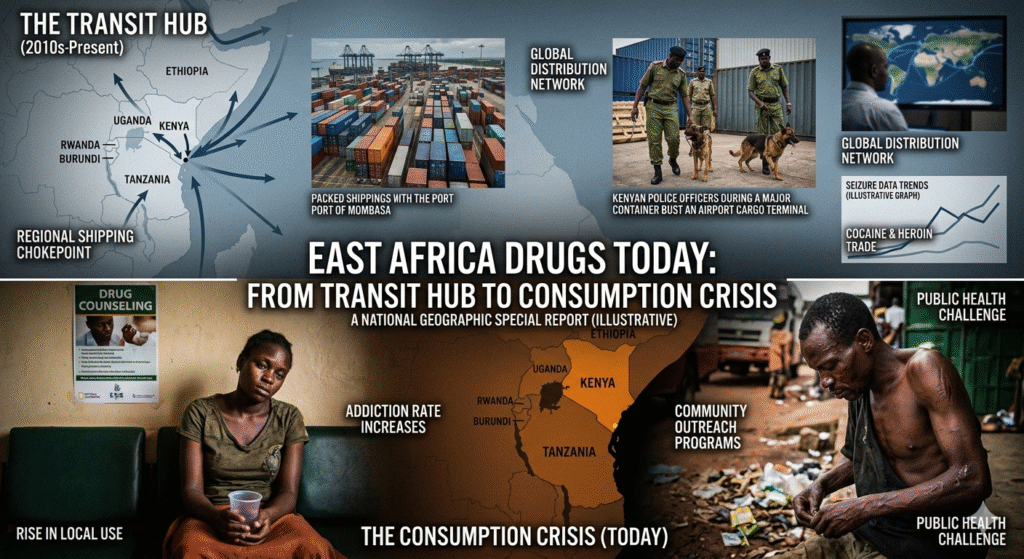
As dawn broke over the Indian Ocean on June 6, 2026, a Tanzanian courtroom heard testimony that laid bare the scale of East Africa’s escalating drug crisis. A container packed with narcotics had entered the country through established trade routes—exposing vulnerabilities in border security that traffickers are exploiting with increasing sophistication .
The case before the court is not an anomaly. From the ports of Mombasa and Dar es Salaam to the wastewater of Nairobi’s neighborhoods, evidence is mounting that East Africa has evolved from a mere transit point for global drug trafficking into a region grappling with local production, widespread consumption, and a public health emergency among its youth .
Part 1: The Shifting Role—Beyond Transit
For years, East Africa was viewed primarily as a corridor: a convenient stopover for heroin from Afghanistan and methamphetamine from the Middle East en route to European markets. That narrative is changing .
According to the Africa Organised Crime Index 2025, Africa has become “deeply embedded in the global criminal economy, serving as a source, transit hub and destination for various criminal markets” . East Africa, with its extensive Indian Ocean coastline and major ports in Mombasa, Dar es Salaam, and Berbera, sits at the heart of this transformation.
The so-called “Southern Route” has become increasingly important as eastern European governments crack down on traditional Balkan trafficking corridors. Traffickers now bring heroin and synthetic drugs through Indian Ocean ports in Kenya, Tanzania, Mozambique, and South Africa, leveraging weak enforcement and corruption to move massive quantities .
Kenya, East Africa’s leading transit and logistics hub, bears the brunt. Security experts describe the country as a “heaven of transnational crime,” citing widespread corruption that places political leaders and police on criminal payrolls .
Part 2: Record Seizures Reveal the Scale
The numbers emerging from law enforcement operations paint a stark picture of trafficking volumes.
In October 2025, the Kenyan Navy and Coast Guard made the largest drug bust in the country’s history. Intercepting a stateless vessel 630 kilometers off the coast, authorities seized 1,024 kilograms of methamphetamine valued at approximately Sh8.2 billion (over $70 million USD). Six Iranian nationals were arrested in the operation, which was based on intelligence shared by international partners .
Just months earlier, in April 2025, Kenyan authorities at Moi International Airport in Mombasa arrested a woman carrying 5.3 kilograms of heroin worth approximately $137,000. She had traveled to Kenya via a trafficking route connecting Southern Africa to East Africa .
The detection came during INTERPOL’s Operation Simba III (March 19–28, 2026), a coordinated border security initiative across Kenya, Tanzania, and Uganda. The operation saw some 4.6 million checks carried out against INTERPOL global databases, leading to the identification of seven individuals wanted under Red Notices for crimes including drug trafficking, fraud, and armed robbery .
Part 3: The Port of Mombasa—A Gateway for Illicit Trade
The Port of Mombasa, East Africa’s largest and busiest seaport, remains a critical vulnerability. Despite tighter surveillance, traffickers continue to exploit key gateways including Mombasa, Lamu Port, and Jomo Kenyatta International Airport (JKIA) .
The methods are increasingly sophisticated. Drug shipments are concealed within legitimate cargo containers, hidden in fishing vessels, and transported through yachts. Criminal networks have adapted faster than enforcement measures, exploiting high traffic volumes, advanced concealment tactics, and insider collusion .
A Tanzanian court recently heard detailed testimony about how a container filled with narcotics entered the country through trade routes, exposing inspection gaps. The case highlighted how traffickers use legitimate commercial channels to move illegal substances across borders .
The threat extends beyond maritime routes. In October 2025, The Standard’s investigative unit exposed a covert operation at JKIA designed to facilitate cocaine movement. Security footage suggested inside assistance after a passenger bypassed multiple security checks with 20 kilograms of cocaine, eventually arrested upon landing at London’s Heathrow Airport .
Part 4: The Wastewater Revelation—Kenya’s Silent Epidemic
On May 14, 2026, Kenya became the first country in East Africa to launch a comprehensive wastewater-based epidemiology study for drug control—a scientific breakthrough that has fundamentally changed understanding of the region’s drug crisis .
The study analyzed 152 wastewater samples from 12 hotspot counties, including Nairobi, Mombasa, Kisumu, Nakuru, Kiambu, and Garissa. Using advanced techniques such as Gas Chromatography-Mass Spectrometry (GC-MS) and UV-Vis Spectrophotometry, scientists detected traces of illicit drugs flowing through municipal sewer systems .
What they found was alarming.
Synthetic drugs and New Psychoactive Substances (NPS) are gaining a dangerous foothold. Detected substances included methamphetamine, MDMA (ecstasy), synthetic cathinones (“bath salts”), benzofurans, alpha-ethyltryptamine, psilocybin, and DMT. The findings pointed to possible clandestine laboratories involved in the local manufacture of synthetic stimulants .
“This study provides concrete evidence that synthetic drugs and new psychoactive substances are gaining a foothold in our communities,” said NACADA Chief Executive Officer Dr. Anthony Omerikwa. “We must move beyond traditional plant-based drug enforcement” .
Perhaps most concerning: Kenya can no longer be viewed merely as a transit route. The country is showing “increasing indicators of local manufacture and consumption of synthetic substances” .
Part 5: Deadly Adulterants and Poly-Drug Use
The wastewater study revealed a hidden danger beyond the drugs themselves: rampant adulteration.
Heroin samples were found mixed with caffeine, diazepam, chloroquine, and dextromethorphan. Cocaine samples contained levamisole (an animal dewormer) and ketamine—substances associated with severe toxicity and increased overdose risks .
Researchers also flagged increasing cases of poly-drug use, where users combine heroin with cannabis or mix alcohol with prescription sedatives such as Rohypnol. This combination dramatically increases health risks and complicates treatment approaches .
Part 6: The Youth Crisis—’Weed Cookies’ and Prescription Abuse
The study painted a disturbing picture of drug use among young Kenyans.
Cannabis edibles, particularly “weed cookies,” have emerged among young people—mirroring trends previously associated with Europe and North America. The report also highlighted rising abuse of prescription medication among students and young adults aged 13 to 25 years .
In Garissa County, local leaders report widespread abuse of bhang, cocaine, shisha, muguka, and miraa among youth. Bhang is often smuggled from Ethiopia to Nairobi before filtering into local markets .
East African Legislative Assembly MP Falhada Dekow condemned the destruction caused by drug abuse: “It is deeply regrettable to see a few individuals enrich themselves by destroying the lives of thousands of young people. Their actions are not only morally wrong but also unacceptable in the eyes of God” .
Part 7: The Social Toll—Crime, Violence, and Lost Potential
The consequences of drug abuse extend far beyond health.
According to former senator and community leaders in Garissa, drug abuse has significantly contributed to rising social challenges including insecurity, sexual violence, domestic abuse, and school dropouts .
The link between drugs and other crimes is well-established. Terrorist activity is often linked to drug trafficking networks, and Operation Simba III demonstrated this connection when Ugandan authorities seized approximately 25 kilograms of ammonium nitrate and other bomb-making materials at the Mutukula border point—chemicals moving through the same corridors used for narcotics .
Part 8: Regional Cooperation—Operation African Star 2
Recognizing that no single country can solve the crisis alone, East African nations have intensified collaborative efforts.
Operation African Star 2, conducted in July 2025, marked a major evolution in pharmaceutical supply chain security across Kenya and Uganda. The operation introduced the first traceability initiative of its kind in Africa—a technology-driven system enabling real-time scanning and verification of pharmaceutical products from entry point to point of sale .
The results were significant: 731 pharmaceutical products scanned across 27 locations, with a 99.9% successful scan rate for products containing GS1 Data Matrix codes. Of those scanned, 46 products (6%) were identified as falsified, substandard, unauthorized, or diverted. In total, enforcement authorities detected 48,000 illicit pharmaceutical units, including psychoactive substances .
The operation brought together over 15 international, regional, and national agencies, including the International Narcotics Control Board (INCB), INTERPOL, the OECD, and enforcement agencies from Kenya, Uganda, and the United States .
Part 9: U.S.-East Africa Cooperation—The Akasha Case
The involvement of international law enforcement has led to major breakthroughs. An indictment in U.S. District Court in Manhattan charged a suspected organized crime family in Kenya—the Akasha organization—with running a large-scale operation to transport heroin and meth from the Middle East through East Africa to U.S. ports .
The Akasha brothers, Ibrahim and Baktash, allegedly worked with associates from India and Pakistan to move massive quantities of narcotics. In recorded conversations with DEA confidential sources posing as Colombian drug traffickers, the organization discussed importing hundreds of kilograms of “100 percent white crystal” heroin into the United States, offering discounts for upfront payment .
The case illustrates the transnational nature of the threat and the challenges of international prosecution. Kenyan authorities arrested the suspects, but extradition to the United States required navigating complex diplomatic and legal processes .
Part 10: The Pharmaceutical Dimension—Prescription Drug Diversion
Beyond illicit narcotics, East Africa faces a growing crisis in pharmaceutical drug diversion.
The Pharmacy and Poisons Board of Kenya, in collaboration with the INCB, launched a three-day training workshop on May 6, 2026, focused on the Global Rapid Interdiction of Dangerous Substances (GRIDS) programme. The initiative aims to strengthen regulated supply chains and protect consumers against illicit drugs .
The workshop highlighted growing concerns over the illicit trade and trafficking of health products and technologies, emphasizing the need for stronger regional and international collaboration. Participants raised alarm about the diversion of legitimate pharmaceuticals into illegal markets—medicines that reach consumers without quality assurance, often containing dangerous adulterants .
Part 11: The Somali Connection—Garissa’s Struggle
Northeastern Kenya, bordering Somalia, faces unique challenges. Garissa county has been listed among counties affected by substance abuse by NACADA, with traffickers exploiting the porous Kenya-Somalia border .
Bhang is often smuggled from Ethiopia through Somalia into Kenya, creating a cross-border trafficking network that local law enforcement struggles to contain. The area’s vast, sparsely populated terrain provides ideal conditions for smuggling operations that would be more easily detected in urban centers .
Community leaders have called for youth empowerment through sports and economic opportunities as alternatives to the drug trade. The Falde Foundation recently sponsored an Eid Cup tournament in Garissa, using football to engage young people and steer them away from substance abuse .
Part 12: Technology as a Weapon—Traceability Systems
The fight against drug trafficking in East Africa is increasingly technology-driven.
The Pharmaceutical Traceability Pilot Programme, introduced under Operation African Star 2, utilizes the U.S. National Association of Boards of Pharmacy (NABP) Pulse platform combined with the INCB’s IONICS Suite. Pulse, based on GS1 global standards, enables real-time scanning and verification of serialized pharmaceutical products using a smartphone or bar-code reader .
When coupled with IONICS, this creates a powerful cross-border intelligence and enforcement ecosystem, enabling backtracking investigations to the sources of violations. By introducing U.S.-developed serialization and digital traceability capabilities, Kenya and Uganda are strengthening supply chains, strengthening borders, and protecting communities .
Part 13: The Path Forward—Early Warning and Public Health
The wastewater study has prompted urgent calls for a National Wastewater Drug Surveillance and Early Warning System to enable real-time monitoring of emerging drug trends in Kenya and eventually across the region .
NACADA’s recommendations include:
- Strengthening forensic and toxicology capacity
- Enhancing border and online drug trafficking surveillance
- Establishing an adulterant alert system
- Expanding naloxone distribution programs for overdose reversal
- Intensifying public awareness campaigns targeting youth and vulnerable populations
As Dr. Omerikwa noted, the evidence is now clear. East Africa can no longer rely on traditional plant-based drug enforcement approaches. The rise of synthetic drugs, local manufacturing, and dangerous adulterants requires a coordinated public health and law enforcement response .
Conclusion
East Africa today stands at a crossroads. The region that for decades served primarily as a transit corridor for other nations’ narcotics has become a destination—a place where drugs are consumed, where young lives are destroyed, and where criminal networks have embedded themselves deep within the fabric of society.
The Tanzanian court hearing testimony about a smuggled container. The wastewater scientists detecting methamphetamine in Nairobi’s sewers. The Kenyan mother watching her teenager spiral into prescription drug abuse. The community leader in Garissa burying another young person lost to overdose.
These are not isolated incidents. They are symptoms of a regional crisis that demands urgent, coordinated, and sustained action.
The tools exist: technology-driven traceability, international cooperation, wastewater surveillance, public health interventions. The will to use them is growing. But as one East African Legislative Assembly MP put it, all efforts will be in vain if there are individuals determined to profit from destroying the lives of young people .
The evidence is in the water, in the courts, and in the streets. The question now is whether East Africa will act before the crisis deepens further.
