

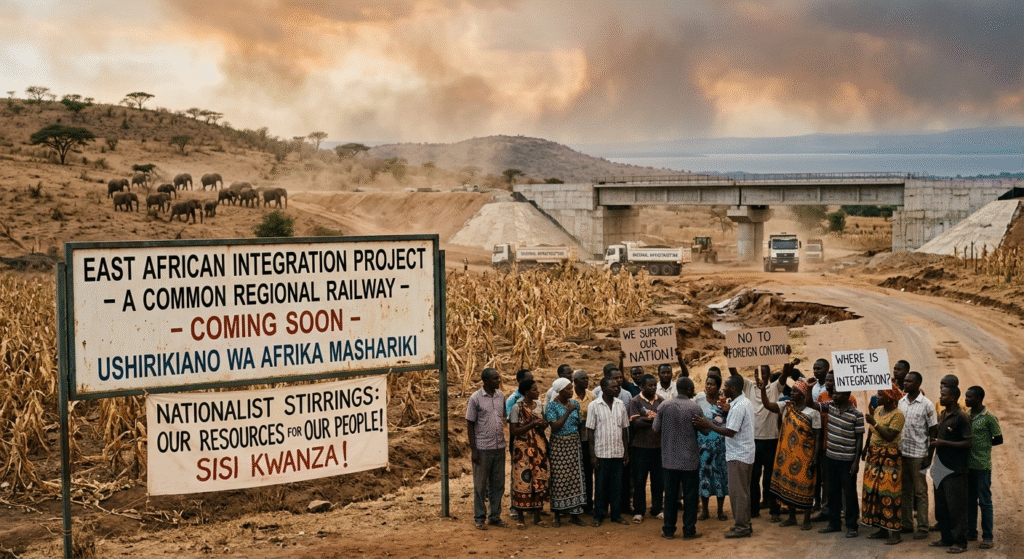
From Nairobi’s political turbulence to Karamoja’s hunger crisis, the region confronts converging pressures that threaten to unravel decades of progress
East Africa stands at a pivotal moment. The region that has long championed itself as Africa’s boldest experiment in supranational integration is now grappling with a constellation of interconnected crises—political, economic, and environmental—that are testing the very foundations of the East African Community. From the streets of Nairobi to the drought-stricken plains of northeastern Uganda, from the diplomatic corridors of Arusha to the flood-prone coast of Mombasa, the pressures bearing down on East Africa today are as diverse as they are daunting.
The Integration Project Under Siege
The most immediate challenge to regional cohesion comes from Kenya, where President William Ruto’s September 2 directive restricting foreign nationals from engaging in small-scale trading has triggered a diplomatic firestorm and raised profound questions about Nairobi’s commitment to the EAC Common Market Protocol .
The directive, which specifically targets hawking and small-scale retail, sent shockwaves through the region’s migrant communities. Dozens of Burundian traders gathered at their embassy in Nairobi seeking to regularize their immigration status or prepare for departure. Similar scenes played out at the Malaba border crossing with Uganda, as footage circulated showing large groups with luggage awaiting transport home .
The East Africa Law Society (EALS) issued a strongly worded statement from Arusha warning that “nationality should not, in itself, be treated as evidence of illegality” . The society invoked Articles 6, 7, 8, 76, and 104 of the Treaty for the Establishment of the East African Community, alongside the Common Market Protocol’s provisions on free movement, to argue that Kenya’s enforcement measures risked violating its treaty obligations .
Kenyan officials have since attempted to walk back the perception of a blanket ban. Prime Cabinet Secretary Musalia Mudavadi clarified that Kenya remains committed to regional integration and that the directive aims to “protect vulnerable economic sectors, promote fair market competition, and safeguard local livelihoods rather than drive out traders from neighboring countries” . He emphasized that foreign nationals with proper documentation remain entitled to live and work in Kenya and that enforcement would account for EAC obligations .
Yet the damage to confidence may already be done. As the Daily Monitor editorialized, the directive represents a “double whammy” for the EAC: it obstructs intra-community trade while threatening democratic norms in a country viewed as the region’s liberal beacon. “Protectionism and economic nationalism—both of which President Ruto’s September 2 directive are either wittingly or unwittingly promoting—are deeply intertwined with the global retreat of liberal democracy,” the editorial warned .
The timing is particularly unfortunate given parallel efforts to deepen integration. Tanzania has begun preparations for a nationwide public education campaign on the draft Constitution of the proposed EAC Political Confederation, the next major step in the community’s long-term integration agenda . Permanent Secretary Charles Kadonya emphasized the need for “transparency, accountability and meaningful public participation,” noting that a successful confederation would “strengthen the Community’s position in international forums” . The contrast between Arusha’s aspirational vision and Nairobi’s restrictive reality could hardly be starker.
Political Violence Casts Shadow Over Kenya
Kenya’s internal political landscape is itself contributing to regional uncertainty. Thousands turned out in Nairobi on Sunday for an opposition rally led by Nairobi Senator Edwin Sifuna, a rising political star who has emerged as one of President Ruto’s most prominent challengers ahead of the 2027 election .
The rally, organized by the Linda Mwananchi movement, proceeded calmly despite what Human Rights Watch described as a surge in political violence. HRW reported that six people have been killed and dozens more injured in attacks on civil society meetings and political gatherings in recent months, warning that “the spate of violence, as the pre-election period begins, threatens a return to the human rights abuses that have marred Kenya’s previous elections” .
Sifuna, 44, has built support by tapping into public anger over corruption and political violence, drawing roars of approval as his convoy moved through the capital. “Kenya is saying, Honorable Ruto, your time is up,” he told supporters. “They’re saying he should serve for one term” . His message appears to be resonating. Joshua Kebwago, a 32-year-old standing by the roadside hoping to glimpse the senator, said Sifuna was “here to uplift the poor, reduce taxes and the cost of living” .
President Ruto, for his part, has not shied away from confrontation. Speaking in Kisumu during his Nyanza tour, he dismissed the Linda Mwananchi movement’s housing proposals, calling its leaders “fools” and accusing them of having no plan for the country . The exchange underscores the increasingly combative tone of Kenyan politics as the 2027 election cycle begins in earnest—a development that bears watching for its potential to distract from regional integration efforts and destabilize East Africa’s largest economy.
Climate Extremes Test Resilience Across the Region
Beyond politics, East Africa is confronting a climate emergency that spares no border. The Kenya Meteorological Department has warned of a 58 to 61 percent probability of El Niño conditions dominating between June and December, potentially enhancing the October-December short rains and increasing flood risks in vulnerable areas .
In Mombasa, Governor Abdulswamad Nassir has put county and national agencies on high alert, warning of “one of the largest rainfall events in quantity within Mombasa and Kenya in general” . The governor cited a 98 percent probability of significantly above-average rainfall, with accumulations potentially reaching 680 millimeters. He warned that humidity levels would be higher than normal and weather changes more rapid and intense than usual .
The county has identified social halls for use as rescue centers and is mapping bottleneck areas where floodwater is expected to collect. Nassir flagged stalled storm water drainage projects as a major vulnerability, noting that public works crews have devised temporary fixes while permanent solutions remain incomplete .
Further inland, Murang’a County has stepped up preparations for the expected enhanced short rains, with a multi-agency team putting in place measures to minimize the risk of floods and landslides. County Commissioner Hassan Bule called for enhanced communication and early warning systems, particularly for residents in landslide-prone areas. The Kenya Red Cross has identified evacuation centers in Kangema and Mathioya sub-counties, considered particularly vulnerable .
Hunger and Displacement in Uganda’s Karamoja
The human cost of climate disruption is most starkly visible in Uganda’s Karamoja region, where child malnutrition has risen sharply due to El Niño-related dry spells. New figures from the Integrated Food Security Phase Classification show the number of acutely malnourished children has risen from 122,100 to 154,200 since June—an increase of 32,100 children now requiring malnutrition support. This includes an estimated 38,800 children suffering or expected to suffer from severe acute malnutrition, the worst form of malnutrition requiring urgent medical attention .
The figures paint a picture of rapidly deteriorating food security. The number of people facing emergency food insecurity conditions has nearly tripled, with households exhausting resources, skipping multiple meals, or running out of food entirely. General food insecurity has worsened dramatically in just a few months, with those facing crisis or emergency situations rising by more than 40 percent .
“Our teams in Karamoja are seeing the impact of this crisis every day,” said Martha Ddambya, Save the Children’s Acting Country Director in Uganda. “Families tell us they have less food to put on the table, harvests have been poor, and more children are arriving at health facilities malnourished and in need of urgent support” .
The Karamoja region, home to about 1.6 million people, has a long history of severe droughts and deadly famines. A devastating famine in 1980 caused up to 50,000 deaths, killing about 21 percent of the population. Decades later, climate change, poor infrastructure, and ongoing insecurity continue to push hundreds of thousands into critical food crises .
Uganda’s Search for Alternative Financing
Even as Uganda grapples with humanitarian emergencies, its government is confronting a longer-term challenge: declining official development assistance and the need to mobilize domestic capital for its development ambitions. State Minister for Finance and Planning Amos Lugoloobi told a gathering in Kampala that the country could no longer rely heavily on external assistance. “ODA assistance is declining dramatically,” he said. “We have to find alternative sources of financing if we are to survive at all” .
Uganda’s Tenfold Growth Strategy targets an economy worth $500 billion by 2040, requiring capital mobilization on a scale that government spending and commercial bank lending alone cannot meet. Lugoloobi pointed to encouraging signs: assets under management in collective investment schemes had risen to more than Shs7.1 trillion by June 2026, a 54.5 percent increase from the previous year, with more than 241,000 funded accounts participating .
The minister called for stronger capital markets, including corporate debt markets and long-term financing instruments capable of supporting businesses, infrastructure, and innovation. “Mobilising more money is not enough,” he said. “The financial system must allocate it prudently and productively” .
A Region at a Tipping Point
East Africa’s challenges are not isolated incidents but interconnected symptoms of a region navigating multiple transitions simultaneously. The push for deeper political integration coexists uneasily with rising economic nationalism. Climate shocks cascade across borders, displacing populations and straining humanitarian systems. Political competition intensifies even as the institutional foundations of regional cooperation face unprecedented tests.
The decisions made in the coming months—by Kenya’s leadership, by EAC institutions, by international partners—will determine whether East Africa can sustain its integration momentum or whether the centrifugal forces of nationalism and crisis will prevail. For the families of Karamoja, the traders of Nairobi, and the flood-prone communities of Mombasa, the stakes could not be higher.
