

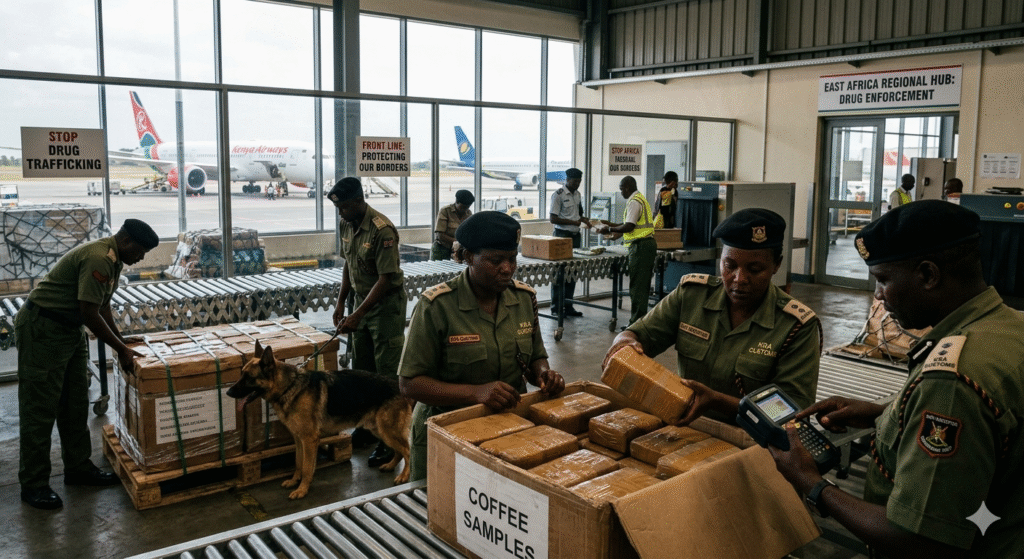
At cargo terminals and passenger checkpoints across East Africa, a silent war is being waged. Every package that arrives, every suitcase that departs, every traveler who passes through—all are subject to scrutiny in an increasingly sophisticated battle against transnational drug trafficking.
In just the past six weeks, authorities across the region have seized narcotics worth millions of dollars, arrested foreign nationals attempting to transit through the region, and uncovered elaborate concealment methods ranging from storybooks to coffee packs. The numbers tell a compelling story: East Africa has become a critical transit point in the global drug trade, and its airports are the frontline.
Here is an in-depth look at how East African airports are checking drugs, the major seizures that have made headlines, and the evolving tactics of traffickers and the authorities pursuing them.
Part 1: The Scale of the Challenge
East Africa’s strategic location has made it an attractive transit corridor for drug traffickers operating between source countries in South America and Asia and destination markets in Europe, North America, and the Middle East. Major international airports in Nairobi (JKIA), Addis Ababa (Bole), Entebbe, Dar es Salaam, and Kigali serve as regional hubs, processing millions of passengers and tons of cargo annually.
The challenge is immense. According to Kenyan police statistics, the quantity of dangerous drugs seized dropped by 41.2 percent to 15,791 kilograms in 2025 from 26,858 kilograms in 2024 . While this decline might appear encouraging, authorities caution that it could reflect traffickers adapting their methods rather than a reduction in overall trafficking volume.
The numbers that do emerge through successful interdictions paint a disturbing picture of the scale of the problem.
Part 2: Nairobi’s JKIA—A Hub of Seizures
Jomo Kenyatta International Airport (JKIA) in Nairobi has emerged as ground zero for anti-narcotics operations in the region. In recent weeks alone, a series of major interceptions have demonstrated both the persistence of traffickers and the growing effectiveness of law enforcement.
The Methamphetamine Pipeline to the Philippines
On May 6, 2026, the Anti-Narcotics Unit (ANU) at JKIA intercepted a consignment of methamphetamine valued at Sh10.56 million . The parcel, destined for Las Piñas in the Philippines, had been deceptively declared as containing handmade bags and clothes. A thorough inspection revealed a concealed stash of white crystalline substances hidden inside two handbags and wrapped in clear packaging. Preliminary field tests confirmed approximately 1,320 grams of methamphetamine .
This seizure was not an isolated incident. Just days earlier, on April 27, 2026, ANU officers at the DHL cargo shed intercepted two separate consignments. The first, originating from Dar es Salaam, Tanzania, and also destined for the Philippines, had been declared as car piston samples. Inside, officers discovered 1,730 grams of methamphetamine valued at Sh13.84 million. The second shipment, from Juja Sub-County in Kiambu County, was declared as handbags but contained 1,020 grams of methamphetamine hidden in false compartments, worth an additional Sh8.16 million .
In total, within a span of just ten days, JKIA authorities seized methamphetamine shipments worth more than Sh32 million destined for a single destination—the Philippines.
The Canada-to-Nairobi Connection
On April 30, 2026, officers conducting routine verification at the FedEx inbound warehouse cargo shed flagged a parcel shipped from Canada to Utawala, Nairobi. The parcel was declared as containing “design relaxed flare jean fit” —clothing. However, upon inspection, officers found a greenish plant material concealed in a clear polythene bag. Preliminary testing identified the substance as cannabis, weighing approximately 6,050 grams with an estimated street value of Sh1.8 million .
The seizure raised eyebrows among investigators, who noted that narcotics are typically sent from Nairobi to Canada and other parts of the world, not the reverse . Investigations were launched to identify both the sender and intended recipient.
Cocaine in Storybooks
Two weeks prior to the cannabis seizure, a multi-agency team at JKIA had seized 700 grams of cocaine valued at Sh2.8 million destined for Saudi Arabia. The consignment originated from Busia and was concealed inside four children’s storybooks .
Part 3: Addis Ababa’s Bole International Airport—Ethiopia’s Vigilant Watch
Ethiopia’s Addis Ababa Bole International Airport has become an increasingly important hub for global air travel, and with that status comes heightened vulnerability to drug trafficking. The National Intelligence and Security Service (NISS) has responded with aggressive counter-narcotics operations.
The Ugandan Transit Passenger
On March 19, 2026, NISS aviation security experts apprehended a Ugandan national, Stella Mukisa, who was attempting to transit through Bole Airport with 500 grams of cocaine. Mukisa was traveling from Lilongwe, Malawi, to Manila, Philippines, when advanced detection technology flagged her luggage .
The operation demonstrated the effectiveness of recent institutional reforms at NISS. According to the agency, the successful detection resulted from “the integration of cutting-edge technology, specialized human resource capacity building, and the implementation of transparent operational protocols” .
Khat Interceptions and Cocaine Hauls
In related operations conducted over consecutive days, NISS experts intercepted 86 kilograms of dried khat en route from London to Kenya via Addis Ababa, and an additional 17.5 kilograms of khat on a flight originating from Milan, Italy, destined for Kinshasa, Democratic Republic of Congo .
Earlier that same week, NISS had seized over 4 kilograms of cocaine at Bole Airport, underscoring the sustained intensity of trafficking attempts through the Ethiopian hub .
The NISS has made its position clear: “Bole International Airport remains a hostile environment for international trafficking and illegal transit activities” .
Part 4: Mombasa’s Moi International Airport—The Southern Route
Kenya’s coastal gateway has also proven to be a key interception point. During INTERPOL’s Operation Simba III (March 19-28, 2026), a coordinated border security initiative across Kenya, Tanzania, and Uganda, authorities at Moi International Airport in Mombasa arrested a woman found carrying 5.3 kilograms of heroin worth approximately USD 137,000 .
The woman had traveled to Kenya via what authorities described as “an alleged drug trafficking route from Southern Africa to East Africa” . The operation, which saw approximately 4.6 million checks carried out against INTERPOL global databases, also detected seven individuals wanted internationally under Red Notices for crimes including drug trafficking, fraud, murder, and armed robbery .
Part 5: Body Packers and Internal Concealment
Not all drug trafficking attempts involve cargo shipments. Passenger screening has uncovered increasingly desperate methods of concealment, with traffickers swallowing or internally hiding narcotics to evade detection.
The 62-Year-Old Businessman
On January 31, 2026, operatives of Nigeria’s National Drug Law Enforcement Agency (NDLEA) at Mallam Aminu Kano International Airport arrested Nwabueze Izueke, a 62-year-old Lagos-based businessman . Izueke was preparing to board Ethiopian Airlines flight ET940 to China via Addis Ababa when NDLEA officials flagged him for screening.
A body scan confirmed the presence of illicit drugs in his system. Under observation, Izueke expelled a total of 95 jumbo-sized pellets of cocaine weighing 1.589 kilograms in seven excretions .
In his statement to investigators, Izueke claimed he had resorted to drug trafficking “to raise enough money to complete the country home he’s building in his village, Iwollo, Enugu State” . The case highlights the economic desperation that drives some individuals into the role of “drug mules.”
The Brazilian National in Abuja
On January 23, 2026, NDLEA operatives at Abuja’s Nnamdi Azikiwe International Airport arrested Ingrid Rosa Benevides, a 30-year-old Brazilian woman working as a private security officer . Benevides arrived on a Qatar Airways flight from Brazil with two checked bags containing 21 factory-sealed packets of Brazilian coffee.
When the coffee packs were opened, authorities found not coffee but 30.09 kilograms of white heroin—the single largest heroin seizure at the Abuja airport, valued at over N3 billion (approximately $2 million USD) .
Part 6: International Cooperation—INTERPOL and Beyond
The fight against airport drug trafficking in East Africa is increasingly a collaborative effort. Operation Simba III, conducted in March 2026, exemplifies this approach. The operation brought together frontline officers from Kenya, Tanzania, and Uganda, enhancing their ability to detect suspicious travelers at air, land, and sea border crossings .
The operation’s results were significant:
- 4.6 million border checks conducted against INTERPOL databases
- Seven Red Notice subjects detected for crimes including drug trafficking, fraud, and armed robbery
- One individual wanted for terrorism links identified
- One individual sought by the International Criminal Court for crimes against humanity detected
The operation also led Ugandan authorities at the Mutukula border point to seize approximately 25 kilograms of ammonium nitrate and other materials used by terrorists to manufacture improvised explosive devices—highlighting the intersection between drug trafficking and other forms of transnational crime .
Part 7: Concealment Methods—The Cat-and-Mouse Game
As detection methods have improved, traffickers have grown increasingly creative in their concealment techniques. Recent seizures in East Africa reveal a catalog of deception:
False Compartments: In the April 27 JKIA seizure, methamphetamine was hidden in false compartments inside handbags, requiring thorough physical examination to detect .
Product Substitution: The Brazilian national in Abuja replaced coffee contents with heroin while maintaining factory-sealed packaging to avoid suspicion .
Internal Concealment: The 62-year-old Nigerian swallowed 95 cocaine pellets, a method known as “body packing” that carries significant health risks .
Disguised Shipments: Parcels declared as car piston samples, handbags, and clothing have all been used as covers for drug shipments .
Literary Concealment: Cocaine hidden inside children’s storybooks bound for Saudi Arabia .
The sophistication of these methods underscores the need for advanced detection technology and highly trained personnel. As one police statement noted, traffickers “continue to employ concealment tactics and false declarations to evade detection, particularly in international cargo shipments” .
Part 8: The Philippine Connection
One of the most striking patterns emerging from recent seizures is the frequency of shipments destined for the Philippines. Multiple interceptions at JKIA in April and May 2026—methamphetamine shipments valued at over Sh32 million—were all bound for various Philippine destinations .
This pattern suggests well-established trafficking routes connecting East Africa to Asian drug markets. Investigators are working to identify the networks behind these shipments, but the anonymity of cargo shipping makes this challenging.
Similarly, the Ugandan national arrested in Addis Ababa was transiting from Malawi to Manila—another Philippine destination—with 500 grams of cocaine .
Part 9: Multi-Agency Operations—A Model for Success
The most successful interdictions in East Africa have been those involving multiple agencies working in coordination. At JKIA, operations typically involve the Anti-Narcotics Unit (ANU), Kenya Airports Police Unit, the Directorate of Criminal Investigations (DCI), and other stakeholders .
This multi-agency approach offers several advantages:
- Information sharing across different intelligence streams
- Specialized expertise from different agencies
- Resource pooling for more effective operations
- Reduced corruption risk through cross-agency oversight
In Ethiopia, the NISS works in partnership with the Ethiopian Federal Police Commission’s Narcotics Control and Investigation Department, which takes over cases for further examination and prosecution .
Part 10: The Role of Technology
Advanced detection technology has been a game-changer in airport anti-narcotics operations. In Ethiopia, NISS attributes much of its success to “the integration of cutting-edge technology” alongside human capacity building .
Body scanners have proven essential for detecting internal concealment, as demonstrated in the Kano airport arrest where a scan confirmed cocaine pellets inside the suspect’s body .
Cargo screening technology allows authorities to inspect shipments without opening every package, flagging anomalies that warrant closer examination. However, as the JKIA seizures demonstrate, thorough physical inspection remains necessary when technology raises suspicions.
Part 11: Challenges and Vulnerabilities
Despite significant successes, East African airports face substantial challenges in the fight against drug trafficking.
Resource Constraints: Anti-narcotics units operate with limited personnel, equipment, and funding relative to the scale of trafficking attempts.
Corruption Risks: Airport personnel, cargo handlers, and even law enforcement officers can be vulnerable to bribery by trafficking networks.
The Transit Problem: Passengers merely transiting through East African airports are subject to less scrutiny than those entering or departing, creating a vulnerability that traffickers exploit.
Cargo Volume: The sheer volume of cargo passing through regional hubs makes comprehensive inspection impossible, requiring intelligence-led targeting.
Regional Disparities: Varying levels of enforcement capability across different countries create weak points that traffickers exploit.
Part 12: Success Stories and Trends
Despite these challenges, there are encouraging signs. The series of major seizures at JKIA in April and May 2026 suggests that Kenyan authorities have successfully identified and are targeting the Philippines trafficking route .
In Ethiopia, the NISS has demonstrated that institutional reform can yield tangible results. The agency’s aviation security directorate has undergone “comprehensive institutional reforms” that have transformed its capabilities .
The decline in total drug seizures from 26,858 kilograms in 2024 to 15,791 kilograms in 2025 could reflect successful deterrence—or could indicate a shift in trafficking methods . Authorities are treating it as motivation to intensify efforts rather than relax vigilance.
Part 13: Looking Ahead
As East Africa continues to develop as a global transit hub, the challenge of airport drug checking will only intensify. Several factors will shape the future of anti-narcotics operations in the region:
INTERPOL and International Partnerships: Continued cooperation with global law enforcement bodies will remain essential, particularly for tracking transnational trafficking networks .
Technology Investment: Maintaining technological parity with traffickers’ evolving concealment methods requires ongoing investment in detection equipment.
Regional Harmonization: Closer coordination among East African nations—Kenya, Tanzania, Uganda, Ethiopia, Rwanda, and others—could close gaps that traffickers currently exploit.
Prosecution and Deterrence: Seizures alone do not dismantle trafficking networks. Successful prosecutions that reach up the chain of command are essential for long-term impact.
Public Awareness: Educating travelers about the consequences of drug trafficking—and the tactics traffickers use to recruit unwitting couriers—could reduce the flow of “mules.”
Conclusion
East African airports are on the front lines of a global battle against drug trafficking. In just the first five months of 2026, authorities in Kenya, Ethiopia, Nigeria (as a connecting hub), and the wider region have seized millions of dollars worth of narcotics, arrested traffickers from multiple countries, and disrupted trafficking routes spanning three continents.
The successes are significant. Methamphetamine shipments destined for the Philippines have been intercepted. Cocaine transiting from South America to Europe has been seized. Heroin concealed in coffee packs and cocaine swallowed in pellets has been detected. Body scanners, intelligence-led operations, and multi-agency coordination have all proven their worth.
But the war is far from over. Traffickers adapt. Routes shift. Concealment methods evolve. The same volume of narcotics that was seized represents only a fraction of what gets through.
For the men and women working the cargo sheds, passenger checkpoints, and screening lines of East African airports, the work continues. Each parcel checked, each traveler screened, each anomaly investigated is another chance to intercept a shipment that might otherwise fuel addiction, violence, and organized crime halfway across the world.
As one INTERPOL official noted, the goal is to make East African borders “a hostile environment for international trafficking and illegal transit activities.” The seizures of recent weeks suggest that goal is slowly being realized—one package at a time.