

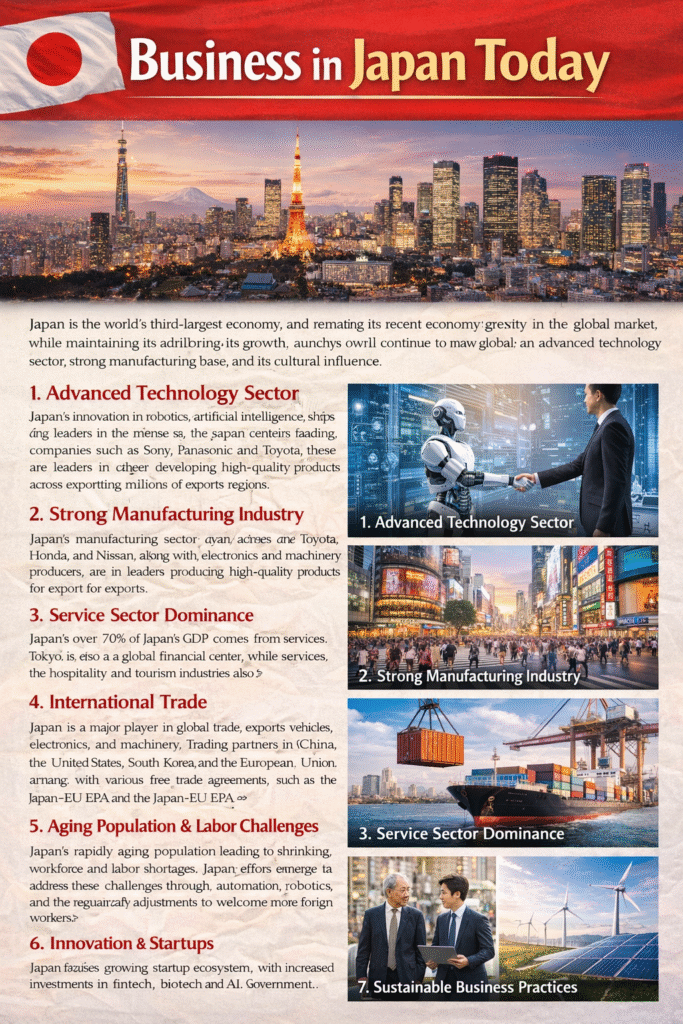
Japan remains one of the world’s largest and most advanced economies. Known for its technological excellence, strong corporate culture, and global brands, Japan’s business environment today reflects a balance between tradition and transformation. While the country faces economic and demographic challenges, it continues to adapt through innovation, reform, and international engagement.
Economic Overview
Japan has a highly developed, market-based economy and consistently ranks among the top global economies by GDP. In recent years, economic policy has focused on maintaining stability, encouraging moderate growth, and addressing long-standing issues such as deflation and slow domestic demand. Government stimulus measures, low interest rates, and structural reforms have supported business activity, especially during periods of global uncertainty.
Corporate Structure and Business Culture
Japanese business culture is shaped by values such as loyalty, long-term planning, teamwork, and respect for hierarchy. Large corporations, often organized within keiretsu networks, continue to play a major role in the economy. These interconnected business groups allow companies to share resources, reduce risk, and maintain stable relationships with suppliers and financial institutions. At the same time, there is a gradual shift toward more flexible and globally oriented management practices.
Technology and Innovation
Technology remains a core strength of Japanese business. Companies in sectors such as robotics, electronics, automotive engineering, and precision manufacturing lead global markets. Japan is also investing heavily in emerging technologies such as artificial intelligence, semiconductors, renewable energy systems, and advanced materials. Collaboration between government, industry, and research institutions supports innovation and helps companies remain competitive.
Manufacturing and Industrial Base
Japan’s manufacturing sector is known for high quality, efficiency, and continuous improvement, often guided by principles such as kaizen and just-in-time production. Automobiles, machinery, electronics, and chemicals are among the country’s key industrial outputs. Despite rising competition from other Asian economies, Japanese manufacturers maintain a strong reputation for reliability and technological sophistication.
Small and Medium-Sized Enterprises (SMEs)
Small and medium-sized enterprises form the backbone of Japan’s economy, accounting for a large share of employment and regional economic activity. Many SMEs are family-owned and specialize in niche products or highly skilled craftsmanship. However, these businesses face challenges such as labor shortages, succession issues, and limited digital adoption. Government support programs and digital transformation initiatives aim to strengthen SME competitiveness.
Global Trade and Investment
Japan is a major global trading nation and a key participant in international supply chains. It exports high-value manufactured goods and imports raw materials, energy resources, and food. Japanese companies are also significant overseas investors, with strong business presence in Asia, North America, and Europe. Trade agreements and economic partnerships play an important role in maintaining Japan’s global business influence.
Digital Transformation
Digital transformation has become a national priority for Japan. While traditionally slower to adopt digital systems, both the public and private sectors are now accelerating efforts to modernize. Businesses are investing in cloud computing, data analytics, cashless payments, and automation to improve efficiency and productivity. Digital reform is seen as essential to maintaining competitiveness in a rapidly changing global economy.
Labor Market and Workforce Challenges
Japan’s aging population and low birth rate present significant challenges for businesses. Labor shortages have increased competition for skilled workers and pushed companies to rethink employment practices. Measures such as increased participation of women, elderly workers, and foreign talent are becoming more common. Automation and robotics also play a critical role in addressing workforce constraints.
Sustainability and Green Business
Sustainability is gaining importance in Japanese business strategy. Companies are investing in renewable energy, energy-efficient technologies, and environmentally friendly production methods. Government policies encourage carbon reduction and sustainable development, while consumers increasingly value corporate responsibility and ethical business practices.
Startups and Entrepreneurship
Japan’s startup ecosystem is growing, particularly in technology, healthcare, fintech, and green innovation. Although entrepreneurship has traditionally been less prominent than in some other economies, improved access to funding, incubators, and global networks is encouraging new business creation. Startups are seen as an important driver of future economic growth.
Challenges Facing Businesses
Despite its strengths, Japan faces ongoing challenges, including slow economic growth, public debt, demographic decline, and increasing global competition. Businesses must also navigate regulatory complexity and adapt to shifting consumer behavior. Addressing these challenges requires flexibility, innovation, and strategic reform.
Conclusion
Business in Japan today is characterized by resilience and adaptation. While rooted in strong traditions and established industries, Japanese businesses are increasingly embracing digital transformation, sustainability, and global collaboration. By balancing innovation with stability, Japan continues to maintain its position as a major force in the global business landscape.