

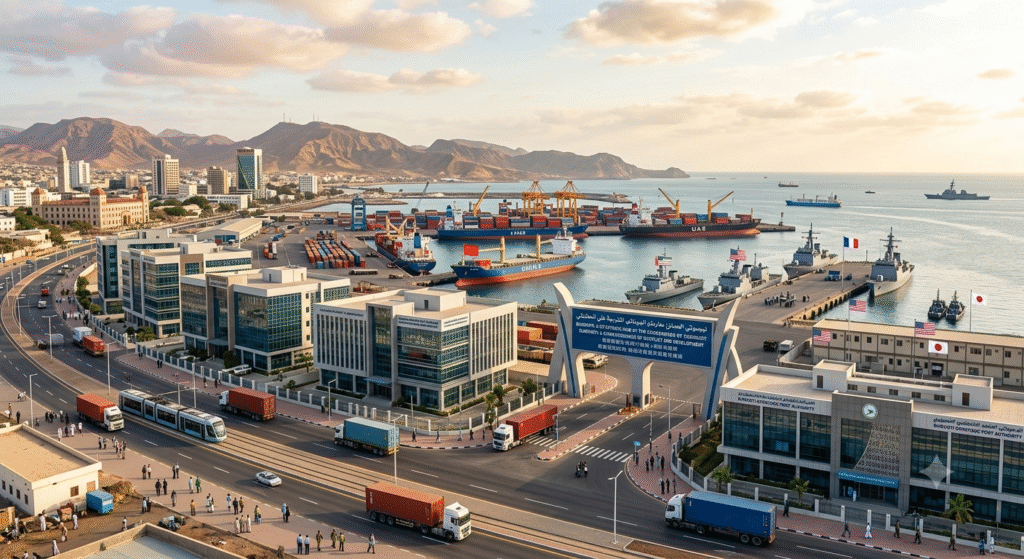
As of August 2026, Djibouti finds itself navigating an increasingly complex geopolitical environment. The small Horn of Africa nation, long celebrated for its ability to balance the competing interests of global powers, is facing unprecedented pressure from the escalating conflicts in the Red Sea and the Middle East. While its economy continues to grow, driven by port activities and the Djibouti International Free Trade Zone, the country’s carefully cultivated neutrality is being tested as it deepens its security alignments .
💥 Red Sea Tensions and Shifting Alliances
The expanding Middle East war has reached Djibouti’s shores, transforming the Red Sea from a commercial corridor into a militarised theatre . With the Bab el-Mandeb Strait becoming a frontline between Houthi forces and a Saudi-led maritime coalition, Djibouti is no longer a neutral bystander.
A Muted Military Incident:
The Djibouti Amiraute, a US military installation, reported an incident on August 9 when a US military aircraft crashed near its airport. Initial investigations by US Africa Command suggested no evidence of external interference, but the incident highlights the risks faced by the numerous foreign forces stationed in the country .
A Coalition and a Base:
More significantly, reports have confirmed Djibouti’s participation in the Saudi-led multinational maritime coalition established to protect navigation in the Red Sea . This represents a concrete evolution of its regional posture, placing it within the broader strategic architecture opposing the Houthis.
In a further sign of deepening ties, Djibouti’s Defence Minister has publicly welcomed a Saudi military presence. “There are historical, ideological and cultural relations with the Kingdom,” stated Ali Bahdon, noting that Saudi experts had arrived to assess military cooperation .
🛡️ Counter-Terrorism and Regional Security
Beyond the Red Sea, Djibouti remains a key player in regional security operations. The country is a major contributor to the African Union Support and Stabilization Mission in Somalia (AUSSOM). In early August, President Hassan Sheikh Mohamud of Somalia received Djibouti’s Army Chief, General Zakaria Sheikh Ibrahim, to bolster security coordination and reaffirm ties, highlighting the importance of Djibouti’s troops in operations against Al-Shabaab in southern Somalia .
Internal Threats:
The government is also dealing with an internal security threat. On August 14, the Djiboutian defence ministry announced a drone attack against the Armed Front for the Restoration of Unity and Democracy (FRUD A), a rebel group operating near the Ethiopian border. The government reported eight “terrorists” were neutralised, though “collateral damage was unfortunately reported among Djiboutian civilians” .
🏗️ Economic Resilience and Diplomatic Manoeuvring
Despite the regional turbulence, Djibouti’s economy remains a bright spot. The African Development Bank estimated real GDP growth at 6.7% in 2025, driven by its strategic role in regional trade .
The Free Trade Zone Engine:
The Djibouti International Free Trade Zone (DIFTZ), the largest in Africa, has had a strong start to 2026. In Q1 alone, land sales exceeded 110,000 square metres, and a total of 513 enterprises have now established operations, representing a 22% increase year-on-year. The zone has created 3,000 direct jobs, solidifying its role as a key engine for the country’s diversification and its position as the primary maritime gateway for Ethiopia .
Infrastructure Upgrades:
The World Bank approved an additional $45 million to modernise the Djibouti-Addis Ababa economic corridor, bringing its total commitment to $205 million. The funding will target high-accident road sections and improve resilience to climate-related disruptions, ensuring the smooth flow of trade for landlocked Ethiopia .
A New Maritime Partner:
In a move that broadens its security partnerships, Djibouti signed a Status of Forces Agreement with the European Union in July. This provides a legal framework for the deployment of EUNAVFOR ASPIDES, the EU’s naval operation tasked with protecting commercial shipping in the Red Sea .
🤝 Conclusion
Djibouti today is a nation in transition. Its economic strategy of leveraging its geographic position to become a trade and logistics hub is paying dividends, with the free trade zone booming and infrastructure projects advancing . However, the geopolitical foundation that enabled this prosperity—its strategic neutrality—is under strain. By joining the Saudi-led coalition and engaging with the EU’s naval mission , Djibouti is no longer simply a platform for others but an active participant in a volatile region. As the war in the Middle East continues to unfold, the question remains whether Djibouti’s economic and strategic gains will be overshadowed by the security risks of its deepening involvement in the regional conflict.