

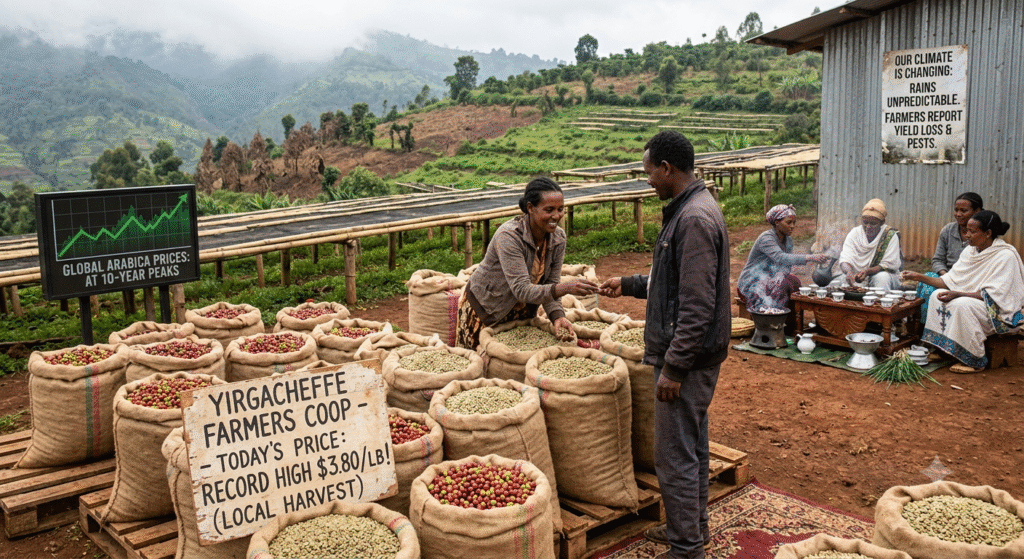
East Africa’s coffee sector is a story of stark contrasts in August 2026. On one hand, the region is experiencing record-breaking auction prices and strong international demand for its premium beans. On the other, a volatile climate, rising costs, and the structural vulnerabilities of smallholder farmers pose significant threats to the industry’s long-term sustainability.
Market Strength and Record Prices
The Nairobi Coffee Exchange delivered a resounding vote of confidence in Kenyan coffee this week, with strong auction performance underlining sustained international demand . The sale of 18,089 bags, weighing over 1.1 million kilogrammes, netted Ksh 994 million .
Premium grades led the charge. Grade AA coffee, the highest quality, saw 1,738 bags sold for Ksh 107.8 million, with top lots fetching up to USD 410 per 50kg bag . The highest price of the auction came from the Ngugu-ini Factory in Kirinyaga County, whose AA sold at Ksh 53,041 per bag. This was closely followed by coffee from the Muisuni Farmers’ Co-operative Society in Machakos County, demonstrating that well-managed coffee from lower-altitude regions can compete with traditional high-altitude producers .
Harvest Realities and Challenges Across the Region
The strong auction performance is set against a mixed harvest picture across East Africa. In Rwanda, the harvest is nearly complete but production is expected to be around 35% lower than last year, driven by poor flowering and a reduction in government fertilizer subsidies . This scarcity has pushed cherry prices higher. Meanwhile, Uganda’s main Robusta harvest is running 4-6 weeks later than usual due to frequent rainfall delaying cherry ripening, tightening near-term supply, though volumes are expected to be broadly stable at around 3.9 million bags .
In Tanzania, the harvest is beginning to ramp up, with both Arabica and Robusta volumes looking slightly higher than last year thanks to favourable weather and new plantations coming into production . The country is also benefiting from a new dedicated mill in Mbinga, which enables more direct sourcing and quality control .
The Climate Challenge and the Push for Resilience
The strong market is a bright spot, but it exists alongside a growing climate threat. A new report from UNIDO’s ACT Coffee Programme and TechnoServe found that all ten of the world’s major coffee-producing countries face growing exposure to climate stress . While East African producers in Ethiopia, Kenya, Uganda, and Tanzania are less exposed to the worst climate projections than their counterparts in Latin America, their farmers tend to work on very small plots with limited resources, making even modest shocks difficult to absorb .
This vulnerability is compounded by forecasts of a potentially historic ‘super’ El Niño, which is expected to bring erratic rainfall and flooding to the region, threatening yields and quality . The industry is responding through initiatives like the ACT Coffee Programme, which aims to strengthen climate resilience and enhance local value creation across the value chain . As the TechnoServe report emphasizes, making coffee farming more productive and profitable is itself one of the most powerful buffers against climate risk—resilience and economic sustainability go hand in hand .
Beyond the Bean: Cultural and Market Development
The region is also working to strengthen its coffee sector beyond production and trade. In Ethiopia, the birthplace of coffee, a recent festival in Addis Ababa called “Coffee for Peace” showcased the rich cultural heritage of the coffee ceremony. Organizers are now pushing for Parliament to declare a National Coffee Culture Day and are working on a nomination to UNESCO’s Intangible Cultural Heritage list . The motivation is not just cultural pride; coffee exports earned Ethiopia about $1.5 billion last fiscal year, and branding the ceremony abroad could lift premiums for specialty beans and attract tourists .
In Kenya, efforts are also focused on market expansion and farmer education. The government is stepping up efforts to secure new markets and promote value addition . Upcoming events like the East Africa Coffee Markets and Conference aim to connect farmers directly with buyers, while programmes like the Flavours of East Africa competition are showcasing specialty coffees from the West of Rift region .
Conclusion
East African coffee today is a sector of immense opportunity and significant vulnerability. The market is rewarding quality with record prices, but the region’s smallholder farmers, who are the backbone of the industry, face mounting challenges from climate change, rising costs, and market access. The success of initiatives focused on climate resilience, value addition, and cultural branding will be critical to securing the future of East African coffee.