

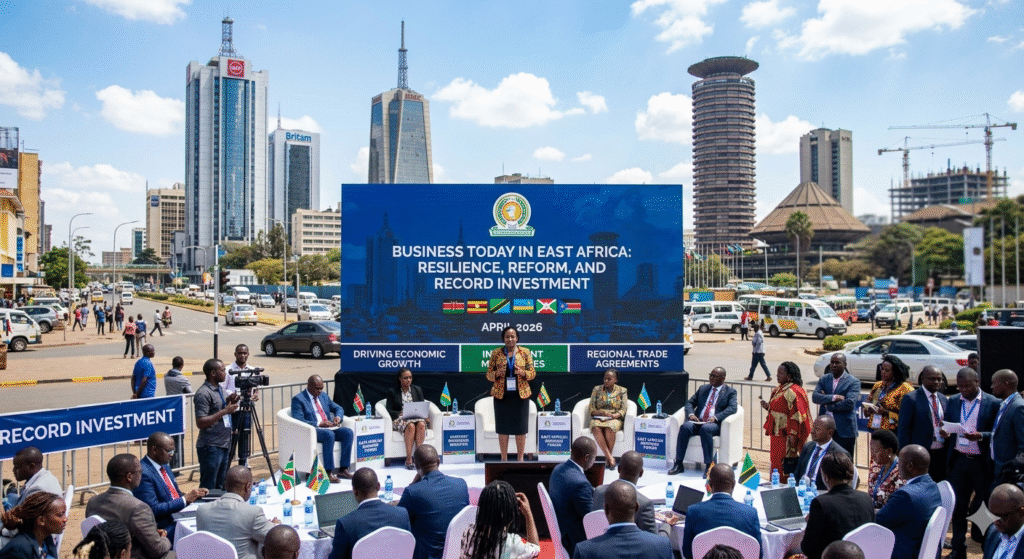
As of April 2026, East Africa stands as the continent’s most dynamic economic frontier. Projected by the United Nations to grow at 5.8% in 2026—the fastest of any African subregion—the area encompassing Kenya, Uganda, Tanzania, Rwanda, Ethiopia, and their neighbors is defying global headwinds . From a $3 billion manufacturing surge in Kenya to a $42 billion LNG project in Tanzania and a groundbreaking regional AI fund, here is the state of business across the region.
Part 1: The Growth Engine – East Africa Leads the Continent
According to the UN’s World Economic Situation and Prospects 2026, East Africa will grow at 5.8% this year, accelerating from 5.4% in 2025 . This outpaces North Africa (4.1%), West Africa, and Southern Africa by a significant margin. Ethiopia and Kenya are the primary drivers, supported by regional integration initiatives and expanding renewable energy capacity .
The broader African context is also positive: the continent is projected to grow at 4.0% in 2026 and 4.1% in 2027, up from 3.5% in 2024, reflecting improved macroeconomic stability in several major economies . However, high debt servicing costs, limited fiscal space, and food inflation remain significant headwinds .
Part 2: The $3 Billion Manufacturing Bet – Kenya’s Industrial Leap
Kenya has secured a landmark $3 billion commitment from Arise Integrated Industrial Platforms (AriseIIP), a Dubai-based infrastructure developer, to build a network of industrial and export-focused zones over five years . The investment will establish two sites along Kenya’s coastline and a third in the Rift Valley city of Naivasha, as well as revive and expand Rivatex East Africa Limited, a key textile sector player.
The project is backed by major institutional partners including the African Export-Import Bank, the Africa Finance Corporation, Saudi Arabia’s Vision Invest, and the Equitane Group . An additional $800 million financing facility will be established in collaboration with KCB Group and Afreximbank to support businesses setting up within the new zones.
Companies from Asia and the Middle East—including firms from China, India, and Lebanon—have already expressed interest in establishing manufacturing bases . For Kenya, this is not just capital inflow but a strategic investment in value addition, export growth, and employment creation. The country is positioning itself as a competitive player in emerging industries including textiles, minerals, and electric vehicle components.
Part 3: Kenya Investment Conference – $2.9 Billion in New Deals
The Kenya International Investment Conference (KIICO 2026) opened with the announcement of over $2.9 billion in investment deals, expected to generate more than 63,000 jobs . The deals span critical sectors:
- Agriculture and agro-processing: $890 million for projects boosting value addition and supporting smallholder farmers
- Manufacturing: $600 million targeting export-driven industries
- Mining: $350 million through the Buru rare earth project
- Real estate: $630 million set to transform urban infrastructure in Nairobi and Mombasa
Ongoing policy reforms—ranging from tax incentives and eased ownership rules in ICT to fully digitized investment facilitation—are lowering entry barriers for foreign investors . With strong participation from the US, UK, UAE, China, and India, Kenya continues to solidify its position as a gateway to East and Central Africa.
Part 4: Rwanda – The World’s Most Profitable Investment Destination
In a remarkable achievement, Rwanda has ranked first globally in the 2026 Baseline Profitability Index (BPI), surpassing India to become the most attractive destination for foreign direct investment . The index, developed by economist Daniel Altman, evaluates over 100 countries based on property rights, political stability, corruption levels, and exchange rate reliability—measuring how much profit investors can realistically repatriate over five years.
Rwanda scored 1.27, narrowly ahead of India (1.26), with Malaysia, Botswana, and Qatar following . Analysts attribute the rise to consistent reforms in governance, fiscal transparency, ease of doing business, and strong enforcement of property rights. The country has invested heavily in the Kigali Convention Centre, attracting international conferences and cementing its status as a regional hub for business and diplomacy .
For foreign investors, this ranking signals that returns, stability, and policy consistency are increasingly outweighing market size in investment decisions, positioning Rwanda as a high-return, low-risk entry point into Africa.
Part 5: Tanzania – LNG Ambitions and Storage Expansion
Tanzania is anchoring its energy ambitions in a $42 billion LNG project led by Shell and Equinor . After years of delays, Deputy Minister for Energy Salome Makamba indicated that the country is targeting signature of the Host Government Agreement by mid-2026, putting the project on a path toward Final Investment Decision, with first LNG cargoes expected in the early 2030s. Upon completion, Tanzania LNG will monetize the country’s 57 trillion cubic feet of natural gas reserves and position it as a major LNG exporter.
Alongside gas development, Tanzania broke ground on a $274 million petroleum storage expansion at Dar es Salaam Port in March 2026, adding 15 new tanks with 378,000 cubic meters of capacity . The project is expected to reduce tanker waiting times by 68%, cut fuel costs, and strengthen supply reliability across the broader East African market.
On the investment climate front, Tanzania has unveiled a new business and investment reform blueprint under Vision 2050, aiming to improve the business environment through regulatory reforms, digitalisation, and better coordination across government agencies . However, stakeholders warn that taxation complexity, bureaucratic inefficiencies, and shifting policy signals remain concerns—success will depend on translating reform commitments into a stable, investor-friendly environment.
Part 6: Uganda – The Oil-Driven Economic Pivot
Uganda is pivoting toward an oil-driven growth strategy with a proposed $20 billion budget for the 2026/27 financial year . The government expects its first major oil revenues—estimated at over $594 million—to begin contributing directly to national financing as production comes online.
The centerpiece is the East African Crude Oil Pipeline (EACOP), a 1,443-km pipeline developed by TotalEnergies, CNOOC, Uganda National Oil Company (UNOC), and Tanzania Petroleum Development Corporation . As of January 2026, the $5 billion project was 79% complete, with construction remaining on schedule for July 2026 commissioning. The pipeline will transport 230,000 barrels per day from Uganda’s Lake Albert Basin to international markets via Tanzania’s Port of Tanga.
Beyond exports, UNOC signed a deal with Alpha MBM Investments in January 2026 for the development of a $4 billion oil refinery set for completion by 2029/2030, with a capacity of 60,000 barrels per day, reducing refined imports and strengthening regional supply security .
Part 7: The AI Revolution – EAC Launches Regional Technology Fund
In a landmark move for digital sovereignty, the East African Community (EAC) has committed to establishing a Regional AI Technologies Fund to scale AI research and innovation into practical, bankable solutions . Announced at the 4th EAC Regional Science, Technology and Innovation Conference in Kigali, the fund will mobilize blended finance and attract private sector investment, ensuring sustained funding for AI innovations developed within the region.
Crucially, the eight EAC Partner States have resolved to promote “African AI sovereignty”—building AI systems that speak the region’s own languages, including Kiswahili, trained on East African data, stored on regional infrastructure, and governed by East Africans . This positions the region to own its digital future rather than depend on external systems.
The fund will finance flagship programs spanning agriculture, fintech, healthcare, and trade, enabling local innovators to transform ideas into commercially viable enterprises . As Kenya’s Cabinet Secretary Beatrice Askul Moe stated, AI is a “critical tool for survival and prosperity” .
Part 8: Cross-Border Payments – Faster, Cheaper, More Reliable
The EAC is also strengthening its payment systems to better serve businesses and citizens across borders. An EU–EAC Payment Systems Knowledge Exchange Mission, held from 23–29 March 2026 in Germany and Luxembourg, supports implementation of the EAC Payment System Masterplan under the Digital Economy, E-Commerce, E-Payments and Public E-Services Programme (DEEP) .
The objective is clear: sending money across East Africa should become faster, more affordable, and more reliable. For businesses operating across multiple EAC partner states, improved payment integration reduces transaction costs, accelerates trade, and enhances financial inclusion.
Part 9: Hotel and Tourism Boom – East Africa’s Hospitality Surge
East Africa is rapidly becoming the continent’s focal point for hotel development, with Kenya, Ethiopia, and Tanzania driving the fastest-growing share of hotel projects . According to the 2026 Hotel Chain Development Pipelines in Africa report, the region has a record 123,846 hotel rooms across 675 properties, an 18.6% year-on-year increase.
In Kenya, approximately 79.5% of hotel rooms in the pipeline are under construction, with 35 projects covering 6,190 rooms. Ethiopia follows with nearly 80% of its 5,964 rooms under construction, while Tanzania has 4,159 rooms in the pipeline, with roughly 77.5% already in the construction phase .
Global hotel chains are leading the charge: Marriott International (31,782 rooms under development across Africa), Hilton, and Accor are focusing on strategic markets such as Kenya and Ethiopia, recognizing the importance of these cities as major international gateways . Government investments in aviation infrastructure—including the expansion of Jomo Kenyatta International Airport—and conference facilities are positioning East Africa as a major player in global tourism.
Part 10: The Infrastructure Corridor – Kisumu-Malaba Railway
On March 21, 2026, Kenyan President William Ruto and Ugandan President Yoweri Museveni officially launched the Kisumu–Malaba standard gauge railway corridor, a $3.9 billion project spanning 369 kilometers . The line will connect the port of Mombasa to the interior of the continent, significantly reducing transport times currently estimated at over 80 hours to Malaba and 100 hours to Kampala.
Beyond transportation, the project aims to support key sectors such as agriculture, fishing around Lake Victoria, and regional industry, while reducing dependence on road transport responsible for congestion and high costs . As Museveni noted, the current transport system is “irrational and wasteful,” with passengers, light cargo, heavy cargo, and petroleum products all concentrated on the roads .
Part 11: Kenya’s Oil and Pipeline Privatization
Kenya is positioning itself as an energy investment destination as the country pursues first oil at its South Lokichar project . The government recently launched the sale of a 65% stake in the Kenya Pipeline Company (KPC) through an IPO expected to raise around 106.3 billion Kenyan shillings, signaling a market-based approach to financing strategic infrastructure.
The Gulf Energy-led South Lokichar project targets 20,000 barrels per day in its first phase (2026), with a planned second phase increasing output to 50,000 barrels per day by 2032 . Gulf Energy recently acquired an onshore drilling rig to support development toward first oil, strengthening East Africa’s emerging energy corridor.
Part 12: The External Threat – Middle East Conflict and Food Security
No assessment of East African business today is complete without acknowledging a significant external shock. The six-week-old Iran-Israel-US war is already influencing planting decisions for upcoming seasons across the region . With more than 30% of global seaborne urea fertilizer exports passing through the Strait of Hormuz—now effectively blockaded—shortages have triggered a 68% surge in prices, directly limiting crop yields for the 2026–2027 harvests.
“The food security consequences of this war are already written into harvests that have not yet been planted,” said Melaku Yirga, Mercy Corps Vice-President for Africa . “Farmers are planting less, or not at all, because they can’t afford inputs.”
In Kenya, fuel prices have risen sharply, with diesel climbing by a record margin despite a government fuel tax cut . The energy regulator raised the cost of diesel by 40 shillings to 206 shillings ($1.60) per liter, while petrol rose by 28 shillings to a similar level. The increase in fuel prices has raised transport costs on Kenyan roads, with a spiraling effect on key sectors including education, health, and food security.
Conclusion: A Region at an Inflection Point
East Africa today is a study in contrasts and momentum. The UN projects 5.8% growth—the fastest in Africa. Kenya has attracted over $2.9 billion in new investment deals at KIICO 2026 and a separate $3 billion manufacturing commitment . Rwanda is the world’s most profitable investment destination. Uganda is on the verge of oil exports. Tanzania is advancing a $42 billion LNG project. The EAC is launching a regional AI fund and improving cross-border payments.
Yet external shocks—particularly the Middle East conflict’s impact on fertilizer and fuel prices—threaten to undermine agricultural productivity and raise costs across the economy . The region’s resilience will be tested in the coming months.
As NJ Ayuk, Executive Chairman of the African Energy Chamber, observed: “East Africa is showing that transformational growth does not begin with a discovery alone—it begins when countries build the infrastructure, legal frameworks and export systems that turn resources into long-term economic value” . For investors willing to navigate the complexities, the opportunity set in East Africa has never been more compelling.
