

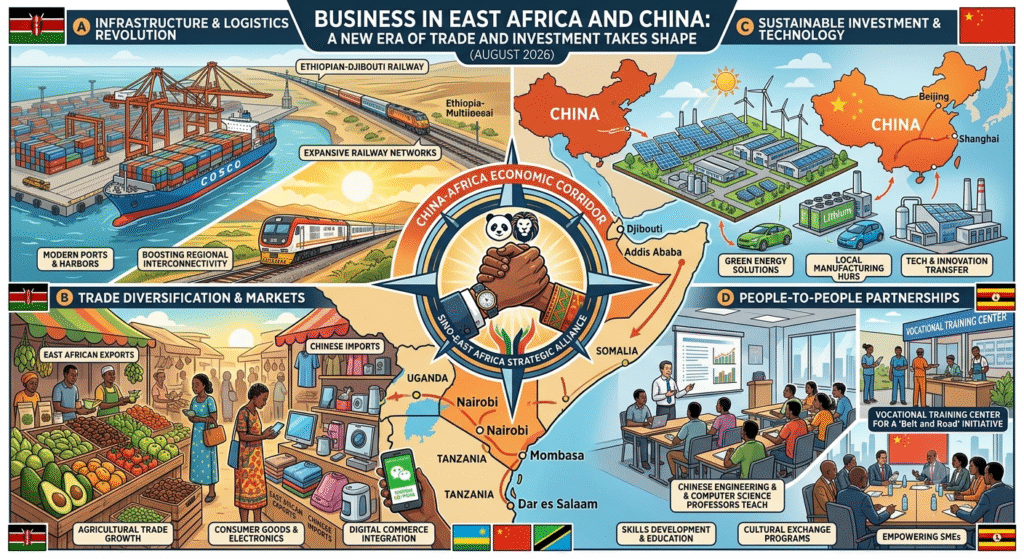
East Africa’s commercial relationship with China is undergoing a profound transformation in August 2026, marked by record trade figures, major infrastructure projects, and unprecedented market access. With China having implemented zero-tariff treatment for all products from 53 African countries in May 2026, the region is seizing the opportunity to move beyond raw material exports toward deeper industrial collaboration . Yet, as the partnership deepens, new questions emerge about Africa’s readiness to capture lasting value from this opening.
📊 Record Trade Figures Signal a Structural Shift
The numbers tell a story of accelerating economic integration. In the first half of 2026, China-Africa trade reached a record 1.41 trillion yuan, representing a 19.6 per cent increase year-on-year . This growth is driven by what analysts describe as a “multidriver” effect, with zero-tariff policy as the central catalyst.
The tariff effect has been transformative. In May and June 2026 alone, China’s imports from Africa totalled 193.8 billion yuan, up 23.5 per cent from the same period last year . Notably, inland African nations recorded export growth exceeding 50 per cent, reversing the previous pattern where coastal resource-exporting countries dominated trade .
The export structure is also evolving. China’s exports to Africa are increasingly composed of capital goods and intermediate products—engineering machinery, photovoltaic modules, and electric vehicles—precisely the inputs needed for Africa’s industrialisation and energy transition . This represents a departure from the historical pattern of exporting low-end consumer goods.
🏗️ Infrastructure: Chinese Companies Power Major Projects
Chinese firms continue to anchor East Africa’s infrastructure development. A significant development this year is Kenya’s selection of China Communications Construction Company (CCCC) for a $2.9 billion expansion of Jomo Kenyatta International Airport . The project comes after Kenya cancelled a controversial 30-year concession with Adani Airport Holdings following widespread public opposition . The modernisation is seen as urgent amid growing competition from Ethiopian Airlines’ new $12.5 billion airport project and Rwanda’s aviation expansion .
Railway expansion continues apace. In March 2026, Kenyan President William Ruto presided over the groundbreaking of the Nairobi-Malaba Standard Gauge Railway Phase 2, a 272-kilometre extension of the China-built Mombasa-Nairobi railway . Once complete, travel time from Nairobi to Kampala is expected to drop from 14 to just 4 hours, with freight costs falling approximately 35 per cent . The project illustrates China’s role in creating regional connectivity that benefits multiple East African nations.
Clean energy is emerging as a new frontier. Kenya is actively seeking Chinese investment in local manufacturing of solar panels, transformers, smart meters, and electric vehicle charging infrastructure . The government aims to add approximately 12,000 megavolt-amperes of transmission capacity by 2030, requiring substantial private investment .
🏭 From Raw Materials to Value Chains
The zero-tariff policy is encouraging African countries to move up the value chain. Rather than simply exporting raw cocoa beans or unroasted coffee, the policy creates incentives for processing and value addition .
Coffee provides a powerful illustration. At the “Export to China” event in Addis Ababa on August 19, Chinese companies signed trade agreements totalling $330 million with Ethiopian businesses . Ten major Chinese firms, including COFCO, brought specific procurement lists, visiting farms and factories to assess production capacity and quality control .
The Kunshan coffee market in China’s Jiangsu Province demonstrates the potential scale. One Chinese company alone imports over 10,000 tonnes of coffee beans annually from African countries including Ethiopia, Uganda, Tanzania, and Kenya . The company’s manager stated plans to increase African imports following the zero-tariff policy implementation . Kunshan has built an entire economic ecosystem around coffee, encompassing processing, equipment manufacturing, supply chains, retail, tourism, and cultural activities .
A Liberian journalist who visited Kunshan noted the model could be replicated for cocoa and other agricultural commodities, encouraging African countries to retain more value domestically .
The “Export to China” platform is scaling up. After successful events in Belarus and Egypt, the initiative entered East Africa with the Ethiopia event . Participating Chinese companies emphasised a shift from “point-based breakthroughs” to “area-based layout,” aiming to establish Ethiopia as a long-term strategic procurement base for East Africa . The model involves “pre-selection + on-site factory inspection,” with Chinese buyers visiting farms and production sites to assess capacity and quality .
🚧 Persistent Challenges
Despite the momentum, significant obstacles remain. Analysts caution that market access alone does not guarantee export success .
Infrastructure deficits remain acute. High logistics costs, unreliable energy supply, and inadequate transport networks continue to constrain African producers’ competitiveness . The experience of previous preferential trade arrangements demonstrates that access must be accompanied by improvements in production capacity and quality standards .
Industrial capacity is limited. Moving beyond raw materials requires investment in processing facilities, technology transfer, and skilled labour—all areas where African countries need sustained support .
Intra-regional fragmentation persists. Despite the African Continental Free Trade Area, many countries still face trade barriers among themselves, limiting their ability to achieve economies of scale .
🔮 Conclusion: A Partnership at a Crossroads
East Africa’s business relationship with China is entering a new phase. The zero-tariff policy has created unprecedented opportunities for African exporters, infrastructure projects continue to transform regional connectivity, and the growing appetite for processed African goods signals a shift from raw materials to value-added trade.
Yet, as experts warn, translating opportunity into lasting economic transformation will require significant investment in industrial capacity, infrastructure, quality assurance, and regional integration . The choices made by governments and businesses in the coming years will determine whether this historic opening becomes a foundation for sustainable growth or an opportunity only partially seized.