

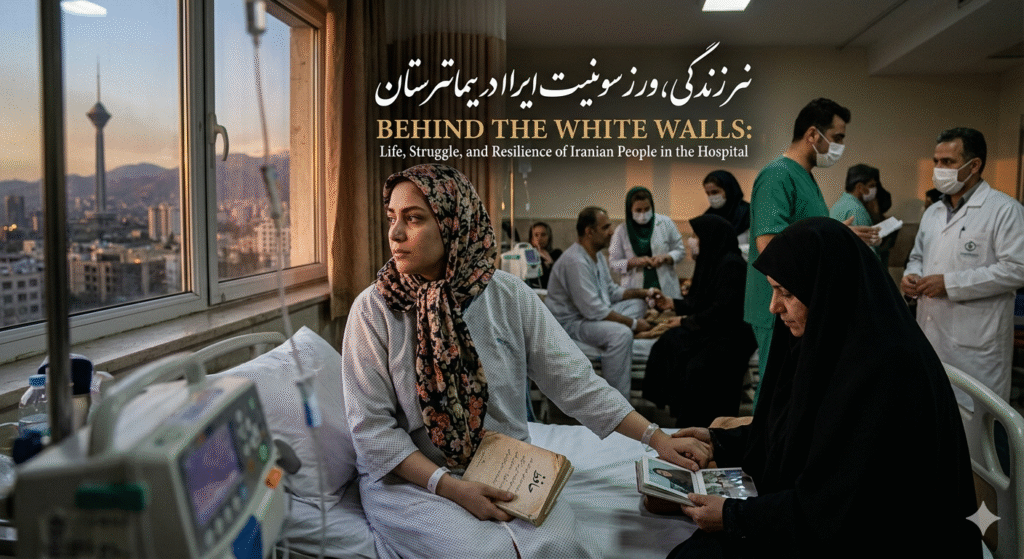
In the Islamic Republic of Iran, hospitals are more than sterile corridors of medicine and surgery. They are mirrors reflecting the nation’s deepest virtues and most painful contradictions. For the Iranian people, a hospital visit is rarely a simple transaction of sickness and cure. It is a journey through economic anxiety, bureaucratic maze, familial duty, and an enduring, almost spiritual, will to survive. To understand Iran today, one must walk its hospital wards—where the sanctity of life clashes with the grind of sanctions, and where exhausted doctors become unsung heroes.
The Waiting Room: A Census of the Exhausted
The day at any public hospital in Tehran, Mashhad, or Isfahan begins before dawn. Outside the gates of a major hospital like Imam Khomeini Hospital Complex in Tehran, families begin gathering at 4 AM, even though the clinics open at 8. They bring their own chairs, their own tea in thermoses, and their own medical records wrapped in plastic bags. There is no online booking system for the poor; there is only the queue.
Inside the waiting room, the air is thick with the smell of disinfectant, stale tobacco, and worry. An elderly woman from a rural village in Khuzestan clutches her chest, unable to afford the four-hour bus ride back home if she is not seen today. A young father holds a limp child, the fever so high that the boy’s lips are cracked. No one shouts. Iranians, for all their public passion, are stoic in suffering. They wait. They have learned that anger does not speed up triage.
The waiting room is also a social leveler. Here, the wealthy merchant in a clean suit and the day laborer in mud-caked boots sit on the same plastic chairs. Sanctions and inflation have crushed the middle class, pushing even former white-collar professionals into the public system. The only distinction is the whisper network: “Do you know a nurse here?” “Can you call Dr. Karimi’s cousin?” In Iran, wasitah (connections) is the real currency of healthcare.
The Economic Anatomy of Illness
To be sick in Iran is to face a financial calculation that no human should make. While the government proudly subsidizes basic medicines and procedures, the reality on the ground is brutal. A standard surgery might be “covered” by insurance, but the disposable surgical supplies—gloves, sutures, scalpels—often are not. The patient’s family must run to the pharmacy across the street to buy them, cash in hand.
Inflation, exacerbated by decades of international sanctions, has made imported drugs a luxury. A cancer patient requiring a specific monoclonal antibody may find that the drug has vanished from public hospital pharmacies. The alternative? The black market. A single vial might cost half a month’s average salary. Families sell gold, borrow from relatives, or take second mortgages on their homes. It is common to see hospital corridors lined not with flowers, but with family members making hushed phone calls: “How much did the smuggler say? Can we trust it?”
The most heartbreaking calculation involves the rural poor. A grandmother with a heart condition in a village in Sistan-o-Baluchistan faces a 500-kilometer journey to a catheterization lab. The ambulance alone costs more than her annual pension. Many simply do not go. They stay home, treat symptoms with herbal remedies, and die quietly. The hospital, for them, is a distant luxury.
The Nurses: Angels Under Siege
If there is a beating heart inside the Iranian hospital, it is the nurse. But that heart is exhausted. Iranian nurses are among the most overworked and underpaid in the Middle East. A typical shift is 12 to 16 hours, often with no break. Wages have not kept pace with inflation; a senior nurse in a Tehran public hospital might earn the equivalent of $250 per month. Many work two jobs. Some sleep in their cars between shifts.
Yet, they persist. In the COVID-19 pandemic, Iranian nurses became national icons. They slept in hospital corridors to avoid infecting their families. They held the hands of dying patients when families were banned from visiting. They sourced oxygen cylinders from fire stations when the central supply ran dry. Today, the pandemic has receded, but the trauma remains. Burnout rates are catastrophic. The nursing brain drain is real: thousands have left for Germany, the UAE, or Canada, where their skills are respected and compensated.
For those who stay, the job is a calling. A head nurse in a burn unit in Shiraz once told a journalist: “We do not treat diseases. We treat the soul of the patient and the panic of the family. If we stop, the whole system collapses.” They are the unseen infrastructure of Iranian resilience.
Gender and the Hospital: A Separate Peace
The Islamic Republic’s rules do not suspend themselves at the hospital door. Gender segregation is enforced, but with pragmatic flexibility. Women’s wards are staffed mostly by female doctors and nurses. Male visitors are restricted, though husbands are usually permitted to stay with their wives. The mandatory headscarf (hijab) is relaxed for female patients—they may be uncovered in the presence of female staff or male doctors during treatment, but they must cover again when walking to the radiology department.
For pregnant women, the hospital is both a sanctuary and a site of anxiety. Iran has a sophisticated maternal health network; maternal mortality rates are impressively low for the region. But a woman having a complicated delivery in a public hospital may find herself at the mercy of overstretched staff. There are too few neonatal intensive care unit (NICU) beds for premature infants. Mothers have been known to rent private ambulances to transfer their newborns across the city, searching for an open incubator.
The most poignant scenes unfold in pediatric oncology wards. Here, bald children play chess on stained linoleum floors while their mothers, always the mothers, sit vigil. The mothers share food, take turns watching each other’s children during chemo, and cry together in the stairwells. The hospital becomes a surrogate village. In a society where the family is everything, the hospital family is a desperate, beautiful improvisation.
The Death of a Stranger: Communal Grief
Death in an Iranian hospital is never a private affair. When a patient dies, especially in a public ward, the news spreads quickly. Fellow patients pause their card games. Nurses bow their heads. The family’s wails echo through the corridor, and no one tells them to be quiet. Instead, strangers approach. They offer tea, a shoulder, a prayer.
There is a tradition, rooted in Shia Islam, of tazieh—a form of communal mourning. In the hospital, this translates into a spontaneous gathering. Other families share their own stories of loss. The wealthy merchant might offer to pay for the deceased’s burial transport. The day laborer might carry the empty stretcher to the morgue. In this moment, the hierarchies of Iranian society dissolve. Rich and poor, religious and secular, reformist and conservative—they are united by the blunt fact of mortality.
The Foreign Patient: A Window into Iran’s Contradictions
Interestingly, Iranian hospitals have become a destination for medical tourism. Patients from Iraq, Afghanistan, Pakistan, and even the Gulf states travel to Iran for surgeries—cardiac, bariatric, orthopedic—that cost a fraction of European or American prices. The quality is high; many Iranian surgeons trained in the US or UK before the 1979 revolution or have maintained skills through online fellowships despite sanctions.
Walk into a private hospital in northern Tehran, and you will hear Arabic, Urdu, and Russian alongside Farsi. These foreign patients occupy a different world: private rooms, English-speaking coordinators, hotel-like amenities. The contrast with the public hospital across town is jarring. Yet, the foreign patient’s presence is a lifeline. Their hard currency (usually paid in US dollars or Turkish lira via informal exchange networks) subsidizes the purchase of medical equipment that the government cannot import directly due to banking sanctions.
Hope and the Horizon
To write only of suffering would be to miss the full picture. Iranians possess a dark, resilient humor that flourishes even in hospital beds. Jokes about the economy, about politicians, about the absurdity of life—they are whispered between IV drips. Laughter is a form of defiance.
Moreover, there are genuine success stories. Iran has a world-class organ transplant program, particularly for kidneys and livers, thanks to a regulated system of living unrelated donors. The country trains more female doctors than male. Emergency response times in major cities are competitive with European standards.
But the fundamental truth is this: the Iranian people in their hospitals are surviving despite their system, not because of it. They navigate sanctions, inflation, understaffing, and bureaucracy with a resourcefulness that borders on the miraculous. They show up at 4 AM. They sell their gold. They hold each other. They refuse to give up.
In the end, the hospital is not just a building where Iranians go to heal. It is a testament to who they are: a people who have learned, through forty years of pressure, that the only reliable medicine is each other. And as long as that remains true, the white walls will keep standing.
