

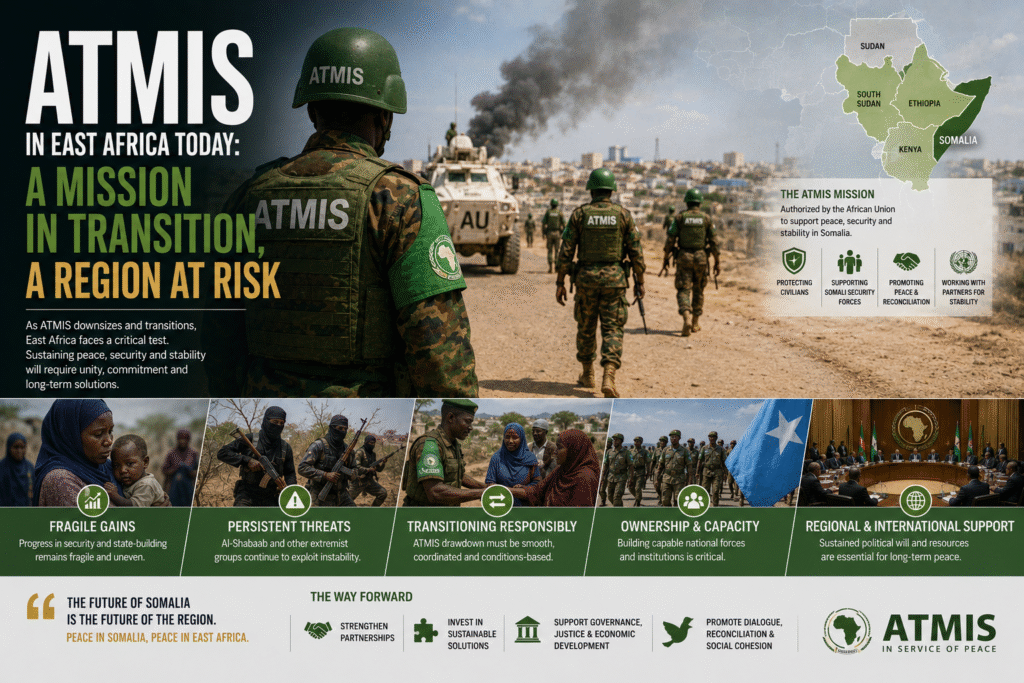
Introduction: The End of an Era
For nearly two decades, the African Union Transition Mission in Somalia (ATMIS) and its predecessor, AMISOM, have been the backbone of Somalia’s fragile security architecture. At its peak, over 20,000 troops from Uganda, Burundi, Kenya, Ethiopia, and Djibouti served under the AU flag, fighting Al-Shabaab and protecting Somalia’s internationally recognized government . But today, ATMIS as the world knew it is gone. Replaced by a new mission with a new mandate—the AU Support and Stabilization Mission in Somalia (AUSSOM)—the transition marks a historic shift from stabilization to consolidation . Yet as of May 2026, the security gaps left by the withdrawal are becoming increasingly evident. Al-Shabaab has regrouped, clan militias are resurgent, and the Somali National Army is struggling to hold the line. This article examines the state of ATMIS/AUSSOM today, the challenges of the transition, and what it means for East Africa’s stability.
Part 1: The Transition from ATMIS to AUSSOM
The African Union Transition Mission in Somalia (ATMIS) officially concluded its mandate on December 31, 2024, after nearly three years of phased drawdowns. In its place, the AU Support and Stabilization Mission in Somalia (AUSSOM) was launched on January 1, 2025, following a decision by the AU Peace and Security Council and endorsement by the UN Security Council through Resolution 2767 (2025) .
The change is more than cosmetic. While ATMIS was primarily focused on offensive operations against Al-Shabaab, AUSSOM has a narrower mandate: supporting the Somali Security Forces (SSF) in maintaining security in major population centers, protecting key infrastructure, and creating conditions for the eventual full handover to Somali-led security. The new mission reflects a strategic shift from “fighting” to “stabilization.”
However, the transition has not been seamless. Speaking at a UN Security Council briefing in early May 2026, James Swan, head of the UN Assistance Mission in Somalia (UNSOM), noted that ATMIS forces continue to leave regions as part of a “planned transition of responsibilities to Somali security forces” . Approximately 5,000 ATMIS troops have departed Somalia since June 2023, with further reductions planned in the coming weeks .
Part 2: The Security Gap Al-Shabaab Has Exploited
The withdrawal of AU forces has created security vacuums that Al-Shabaab has rapidly exploited. According to detailed assessments of the situation in southern Somalia, the group has retaken at least five districts in the Lower Shabelle and Middle Jubba regions since mid-2025 .
The pattern is clear: as ATMIS vacates forward operating bases, Al-Shabaab moves in. The Somali National Army (SNA), despite significant investment and training from international partners, has proven unable to hold all the territory that AU forces previously secured. The group has increased its use of improvised explosive devices (IEDs) and vehicle-borne bombs, with attacks in Mogadishu becoming more frequent and deadly . A February 2026 attack near Mogadishu International Airport killed over 30 people, demonstrating that Al-Shabaab can still strike at the heart of the Somali capital despite years of counter-terrorism operations.
This resurgence has direct implications for the AUSSOM mission. Rather than a stable environment where stabilization can proceed, the new mission finds itself operating in a context of renewed militant momentum.
Part 3: Baidoa — A Microcosm of the Crisis
The gravity of the current security situation was starkly illustrated just days ago. On May 14, 2026, the Somali Ministry of Defense announced that government forces had killed at least 50 militants and armed militia fighters during a coordinated military operation on the outskirts of Baidoa, the interim capital of Southwest State .
The operation was launched in response to an ambush early that morning on government troops patrolling the area, in which senior Somali military commanders were killed . The Ministry of Defense accused militias loyal to former Southwest State President Abdiaziz Hassan Mohamed Laftagareen of fighting alongside Al-Shabaab, stating that the two groups had “directly merged” and that Al-Shabaab’s claim of responsibility for the ambush demonstrated “direct cooperation” between the two sides .
While these claims could not be independently verified, the incident highlights a troubling dimension of Somalia’s conflict: the blurring lines between Islamist militancy, clan warfare, and political violence. A formal militia aligned with a former regional president allegedly coordinating attacks with Al-Shabaab represents a dangerous escalation that AUSSOM and the SNA must now confront.
Part 4: A New Maritime Threat — The Houthi-Pirate Alliance
Beyond the land-based insurgency, a new and unexpected maritime threat has emerged. In recent months, Somali pirates have staged a dramatic comeback in the Red Sea and the Gulf of Aden, not as independent criminal enterprises but as part of a “functional alliance” with Yemen’s Houthi movement .
According to a 2025 report by the UN Analytical Support and Sanctions Monitoring Team, Al-Shabaab representatives met with Houthi officials in Somalia at least twice in July and September 2025 to request modern weapons and training. In exchange, Al-Shabaab would increase pirate operations in the Gulf of Aden, targeting cargo ships and disrupting maritime traffic .
The alliance is described as “transactional or opportunistic” rather than ideological. Pirates are primarily motivated by economic gain—ransom payments and cargo theft—while Al-Shabaab and the Houthis have broader strategic objectives. But the practical effect is a more sophisticated and dangerous maritime threat. Somali pirates have reportedly received GPS equipment from the Houthis, allowing them to track commercial vessels with unprecedented accuracy .
The resurgence is also a direct consequence of the broader Middle East conflict. Since the US-Israel campaign against Iran began in February 2026, naval assets that once patrolled the Red Sea have been redirected to the Strait of Hormuz, creating a security vacuum that pirates and their backers have exploited .
Part 5: The Ongoing Fight — Counter-Terrorism Operations
Despite these challenges, the Somali government and its international partners continue to wage an aggressive campaign against Al-Shabaab. Just this week, Somali elite forces (Danab) conducted an operation in the Middle Shabelle region, north of Mogadishu, liberating nine civilians who had been kidnapped by Al-Shabaab and killing five militants, including the alleged leader of the cell .
The Ministry of Defense reiterated that “the government remains committed to intensifying operations aimed at eliminating the remnants of terrorist groups, so that the Somali people can live in peace, stability, and dignity” .
These operations, while tactically successful, face strategic headwinds. The AUSSOM mission is smaller and more focused than its predecessor, and the Somali security forces continue to face challenges with logistics, intelligence, and retention. The February 2026 attack near the airport, the Baidoa ambush, and the resurgence of piracy all point to an insurgency that remains resilient despite years of counter-terrorism pressure.
Part 6: Regional Implications — What the Transition Means for East Africa
The transition from ATMIS to AUSSOM is not merely a Somali affair—it has profound implications for the entire East African region. Troop-contributing countries (TCCs), including Uganda, Burundi, Kenya, Ethiopia, and Djibouti, have invested heavily in Somalia’s stabilization for nearly two decades . A premature collapse of Somali security would create a power vacuum that could destabilize the entire Horn of Africa.
The AU Peace and Security Council has repeatedly reaffirmed “the unwavering commitment of the AU to continue supporting Somalia until Al-Shabaab is completely eliminated and durable peace, security and stability are fully restored” . But words must be matched by resources. AUSSOM is operating with a reduced footprint, and the Somali government has repeatedly requested a slower drawdown to allow the SNA time to fill the gaps.
The emergence of the Houthi-pirate alliance adds a new dimension to regional security. The Red Sea and Gulf of Aden are vital waterways for global trade and for the economies of East African nations. A sustained pirate resurgence, particularly one backed by a sophisticated state-actor like the Houthis, would require a coordinated international response that currently does not exist .
Part 7: The Humanitarian Dimension — Civilians Caught in the Crossfire
Behind the military metrics and strategic assessments lies a devastating human toll. The renewed fighting has displaced thousands of civilians. An October 2025 attack in Marka, Lower Shabelle, led to the town falling under Al-Shabaab control and thousands being displaced . In March 2026, an attack on an IDP camp in Beledweyne resulted in forced recruitment of young men and the displacement of hundreds of families .
The UN has described Somalia’s humanitarian needs as “exacerbated” in the face of both climate shocks and ongoing counter-terrorism operations . For civilians living in areas contested by Al-Shabaab, the government, and AUSSOM forces, the violence is a daily reality. For those living under Al-Shabaab control, forced recruitment, taxation, and punishments under the group’s strict interpretation of Sharia law are constant threats .
The AUSSOM mission’s stabilization mandate explicitly includes protecting civilians, but with a reduced force footprint and an emboldened insurgency, that task has become increasingly difficult.
Part 8: The Road Ahead — What to Watch
As East Africa looks toward the remainder of 2026, several key questions will determine the success or failure of the AUSSOM mission and Somalia’s security transition.
First, can the Somali National Army hold the territory that AU forces have vacated? The evidence from Lower Shabelle and Middle Jubba is not encouraging. Without sustained international support for training, equipping, and paying SNA forces, the gains of the past two decades risk being reversed.
Second, will the international community provide adequate resources for AUSSOM? The mission is operating on a leaner budget than ATMIS, but the security challenges have not diminished. The AU has repeatedly called for predictable, sustainable funding, but donor fatigue remains a significant constraint.
Third, can the alliance between Al-Shabaab and the Houthis be countered? This new maritime dimension requires a coordinated response that goes beyond Somalia’s borders, involving Yemen, the Gulf states, and international naval forces.
Finally, can Somalia’s political leaders unite behind a common security vision? The Baidoa incident—in which a former regional president’s militia allegedly coordinated with Al-Shabaab—highlights the dangerous fragmentation of Somali politics. Without political cohesion, military efforts will always face an uphill battle.
Conclusion: A Mission in Transition
The African Union’s presence in Somalia today is no longer called ATMIS. AUSSOM has taken its place, with a narrower mandate and a reduced footprint. But the underlying challenge remains unchanged: how to prevent Al-Shabaab from reconstituting while building a Somali security apparatus capable of standing on its own.
The past week has demonstrated both the progress and the peril. Somali forces killed 50 militants near Baidoa and rescued nine civilians from a kidnapping cell—tactical successes that show the SNA is capable of offensive operations. But the ambush that preceded that operation, which killed senior Somali commanders, and the resurgence of piracy linked to Houthi-Al-Shabaab cooperation, reveal the scale of the challenge that remains.
ATMIS may be gone in name, but the mission it represented—stabilizing Somalia, protecting civilians, and defeating Al-Shabaab—is far from complete. The transition to AUSSOM was always going to be difficult. The question now is whether the new mission, with its smaller footprint and more constrained mandate, can succeed where its predecessor spent 18 years fighting. For the people of Somalia and the stability of East Africa, the answer matters more than ever.
