

MOGADISHU – As the sun rises over the Horn of Africa, Somalia finds itself standing at a precipice familiar yet terrifying. We are a nation defined by our resilience—the Istisqa prayer for rain, the poetry of survival, and the unyielding spirit of our entrepreneurs. Yet, as we move deeper into 2026, the headlines paint a dual reality: one of international isolation and hunger, and another of fierce diplomatic maneuvering and military modernization.
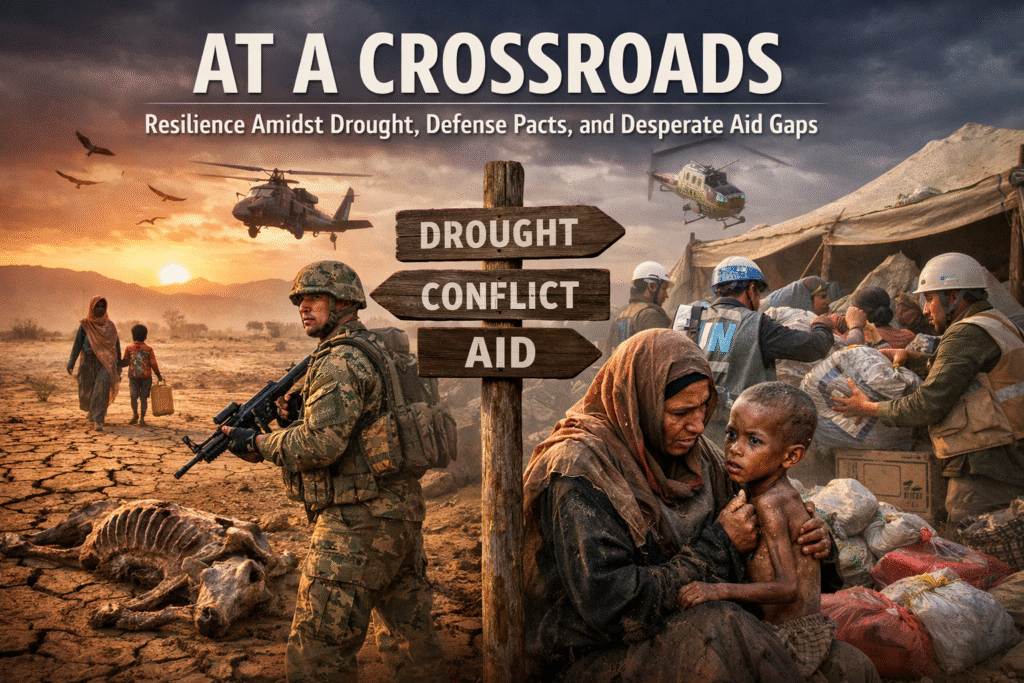
This week, Somalia Today looks beyond the breaking news to examine the complex machinery of a nation fighting for its future on three fronts: the battle against famine, the battle against extremism, and the battle for economic sovereignty.
The Shadow of 2011 Returns
In Brussels, the European Union announced an emergency funding package of €63 million ($68 million) this week. On paper, this sounds like a victory for Somali diplomacy. But in the displacement camps on the outskirts of Mogadishu, aid workers are sounding a different alarm: it is not enough, and it may be too late .
The latest food security data reveals a staggering statistic: 6.5 million people—one in every three Somalis—are projected to face crisis-level hunger by the end of this month. Even more haunting is the fate of our children. An estimated 1.85 million children under the age of five are expected to suffer from acute malnutrition in 2026. Nearly half a million of them are on the brink of becoming severely malnourished .
We have heard these numbers before. We remember 2011, when 250,000 people died, half of them children, before the world officially declared a famine. The World Food Programme (WFP) has warned that they may be forced to halt life-saving operations by April unless an immediate cash infusion arrives. They have already slashed support from 2.2 million people to just 600,000 .
Why the sudden collapse? The “toxic mix” is worse than ever. The country declared a national drought emergency in late 2025 after the rains failed. Climate shocks have destroyed our pastoralist economy, while global aid cuts—a contraction in humanitarian financing—have left the UN’s $852 million appeal largely unanswered .
The Security Calculus: Capturing Commanders and Ankara Agreements
While the world focuses on the drought, Somalia’s security forces are engaged in a relentless, high-intensity fight. In a significant breakthrough, the African Union Support and Stabilization Mission in Somalia (AUSSOM) and our National Army captured a senior Al-Shabaab commander, Salaad Cusmaan Macalin (alias Sahm), near the southern town of Mubarak .
This was not just a random arrest. Intelligence indicates that Macalin was scouting defensive positions for a planned attack, accompanied by 17 foreign militants recently deployed from the group’s command center in Jilib. The capture of a Kenyan national volunteering as a suicide bomber highlights the enduring transnational threat of the group .
Simultaneously, our defense diplomacy is accelerating. In Ankara, the Permanent Secretary of the Ministry of Defence concluded high-level meetings with Turkish officials and defense giants ASELSAN, HAVELSAN, and MKE. These talks signal a strategic pivot: Somalia is not just asking for troops; it is building an industrial base .
The focus is on technical collaboration and modernization. We are witnessing the birth of a more sophisticated Somali National Army, one that hopes to eventually take full responsibility for the nation’s security without relying on external ATMIS or AUSSOM boots on the ground.
A New Social Contract: Protecting the Protectors
There is a notable shift in the air at Villa Somalia. Last week, the Cabinet approved a landmark Protection of Civilians Policy for Security Operations .
For decades, the narrative of this war has been haunted by civilian casualties. Whether through crossfire or militant exploitation, the innocent have paid the highest price. This new policy, aligned with the Geneva Conventions, provides clear guidance to our forces to minimize harm during combat.
It is a significant step. As the government pushes into militant strongholds in central and southern Somalia, the distinction between liberating a town and traumatizing its population is razor-thin. This policy is an acknowledgment that the endgame of counter-insurgency is winning the trust of the people, not just controlling the land.
The Economic Horizon: World Bank Warnings and Green Shots
On the economic front, the World Bank recently delivered a sobering report. Without urgent action on climate resilience, climate change could reduce Somalia’s GDP by up to 13.5 percent by 2060 . That is a potential loss of billions of dollars, effectively wiping out the gains made since the HIPC debt relief deal.
However, the report also offers a roadmap. By investing in climate-smart agriculture and resilient cities, we can cut those projected losses in half .
President Hassan Sheikh Mohamud is aware of this ticking clock. In a recent meeting with a World Bank delegation, the discussion moved beyond survival to macroeconomic stability. The agenda is shifting from “food aid” to “infrastructure.” The government is doubling down on energy access and regional integration, hoping to position Somalia as a hub for the East African Community .
Voices from the Ground: The Clan Conflict
While we focus on Al-Shabaab and drought, a third, older enemy is resurfacing: inter-clan violence. In the Mudug region, a flash alert from UNHCR confirms that over 1,500 people have been displaced following clashes in Dhinowda and Hir-Salama .
Ironically, the trigger was recent rainfall. As water and grazing land temporarily returned, competition over these precious resources turned violent between clan militias. It is a tragic paradox: in Somalia, even the arrival of rain can spark a fire. Sixty percent of the displaced are women and children, fleeing not bombs, but their neighbors .
The Somalia Today Takeaway
Somalia is in a race against time.
- The Climate Race: Can we build water infrastructure before the next drought kills our livestock?
- The Security Race: Can we strengthen our military institutions faster than Al-Shabaab can recruit desperate youths?
- The Diplomatic Race: Can we secure international funding before the 6.5 million hungry people become 8 million?
The EU’s €63 million is a lifeline, but it is a bandage on a hemorrhage. The defense pacts with Turkey are strategic, but they take years to materialize. The new civilian protection policy is moral, but it requires rigorous enforcement.
As we publish this, the April-to-June Gu season rains are either arriving or failing. Meteorologists offer “little hope of a swift recovery” . But if there is one constant in Somali history, it is that we do not wait for hope. We create it.
We call on the international community not to look away. And we call on our leaders in Mogadishu to ensure that the arms purchased in Ankara and the policies written at Villa Somalia translate into one thing: a plate of food for every Somali child.
— Ayaan Abdullahi, Senior Correspondent, Somalia Today.
Sources: EU Humanitarian Office, WFP, World Bank, UNHCR, SONNA, Xinhua News Agency.
