

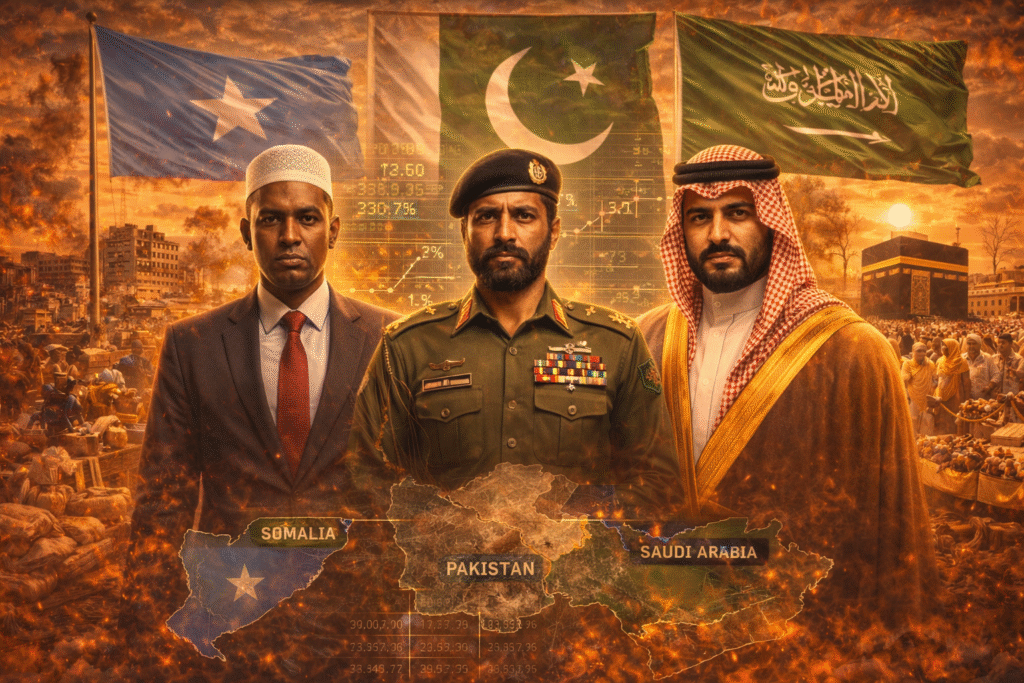
MOGADISHU, ISLAMABAD, RIYADH – In the complex cartography of the Muslim world, three nations—Somalia, Pakistan, and Saudi Arabia—form a unique and increasingly pivotal strategic triangle. Their relationship, woven from threads of faith, finance, and hard-nosed geopolitics, transcends traditional diplomatic boundaries. Today, this nexus is being tested and redefined by war, economic turmoil, and a shifting global order, revealing a dynamic where Saudi Arabia’s religious and financial capital, Pakistan’s military and diplomatic heft, and Somalia’s strategic location create a web of interdependence with profound regional implications.
Saudi Arabia: The Custodian and Banker
At the apex of this relationship sits Saudi Arabia, wielding influence through its dual identities as the Custodian of the Two Holy Mosques and the financial powerhouse of the Gulf.
- The Religious Lifeline: For Somalia and Pakistan, Saudi Arabia is the spiritual epicenter of the Muslim world. The annual Hajj pilgrimage is a profound socio-religious event for millions of Somalis and Pakistanis, fostering deep cultural and religious affinity. This spiritual connection provides Riyadh with immense soft power, which it leverages to promote its state-sanctioned version of Sunni Islam (often Salafi/Wahhabi thought). Historically, this has translated into funding for madrassas, mosques, and charities in both Somalia and Pakistan, shaping religious discourse and education. In Somalia, this has at times conflicted with local Sufi traditions and fueled complex intra-Islamic dynamics.
- The Economic Anchor: Saudi Arabia is a vital economic partner for both. It is the primary destination for Pakistani and Somali labor migrants, whose remittances are a bedrock of their home economies. Pakistan receives over $4 billion annually in remittances from Saudi Arabia, while for Somalia, Gulf remittances via the hawala system are a literal lifeline. Furthermore, Saudi (and broader GCC) aid, investment, and energy deals are critical for Islamabad’s and Mogadishu’s fragile finances. Saudi Arabia’s Vision 2030 diversification strategy also sees both nations as potential markets and logistical partners.
- The Geopolitical Patron: Riyadh views both Pakistan and Somalia through a lens of regional competition, primarily against Iran and Turkey. It seeks a reliable military partner in nuclear-armed Pakistan to counterbalance Iranian influence. In Somalia, Saudi Arabia (and the UAE) vies with Turkey and Qatar for dominance, seeing the Horn of Africa as a critical front in its contest for influence, control of Red Sea trade routes, and isolation of Iran.
Pakistan: The “Islamic Sword” and Mediator
Pakistan occupies a complex middle ground: a populous, nuclear-armed state with a powerful military, perennially balancing its relationships with the Gulf, its own economic needs, and its identity as a leader of the Muslim world.
- The Military Exporter and Security Partner: Pakistan’s most tangible export to both Saudi Arabia and Somalia is security expertise. For decades, Pakistani troops, pilots, and military advisors have been stationed in Saudi Arabia, forming a key pillar of its defense infrastructure. In Somalia, Pakistan has been a major contributor to UN and African Union peacekeeping missions, with its troops often seen as effective and professional. Pakistani private security contractors and trainers are also active in Somalia. This role casts Pakistan as the “muscle” of the relationship—a trusted, capable, and fellow Muslim military power.
- The Diplomatic Go-Between and Balancing Act: Pakistan has historically attempted to mediate within the Muslim world, including between Saudi Arabia and Iran, though with limited success. It walks a diplomatic tightrope, maintaining its indispensable bond with Riyadh while avoiding being dragged into a direct confrontation with Tehran, which shares a border with Pakistan. In the Horn, Pakistan’s neutrality and UN role give it a stature that purely Gulf-aligned actors lack.
- Economic Dependence and Leverage: Pakistan’s reliance on Saudi financial aid (bailouts, oil on deferred payments) and remittances gives Riyadh significant leverage. This was starkly demonstrated in recent years when Pakistan, under Saudi pressure, scaled back its participation in a Saudi-led Islamic military alliance and recalibrated its relationship with Malaysia and Turkey, which Riyadh viewed with suspicion. Pakistan’s need often dictates its diplomatic fidelity.
Somalia: The Strategic Prize and Fragile Client
Somalia is the most vulnerable corner of the triangle, but its geographic position makes it a coveted prize.
- The Battlefield for Gulf Rivalry: Somalia’s airspace, ports, and political alignment have become a proxy battleground in the Saudi-UAE vs. Qatar-Turkey rivalry. The 2017 Gulf crisis split Somalia, with the Federal Government initially trying to remain neutral but later leaning towards Qatar and Turkey, while the breakaway region of Somaliland and the federal state of Puntland developed strong ties with the UAE and Saudi Arabia. This external fragmentation exacerbates Somalia’s internal divisions. Saudi Arabia invests in development projects and political alliances to pull Somalia into its orbit and counter Turkish inroads.
- In Search of a Sovereign Path: The Somali Federal Government is engaged in a desperate balancing act. It values Turkish military training and Qatar’s diplomatic support but cannot afford to alienate Saudi Arabia and the UAE, whose economic power and influence in the Arab League are immense. Mogadishu seeks investment and support without becoming a vassal state in a Gulf cold war, a nearly impossible task given its desperate need for capital and security assistance.
- The Remittance Republic: Ultimately, the most critical daily link for ordinary Somalis is the flow of remittances from the Gulf, facilitated by the Saudi and UAE financial systems. This economic umbilical cord ensures that, regardless of high politics, Saudi Arabia holds enduring, grassroots-level influence over Somali society.
Convergences and Cracks in the Triangle Today
Current Dynamics:
- The Yemen War Calculus: The war in Yemen placed immense strain on the triangle. Saudi Arabia pressured Pakistan for direct military involvement, which Islamabad refused, opting for a more limited advisory role to preserve its domestic consensus and relations with Iran. This refusal caused a temporary but significant rift, highlighting the limits of Saudi leverage.
- The New Pragmatism in Riyadh: Under Mohammed bin Salman, Saudi Arabia’s foreign policy is becoming more pragmatic and less ideologically driven. The potential détente with Iran (brokered by China) and the focus on Vision 2030 economic goals could reshape its relationships. Somalia and Pakistan may be viewed less as ideological allies in a sectarian struggle and more as economic and security partners in a diversified portfolio.
- Somalia’s Precarious Agency: The recent Ethiopia-Somaliland Memorandum of Understanding, which shocked Mogadishu, has forced Somalia to urgently rally international support. It will look to traditional allies like Turkey and Qatar, but also to Saudi Arabia and Pakistan, to defend its territorial integrity, testing the depth of their commitment against other strategic interests (like Saudi and Pakistani ties with Ethiopia).
Conclusion: A Relationship of Unequal Interdependence
The Somalia-Pakistan-Saudi Arabia triangle is not a formal alliance, but a layered relationship of profoundly unequal interdependence. Saudi Arabia provides capital and religious authority. Pakistan provides military manpower and diplomatic weight. Somalia provides strategic geography and a claim to leadership in the Horn.
Their ties are resilient, forged in the fires of faith, migration, and mutual need. However, they are not unbreakable. As Saudi Arabia pivots toward economic transformation and regional de-escalation, as Pakistan grapples with its own political and economic crises, and as Somalia fights for survival and sovereignty, the terms of their engagement are evolving.
The future of this nexus will depend on whether it can transition from a model of patronage and proxy competition to one of genuine partnership for development and stability. For now, it remains a crucial, under-examined axis in the Muslim world—a relationship where geopolitics is infused with faith, and where the fortunes of a struggling state in the Horn of Africa are inextricably linked to the decisions made in the palaces of Riyadh and the power corridors of Islamabad.
