

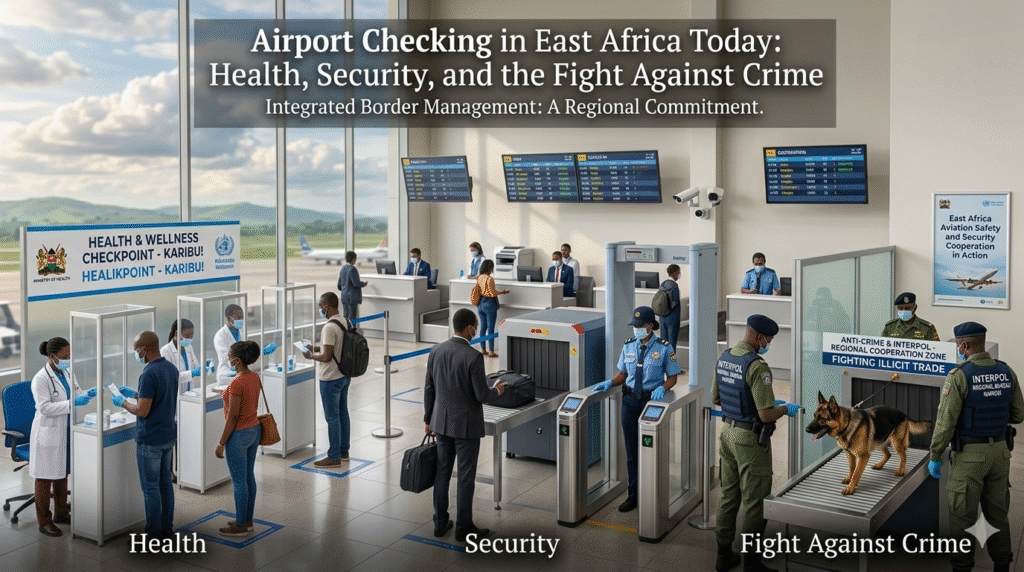
Airports across East Africa are operating under unprecedented pressure, balancing health screening for disease outbreaks, counter-narcotics operations, and enhanced security protocols. From Jomo Kenyatta International Airport in Nairobi to Entebbe in Uganda, authorities are implementing sophisticated measures to detect everything from Ebola to methamphetamine and illegal wildlife products.
Part 1: The Ebola Emergency — Regional Coordination
The most urgent driver of enhanced airport screening is the Ebola outbreak that has spread across the Democratic Republic of the Congo and into Uganda. As of June 2026, the DRC had reported 121 confirmed cases and 1,077 suspected cases, while Uganda recorded 11 confirmed cases and one death .
In response, East African Community (EAC) health ministers convened an extraordinary virtual meeting on June 1-2 and agreed to harmonise Ebola surveillance and protective measures at all airports, ports, and land border crossings across the region . The ministers directed partner states to implement surveillance and control measures at affected areas and points of entry in accordance with national regulations and WHO guidance .
Part 2: Harmonised Screening Procedures
A key outcome of the EAC meeting was the decision to standardise screening procedures and traveller health declaration requirements across all eight partner states . The EAC Secretariat, working with the Civil Aviation Safety and Security Oversight Agency (CASSOA), was tasked with urgently convening a meeting to harmonise protocols .
The ministers also directed member states to introduce exit screening at designated points of entry while intensifying risk communication, community engagement, and disease surveillance activities . This ensures that travellers departing from affected regions are screened before boarding international flights.
Part 3: Mobile Laboratories and Rapid Detection
To strengthen disease surveillance and laboratory capacity, the ministers directed partner states to facilitate and sustain the deployment of EAC mobile laboratories and technical experts at strategic locations, including border points of entry and identified hotspots .
Ten EAC mobile laboratories have already been deployed across the region in the DRC, Uganda, Kenya, Rwanda, Burundi, South Sudan, and Tanzania to support rapid testing and detection of suspected Ebola cases . These mobile units are capable of providing on-site diagnostic testing, dramatically reducing the time between detection and response.
Part 4: Real-Time Information Sharing
The ministers emphasized the importance of real-time sharing of epidemiological information among partner states to facilitate early detection of cases and support a coordinated regional response . This ensures that airports across the region receive immediate updates about potential exposure risks and can adjust screening protocols accordingly.
Each member state has been directed to nominate two technical experts from their Ministries of Health and one expert from their Ministries responsible for EAC Affairs to serve on a dedicated Regional Technical Taskforce on Ebola and other high-consequence diseases .
Part 5: Global Travel Restrictions and Airport Screening
The Ebola outbreak has triggered a coordinated wave of global aviation health responses. Multiple countries—including the UAE, US, UK, Canada, Thailand, Bahamas, Jordan, and Bahrain—have tightened entry rules for travellers from Uganda, the DRC, and South Sudan .
These measures include enhanced airport screening, travel advisories, visa limitations, and quarantine-based entry systems. The UAE, operating one of the world’s busiest international aviation hubs, has implemented layered health screening systems at airports, including enhanced thermal screening and documentation verification for passengers with recent travel history to affected countries .
Part 6: Kenya’s Anti-Narcotics Operations at JKIA
Alongside health screening, East African airports are intensifying counter-narcotics operations. Jomo Kenyatta International Airport (JKIA) in Nairobi has become a key frontline in the fight against drug trafficking.
A multi-agency team led by the Anti-Narcotics Unit conducted a swift operation at the United Parcel Service–G4S facility within the Kenya Airways cargo shed, intercepting a suspicious parcel destined for Las Piñas in the Philippines. The package, declared as containing handmade bags and clothes, was found to conceal approximately 1,320 grams of methamphetamine with an estimated street value of Ksh 10.56 million . The operation demonstrates the sophisticated detection methods employed at JKIA, including detailed physical inspections of cargo shipments.
Part 7: Entebbe’s Wildlife Trafficking Crackdown
Entebbe International Airport in Uganda has proven its capabilities in detecting illegal wildlife products. The Uganda Civil Aviation Authority (UCAA) recently handed over 8,857.84 kilogrammes of confiscated wildlife products to the Uganda Wildlife Authority, a stockpile secured through joint operations over the years .
The exhibits included ivory, pangolin scales, rhino horns, hippopotamus teeth, skins, lion teeth, and ostrich eggshells—some of which had been concealed in containers labelled as shea butter in an attempt to evade detection . UCAA spokesperson Vianney Luggya stated that the handover demonstrated “the effectiveness of the security, screening and enforcement mechanisms in place at Entebbe International Airport to detect and intercept prohibited and illegally trafficked items” .
Authorities attribute improvements to enhanced screening measures, including the deployment of a canine unit and strengthened cooperation among security and enforcement agencies .
Part 8: Mozambique’s Fentanyl Interception
Maputo International Airport recently demonstrated its drug detection capabilities with the interception of a fentanyl shipment. On June 7, 2026, a consignment weighing 3,750 kg arrived from India, declared as “Multivitamin Tablet Cyproheptadine Hydrochloride” .
The Joint Special Unit for Goods Control—comprising Customs, SERNIC, PRM, and ANAC—identified indicators during inspection that justified a physical verification based on the importer’s profile and the declared product’s nature . Laboratory tests confirmed the substance was illicit, leading to formal seizure and handover to SERNIC for criminal investigation .
Part 9: The Regional Taskforce for Border Health
The EAC has established a dedicated Regional Technical Taskforce on Ebola Response and other high-consequence diseases, comprising experts nominated by partner states and the EAC Secretariat . This taskforce monitors the outbreak, coordinates technical interventions, reviews epidemiological trends, and provides regular reports to ministers and other EAC policy organs .
Part 10: Challenges and Gaps
Despite significant progress, challenges remain. The EAC ministers cautioned that inconsistencies in border controls and screening could put neighbouring countries at risk of further Ebola transmission . Porous borders, high population mobility, and limited resources continue to strain regional response capacity.
The ministers directed the EAC Secretariat to mobilize additional financial and technical resources to support surveillance and response activities and to expedite the procurement and deployment of container laboratories across the region .
Part 11: The Role of International Cooperation
The airport checking regime in East Africa relies heavily on international cooperation. The EAC mobile laboratories were provided with support from the Government of Germany through the German Development Bank KFW and technical support from the Bernhard Nocht Institute for Tropical Medicine .
The WHO provides guidance on screening protocols, while the International Health Regulations framework ensures that measures are proportionate and evidence-based . The coordinated global aviation health response, involving countries from the US to Thailand, reflects the interconnected nature of modern air travel.
Part 12: Looking Ahead
The coming months will test East Africa’s airport checking capabilities. The ongoing Ebola outbreak requires sustained vigilance, while drug trafficking networks continue to adapt their methods. The threat of other high-consequence diseases—including mpox and cholera—adds further pressure.
The EAC is pursuing the procurement of Ebola testing kits and emphasizing continued investment in laboratory systems capable of rapidly detecting emerging and re-emerging disease threats . As one UCAA official warned, “The airport’s surveillance, screening and enforcement systems remain robust, and offenders will face the full force of the law” .
Conclusion
Airport checking in East Africa today represents a multi-layered response to interconnected threats: infectious diseases, drug trafficking, and wildlife crime. From the coordinated health screening protocols agreed by EAC health ministers to the dog units detecting pangolin scales at Entebbe and the chemical analysis labs catching fentanyl in Maputo, the region is building a comprehensive aviation security framework. The challenge ahead lies in sustaining these capabilities, closing gaps, and ensuring that East Africa’s airports remain safe gateways rather than corridors for illicit activity.
