

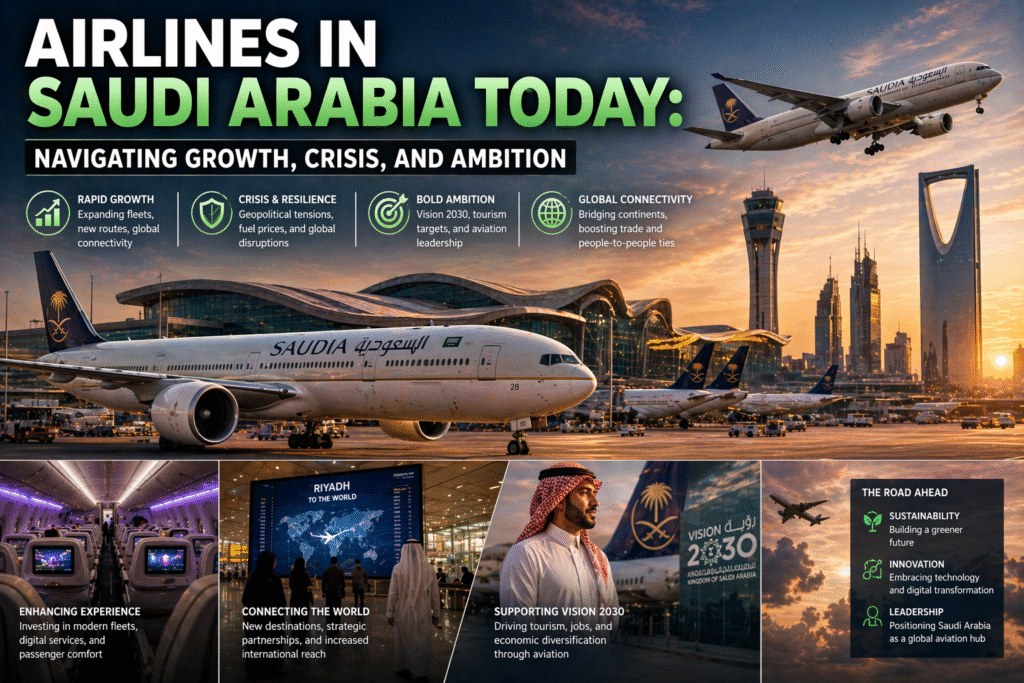
On a single day in early April 2026, nearly 200 flights were delayed or canceled across Saudi Arabia’s busiest airports, stranding thousands of travelers and exposing the stress fractures beneath the Kingdom’s soaring aviation ambitions . Yet just days later, the national carrier Saudia announced it would resume limited international routes, signaling a cautious return to normalcy . This is the paradox of Saudi aviation today: a sector racing toward a Vision 2030 future while grappling with the immediate turbulence of regional conflict, record-breaking passenger demand, and an unprecedented transformation that is reshaping the skies above the Arabian Peninsula.
The Regional Storm: When War Grounds the Skies
Since February 28, 2026, Saudi airlines have been operating under a shadow. The escalation of military conflict across the Middle East forced Saudia—the Kingdom’s flag carrier—to halt numerous regional services entirely . The suspension, tied directly to safety concerns and restricted air navigation conditions, represented a significant blow to connectivity across the Gulf .
The impact became painfully visible on April 12, when King Abdulaziz International Airport in Jeddah reported 148 flight delays and three cancellations, while King Fahd International Airport in Dammam recorded 41 delays and three cancellations . For the hundreds of passengers caught in the chaos, the experience was a stark reminder of how quickly the region’s geopolitical volatility can uproot travel plans. Families heading to Dubai for Eid holidays, business travelers with tight schedules, and pilgrims transiting through the Kingdom’s hubs all found themselves staring at departure boards that refused to update .
“The delays at Jeddah and Dammam highlight a broader truth,” one industry observer noted. “Middle Eastern aviation networks are so tightly interconnected that a disruption in one hub creates a cascade effect across the entire region” .
The Gradual Return: Saudia’s Phased Resumption
But the news is not all bleak. On April 11, Saudia began restoring a limited set of regional services—a controlled reboot designed to prioritize high-demand routes while maintaining flexibility for further adjustments . The airline resumed daily flights between Jeddah and three key destinations: Dubai (SV588), Abu Dhabi (SV570), and Amman (SV631), with corresponding return services .
It is not a full return to pre-crisis schedules. Flight allocations remain tightly controlled, with frequencies restricted to a single daily rotation per route . But for passengers and businesses dependent on regional connectivity, the resumption is a lifeline. “Services will continue to be adjusted as conditions evolve,” Saudia stated, urging travelers to verify flight status through official channels before heading to airports .
The Growth Engine: Defying Gravity
Strip away the conflict-related disruptions, however, and a more profound story emerges. Saudi Arabia’s aviation sector is growing at a pace that few global markets can match. According to IATA’s February 2026 demand report, Middle Eastern carriers—led by Saudia and its low-cost cousin flyadeal—recorded a year-on-year demand increase, with capacity expansion outpacing many Western markets .
Steven Greenway, CEO of flyadeal, put the numbers in sharp relief. The Kingdom’s domestic aviation market is expanding at an annual rate of approximately 15 percent, he told Argaam in January—a figure that outpaces most global markets . flyadeal itself carried 10.7 million passengers in 2025, a staggering 33 percent increase from the previous year, driven by both domestic expansion and international growth into Egypt, Turkey, and particularly Pakistan, where the airline now serves five destinations .
The growth trajectory for 2026 is even more aggressive. Greenway expects capacity expansion in the range of 30 to 35 percent, driven by a strong start to the year and shifting travel patterns following adjustments to school holiday schedules .
The Fleet Revolution: 185 New Aircraft and 12,000 Jobs
Behind the passenger numbers lies an industrial transformation. Saudia Group has outlined plans to take delivery of 185 new aircraft over the coming years—an expansion expected to generate more than 12,000 jobs across the aviation ecosystem . The fleet renewal is not merely about adding planes; it represents a strategic shift. flyadeal, for instance, currently operates 44 aircraft but expects to reach 98 within three to four years, with the A321 and eventually the A330neo joining the fleet to enable expansion into Southeast Asia and Western Europe .
The scale of Saudi Arabia’s ambition is captured in a single statistic from aviation lessor Avolon: the combined order backlog for the UAE, Saudi Arabia, and India exceeds 3,000 aircraft—more than double the current in-service fleet . For Saudi carriers, this means a pipeline of new-technology aircraft that will enhance fuel efficiency, reduce emissions, and support the transition to a more modern, competitive fleet.
The Workforce Transformation: Saudization Takes Flight
Aircraft alone do not fly an airline. People do. In February 2026, Saudia Group celebrated the largest graduation in its history, honoring more than 1,000 Saudi men and women who completed aviation training programs . The graduates will be distributed across Saudia Airlines, Saudia Academy, Saudia Technic, Saudi Ground Services, SAL Logistics Services, flyadeal, and CATRION—a testament to the breadth of the group’s human capital ambitions.
“We have achieved significant progress in localizing key aviation jobs,” said Eng. Ibrahim Al Omar, Director General of Saudia Group, noting that localization rates exceed targeted performance indicators by between 43 and 230 percent across core roles . The expansion of Saudia Technic’s maintenance hangar at King Abdulaziz International Airport is expected to create thousands of additional direct jobs in aircraft maintenance, repair, and overhaul.
The localization push extends beyond employment numbers to knowledge transfer. Saudi Arabia now embeds clauses in its agreements with major global manufacturers that ensure technology transfer and the qualification of Saudi cadres within the Kingdom. The result: local content within the group has risen from 19 percent in 2019 to 29 percent currently, with a target of 45 percent in the coming years .
The Industrial Ambition: Building, Not Just Buying
Perhaps the most significant development in Saudi aviation is happening on the ground—in factories, engineering centers, and supply chains. In February 2026, the National Industrial Development Center signed a cooperation memorandum with European aerospace giant Airbus to explore opportunities for developing and localizing the aviation and helicopter industry in Saudi Arabia .
The memorandum is not a simple procurement deal. It envisions the creation of an engineering center to develop national capabilities in manufacturing, assembly, maintenance, and repair, alongside a supporting logistics network. The agreement covers technology and knowledge transfer, encouraging global suppliers to invest in Saudi Arabia and developing Saudi talent through educational and training partnerships .
“This is Saudi Arabia moving from being a consumer of aviation to a producer,” one industry analyst noted. The Kingdom is positioning itself not merely as a hub for flights but as a manufacturing and maintenance hub for the broader region.
The Competitive Landscape: Rivals and New Entrants
Saudia and flyadeal do not operate in a vacuum. The Saudi market is becoming increasingly competitive, with international carriers—Emirates, Qatar Airways, Etihad—continuing to serve the Kingdom’s major hubs, despite the recent disruptions . Greenway acknowledges that competition will intensify with the entry of new players and the expansion of international carriers .
But this competition, he argues, benefits consumers by enhancing choice and raising service standards. “The Saudi aviation sector is highly dynamic,” he told Argaam. “Demand remains robust, and growth is expected to continue” .
Looking Ahead: Vision 2030 in the Skies
The ultimate horizon for Saudi aviation is Vision 2030. The national strategy aims to increase international connectivity to 250 destinations, double air cargo capacity to more than 4.5 million tons, and establish the Kingdom as a global logistics hub . A second national airline—beyond the Saudia Group—has been discussed as part of this expansion, though details remain sparse .
For now, the sector is navigating a narrow path between crisis and opportunity. The regional conflict has exposed vulnerabilities, delayed flights, and disrupted connectivity. But beneath the turbulence, the fundamentals remain strong: double-digit passenger growth, massive fleet orders, workforce expansion, and an industrial strategy that aims to make Saudi Arabia a player in aviation manufacturing, not just aviation transit.
As Greenway put it: “We expect growth to accelerate in 2026” . Whether the skies will remain clear enough for that growth to take full flight depends on forces far beyond the control of any airline CEO. But Saudi aviation is, for better and worse, no longer a passive observer of regional events. It is a central character in the story—and it is betting big on taking off.
