

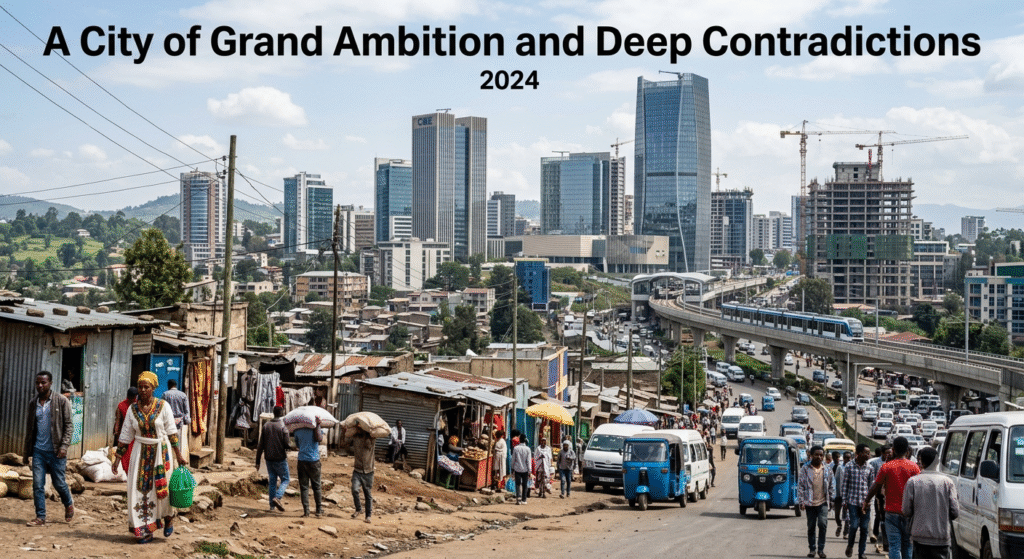
As of August 2026, Addis Ababa presents a picture of profound duality. The city is racing to reinvent itself as a modern African metropolis, with massive infrastructure projects and ambitious urban renewal schemes reshaping its skyline. Yet beneath the construction dust and ribbon-cutting ceremonies, the Ethiopian capital is grappling with a volatile security situation, a severe cost-of-living crisis, and a deep constitutional debate over its very identity and future status within the nation.
A City Transformed: The Development Juggernaut
The most visible aspect of Addis Ababa today is the rapid pace of its physical transformation. The city administration, led by Mayor Adanech Abiebie, has embarked on an aggressive, multi-year strategic plan to modernize the capital and steer it away from what she describes as “unproductive agendas,” turning it into a center of development, peace, and international attention .
The Corridor Development Project is the centerpiece of this urban renewal. In July 2026, Prime Minister Abiy Ahmed and Mayor Adanech inaugurated the fifth major corridor in the second phase of development: an 8-kilometer stretch from Meskel Square to Megenagna . This project, representing a major economic and infrastructural investment, is part of a larger vision that will ultimately span 21.5 kilometers across five sub-cities .
These corridors are not just roads. They are designed as comprehensive public spaces featuring:
- Wide concrete pedestrian walkways and dedicated bicycle lanes
- Sports fields, recreation areas, and playgrounds for children
- Modern electric lines and smart poles
- New market centers, like the recently opened facilities and parking lot at Arat Kilo Plaza, which can accommodate over 5,000 people
The overarching goal is to significantly expand the road network, accommodate commercial establishments, and create a more livable and inclusive city for all residents, including people with disabilities . Beyond aesthetics, the riverside development project is intended to eliminate pollution, reduce vulnerability to flooding, and create significant job opportunities .
The Bishoftu International Airport project, located 45 kilometers southeast of Addis Ababa, represents the crown jewel of this ambition. This mega-project aims to create one of Africa’s largest aviation hubs, with the first phase expected to accommodate 60 million passengers annually . The project is a massive undertaking requiring over USD 9 billion in financing. The African Development Bank (AfDB) is leading efforts to raise USD 8.7 billion and has already pledged USD 500 million, while the US has expressed strong interest in securing participation .
However, the project is not without its challenges. Ethiopian Airlines recently postponed the selection of contractors from August 2026 to January 2027 after bidders requested more time to prepare proposals and secure financing . The full completion of the airport is not expected until 2030, underscoring the long-term nature of this transformation .
The Political Fault Line: A City at the Center of a National Debate
While the physical transformation is impressive, Addis Ababa finds itself at the epicenter of a far more consequential political debate: its constitutional status and relationship with the Oromia Regional State .
Addis Ababa is currently a self-governing federal capital constitutionally connected to Oromia. However, the Constitution’s Article 49(5), which recognizes Oromia’s “special interest” in the city, has never been clearly defined, leading to decades of tension . This issue was thrust into the national spotlight when it became a key agenda item at the National Dialogue Forum, which opened in Addis Ababa in July 2026, convening over 4,000 participants .
The debate is not academic. It touches on fundamental questions of national unity and identity:
- For many Oromo, the city, known to them as Finfinnee, represents historical, cultural, and geographical connection to Oromia.
- For many other Ethiopians, Addis Ababa is a shared national capital whose neutrality and symbolic importance must be protected.
The National Dialogue is examining five constitutional options for the city’s future, ranging from maintaining the existing arrangement with clearer implementation of the “special interest” clause, to establishing Addis Ababa as a federal capital territory (like Washington D.C. or Abuja), granting it full federal member-state status, integrating it into Oromia, or creating a framework of shared constitutional responsibility . This deliberative process underscores that the city’s future is a bellwether for the country’s broader struggle to balance competing visions of federalism and identity.
Security and the Shadow of Conflict
This backdrop of development and political debate is cast in a long shadow of security concerns. The security situation in Addis Ababa itself is considered stable by diplomatic missions, such as the US Embassy, which noted that elections-related unrest in the capital is low . However, the recent eruption of fresh fighting in the Tigray region—with federal forces accused of launching an attack on Tigrayan forces near the Sudanese border—underscores the fragility of the Pretoria Peace Agreement and the risk of conflict spilling back to the heart of the nation .
The German Embassy warns that the security situation outside the capital remains volatile, with the potential for violent demonstrations and armed clashes . Even in Addis Ababa, residents and travelers are advised to be vigilant against petty crime and to be aware that the government has warned of potential Al-Shabaab activity in Ethiopia . The city also faces a severe cost-of-living crisis, which Mayor Adanech has acknowledged as a major challenge .
Conclusion
Addis Ababa today is a city in the throes of a grand and contradictory makeover. From the dust of its mega-corridors and the blueprints of its future mega-airport, a new capital is being forged. It is a city that champions peace and development while being a stone’s throw from a volatile region. It hosts a national dialogue to determine its own fate, even as it grapples with an ongoing cost of living crisis. For all its ambition, the greatest challenge for “Sheger” is whether its physical transformation can keep pace with the critical political and economic stability required to ensure that its future is one of prosperity for all its residents.
