

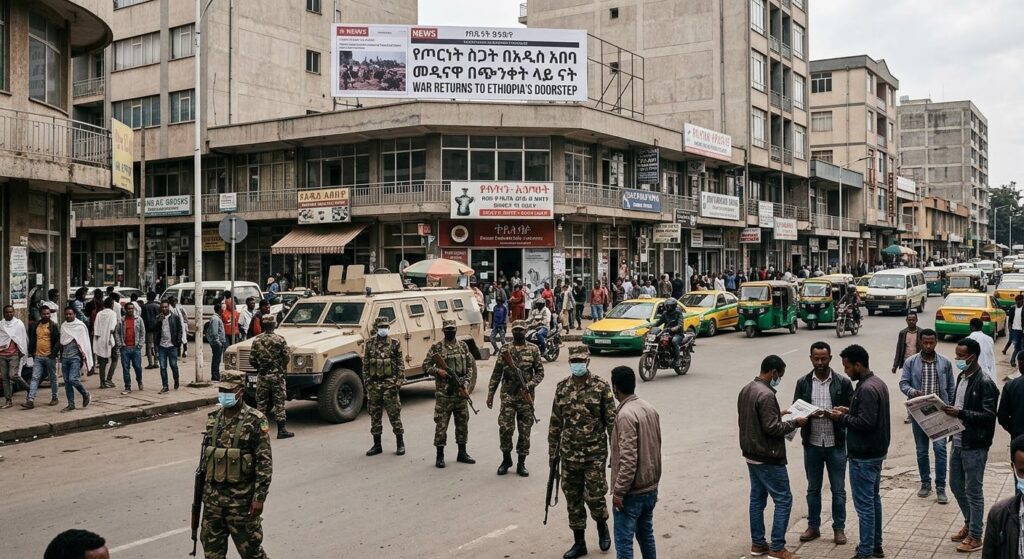
ADDIS ABABA — The Ethiopian capital is holding its breath. Two weeks after explosions rocked the city and war resumed in the north, Addis Ababa finds itself navigating a precarious duality: officially at peace, economically ambitious, and diplomatically active, yet surrounded by a conflict that has already reached its streets and threatens to engulf the wider region. On October 14, Prime Minister Abiy Ahmed spoke by phone with U.S. Secretary of State Marco Rubio, welcoming “assurance of continued U.S. support” . On the same day, Eritrea formally demanded that the African Union restore its representation in Addis Ababa after Ethiopia expelled its diplomats . Between these diplomatic maneuvers, the city’s residents confront a reality few expected to face again so soon: the return of war to the capital.
The Night the Explosions Came
The first sign that the northern conflict had reached Addis Ababa came in the early hours of October 1. Multiple explosions shook the Tor Hayloch area, near the Ethiopian National Defence Force headquarters. Diplomatic and security sources told AFP the blast occurred between midnight and 1:00 a.m., describing it as “powerful” and triggering “significant panic among people in the vicinity” . A nearby bar worker relayed colleagues’ accounts: “There were a few minutes of disturbing sounds followed by an explosion” .
A source linked to the opposition alliance claimed responsibility for drone attacks targeting the army headquarters and other sites. If confirmed, it would mark the first known instance of anti-government forces striking the capital with drones . The government did not confirm the nature of the blast or any casualties. What followed was immediate: the National Intelligence and Security Services banned all drone flights over the capital and surrounding areas .
The explosions came just days after fighting resumed on September 23 between federal forces and the Tigray People’s Liberation Front (TPLF), shattering the Pretoria peace agreement that had ended the 2020-2022 civil war . For Addis Ababa, a city of five million that had largely been spared the worst of the northern war, the message was unmistakable: this conflict would not stay in the north.
The Capital’s Precarious Calm
In the days since the explosions, Addis Ababa has settled into an uneasy normalcy. The streets are busy, cafes full, government offices functioning. On October 5, Prime Minister Abiy was sworn in for a second five-year term after his Prosperity Party’s landslide election victory in June . On October 8, Parliament unanimously approved a new 23-minister government, retaining key figures like Deputy Prime Minister Temesgen Tiruneh and Foreign Minister Gedion Timothewos, while appointing nine women to the cabinet .
The following day, President Taye Atske Selassie addressed a joint session of Parliament, striking a tone of defiant optimism. He emphasized that the new government would work to “strengthen Ethiopia’s multinational unity, peace and dialogue,” and declared that “the Ethiopian people have clearly expressed their desire for peace and stability and have rejected war and violence” . He warned that “attempts to return Ethiopia to cycles of violence would ultimately fail” .
Yet these words coexist with the reality of a city under a drone ban, its military headquarters attacked, and its northern regions in flames. The government has repeatedly blamed external forces for the crisis, accusing Eritrea of supporting the TPLF and Egypt of backing the rebel alliance . On October 1, Ethiopia declared ten Eritrean diplomats persona non grata, including the Chargé d’affaires accredited to the African Union, effectively stripping Eritrea of its representation at the AU headquarters located in Addis Ababa . Egypt retaliated by expelling an Ethiopian diplomat, prompting the African Union Commission to issue a statement urging Ethiopia, Eritrea, and Egypt to exercise “maximum restraint” .
The African Union’s Dilemma
The diplomatic crisis has placed Addis Ababa at the center of a regional storm that the African Union, headquartered in the city, is struggling to contain. The AU’s October 1 statement urging restraint was immediately rejected by Egypt, whose officials described it as an “incomprehensible attempt” to draw Cairo into an internal Ethiopian matter . The AU Commission was forced to clarify that it had “under no circumstances” intended to assign responsibility to any neighboring state .
Eritrea’s letter to the AU, dated October 12 and released publicly this week, sharpened the stakes. It argued that “Eritrea’s statutory rights of membership in the African Union cannot be curtailed or compromised at the whim of another Member State,” and that hosting regional organizations “is not subject to the unilateral discretion of the host country” . The letter represents a direct challenge to Ethiopia’s use of its position as AU host to gain diplomatic leverage—and a test of whether the continental body can protect its own members’ rights within its own headquarters.
The African Commission on Human and Peoples’ Rights added its voice on October 6, expressing “profound concern” over the renewed hostilities and warning of “a recurrence of the grave human and peoples’ rights violations and humanitarian suffering experienced during the 2020–2022 conflict” . The Commission called for the protection of access to information and communications, noting that “disruptions to internet and telecommunications services in parts of Northern Ethiopia have also been noted” .
A Government in Transition, a Region in Crisis
The caretaker administration announced for Tigray on October 16 represents the government’s most significant policy response to the crisis . The six-month transitional body is tasked with restoring peace and security, reestablishing government structures, rebuilding damaged infrastructure, and organizing regional elections . The Prime Minister’s office framed the decision as an effort to help “the people of Tigray… emerge from the cycle of conflict so that they can enjoy the peace that has long eluded them” .
But the establishment of a caretaker administration also signals that Addis Ababa does not expect a quick return to normal governance in the north. It is an acknowledgment, in bureaucratic form, that the Pretoria framework has collapsed and that a new political arrangement—imposed from the center—will define Tigray’s immediate future.
For Addis Ababa itself, the war’s return has injected a new uncertainty into daily life. The city’s economy, which had been showing signs of recovery after years of conflict and the COVID-19 pandemic, now faces the prospect of renewed disruption. International airlines that had resumed flights to Addis Ababa—a major hub for African aviation—may reassess their schedules. Investors, drawn by Ethiopia’s economic reforms and growth projections, may pause. The city’s reputation as a diplomatic capital, hosting the AU and dozens of embassies, is now entangled with the perception of a country at war.
On October 9, Indian External Affairs Minister S. Jaishankar visited Addis Ababa, meeting with Prime Minister Abiy and speaking at the Adwa Memorial Museum about India-Africa partnership . The visit proceeded as scheduled, a signal that at least some of the international community is treating the crisis as manageable. But the presence of foreign diplomats in a city where explosions have recently been heard is itself a reminder of the stakes: Addis Ababa is not merely Ethiopia’s capital. It is the diplomatic heart of Africa.
The Road Ahead
Ethiopia’s government insists it is winning the war. Pro-government forces have retaken Mekelle, Adwa, and other northern towns. The TPLF has withdrawn from urban centers and declared a shift to guerrilla tactics . The caretaker administration is in place. The new cabinet is seated. The Prime Minister is in contact with Washington.
Yet the fundamentals of the crisis remain unresolved. The TPLF and its allies have not surrendered. Eritrean forces are reportedly inside Ethiopian territory, a claim Eritrea denies but which the UN Secretary-General has flagged as a serious concern . The diplomatic rupture with Asmara and Cairo has created a web of regional tensions that could spiral beyond Ethiopia’s control.
For the people of Addis Ababa, the coming months will test their resilience. The city has survived civil war, political transition, and economic hardship in recent years. But the return of war to its doorstep—and the possibility of further attacks—represents a new and uncertain chapter. The government’s message is that the war will be won and peace restored. The evidence on the ground suggests that both outcomes remain far from guaranteed.