

Part 1: The SIPRI Report — India’s Nuclear Lead Widens
The Stockholm International Peace Research Institute (SIPRI) released its Yearbook 2026 on June 8, revealing a significant shift in the South Asian nuclear balance. As of January 2026, India’s nuclear arsenal has reached an estimated 190 warheads, while Pakistan possesses 170 warheads .
This marks a lead of approximately 20 warheads for India, reflecting both nations’ continued strengthening and modernisation of their nuclear capabilities throughout 2025 . The report noted that India has placed greater emphasis on investing in longer-range weapon systems capable of reaching targets throughout China, though its planning “still remains heavily influenced by its long-standing rivalry with Pakistan” .
Overall, the nine nuclear-armed states—the US, Russia, UK, France, China, India, Pakistan, North Korea, and Israel—combined possess about 12,187 nuclear weapons as of early 2026, of which 4,012 are actually deployed with operational forces .
Part 2: Operation Sindoor — A Military Crisis That Reshaped the Region
The SIPRI report identified Operation Sindoor—India’s military response to the Pahalgam terror attack—as an “unusually severe military crisis” between the nuclear-armed neighbours . Launched on May 7, 2025, the operation involved Indian forces conducting precision strikes on multiple terror infrastructures in Pakistan and Pakistan-occupied Kashmir .
During the operation, India reportedly targeted Pakistani air and missile installations that may have had links to nuclear operations . Despite the intensity of the standoff, both sides ultimately acted to prevent the situation from spiralling into a full-scale nuclear confrontation.
Part 3: The Naval Dimension — Pakistan Navy Confined to Ports
Defence Minister Rajnath Singh revealed on May 31, 2026, that the Indian Navy played a decisive role during Operation Sindoor, effectively confining the entire Pakistan Navy to its ports .
Addressing the inauguration of the ‘Nausena Shaurya Vatika’ naval museum in Lucknow, Singh said the Indian Navy was deployed in the Arabian Sea “with full preparedness and strength, maintaining constant pressure on the adversary” .
Navy Chief Admiral Dinesh K. Tripathi confirmed that the Navy’s immediate deployment of a Carrier Battle Group and forward operational posture in the Northern Arabian Sea forced the Pakistan Navy to remain “confined to harbour or close to the Makran coast” . The operation also validated the growing importance of tri-service joint operational capability.
Part 4: Defence Spending and the Arms Race
The defence spending gap between the two neighbours continues to widen. India, the world’s fifth-largest military spender, allocated $92.1 billion to defence in 2025—an 8.9% increase from the previous year . Pakistan does not feature among the world’s top 15 military spenders .
India also remains the world’s second-largest arms importer (8.2% of global imports), while Pakistan ranks fifth (4.2%) . India imported nearly twice the volume of major arms compared to Pakistan during the 2021-2025 period .
Part 5: Military Strength Comparison
According to the International Institute for Strategic Studies’ Military Balance database, the scale disparity between the two militaries is substantial :
India:
- Active military: 1,475,000
- Paramilitary police: 1,616,000
- Defence budget: $81 billion (2025)
- Fixed wing aircraft: 1,437
- Rotary-wing helicopters: 995
- Armoured fighting vehicles: 7,074
- Artillery: 11,225
Pakistan:
- Active military: 660,000
- Paramilitary police: 291,000
- Defence budget: $10 billion (2025)
- Fixed wing aircraft: 812
- Rotary-wing helicopters: 322
- Armoured fighting vehicles: 6,137
- Artillery: 4,619
Despite the disparity, Pakistani analysts point to Islamabad’s decades of experience fighting insurgencies along its border with Afghanistan .
Part 6: Ceasefire Violations Along the Line of Control
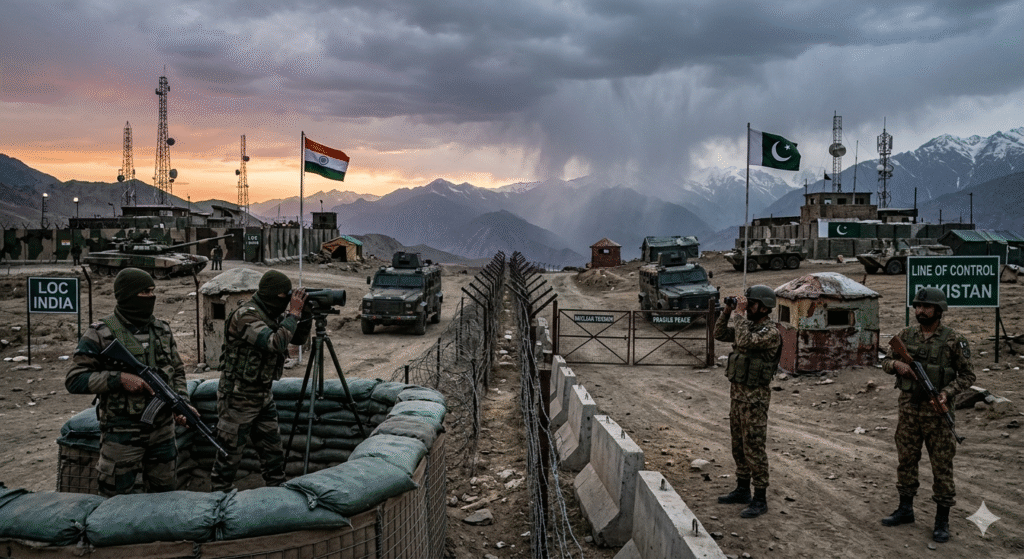
Tensions along the Line of Control (LoC) remain elevated. On June 14, 2026, Pakistani troops resorted to “unprovoked firing” in the Balakot sector of Poonch district, Jammu and Kashmir, targeting an Indian Army post with 10 to 15 rounds of small-arms fire . The Indian Army retaliated swiftly, and the situation was brought under control .
Earlier, on June 8, the Pakistani Army reported that Indian cross-border shelling had killed at least one soldier and two civilians . Pakistan claimed it retaliated and killed five Indian soldiers .
According to Pakistan military spokesman, Indian forces have committed 580 ceasefire violations so far in 2026, described as the “highest in any year” .
Part 7: The Threat of Nuclear Modernisation
SIPRI identified that nuclear modernisation, long-range missiles, armed drones, AI-enabled systems, and cyber capabilities are “increasingly shaping military competition in South Asia” .
Pakistan has been developing new missile technologies and accumulating fissile material, which could allow it to increase its nuclear stockpile in the years ahead . Both countries are actively modernising their delivery systems, with India testing an intercontinental-range version of its ballistic missiles while Pakistan continues its focus on medium-, short-, and close-range systems .
Part 8: The First Cyber Conflict
A significant development noted in the SIPRI report is that cyber operations were “integrated into an active military conflict for the first time” during Operation Sindoor . This marks a new frontier in India-Pakistan military competition.
Part 9: AI Warfare Disinformation — The Fake Operation Sindoor 2.0 Letter
On June 16, 2026, a fabricated “Top Secret” letter began circulating on social media, allegedly directing preparations for “Operation Sindoor 2.0” . The forged document, dated June 8, 2026, purported to have been issued from the Ministry of Defence and carried the subject: “Operation Sindoor 2.0; Prime Minister’s Directive, Strategic Intent” .
The Indian Army’s official fact-check handle on X categorically rejected the document’s authenticity, stating it was “synthetically generated information” fabricated using artificial intelligence tools . The Press Information Bureau also dismissed the letter as fake .
The Army noted that the episode follows a familiar pattern employed by disinformation networks: creating an alleged leaked document, giving it an official appearance, attaching military-related narratives, amplifying screenshots on social media, and using the content to sow confusion .
Part 10: The Terror Attack Catalyst
The current tensions trace back to a suicide car bombing by Pakistan-based militants in Indian-controlled Kashmir on February 14, which killed at least 40 Indian paramilitary police . The attack was claimed by Jaish-e-Mohammed .
Following the attack, India launched an air strike on what it said was a militant training base in Pakistan. Pakistan responded by shooting down two Indian jets, with one pilot captured . The Indian Air Force subsequently ordered closure of Kashmir’s main airport in Srinagar and three others .
Part 11: Pakistan’s Weapons Suppliers
Pakistan’s primary weapons supplier is China, Islamabad’s closest regional ally, along with drones from Turkey . India, by contrast, continues to rely heavily on Russia for its military imports while also expanding suppliers to include the United States, France, and Israel .
Part 12: The Path Forward — Two Scenarios
Scenario One: Continued Escalation. With ceasefire violations at record levels and both nations continuing nuclear modernisation, the risk of another military confrontation remains high. The integration of cyber and AI capabilities adds a dangerous new dimension to the conflict.
Scenario Two: De-escalation. Despite the tensions, both sides have demonstrated restraint since Operation Sindoor, ultimately preventing a full-scale nuclear confrontation. The swift debunking of the fake Operation Sindoor 2.0 letter suggests authorities are aware of and countering disinformation that could inflame tensions.
Conclusion
India and Pakistan’s military relationship today is defined by a paradox: record ceasefire violations and a widening nuclear lead coexist with established mechanisms—however fragile—that have prevented outright war. The military balance remains heavily tilted in India’s favour across conventional and nuclear dimensions. Yet the unresolved status of Kashmir, the integration of cyber and AI into military operations, and the ever-present threat of terror attacks mean the situation remains precarious. For now, nuclear deterrence holds—but the margin for error grows ever thinner.
