

MOGADISHU — June 17, 2026
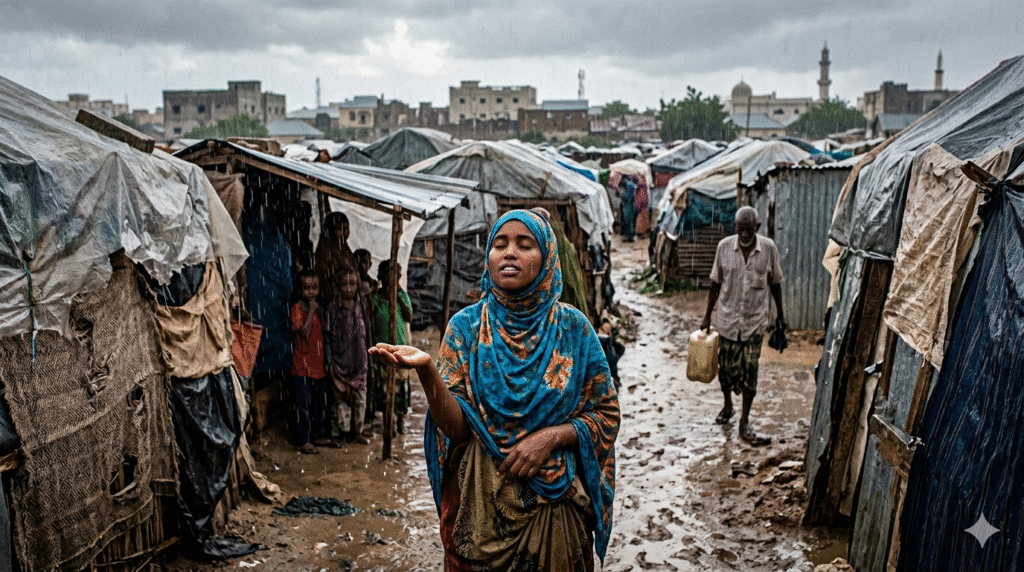
The rain that fell on Mogadishu today was gentle—a light drizzle that barely disturbed the dust of the city’s sprawling displacement camps. Yet it carried the weight of paradox. To the farmers of Lower Shabelle, rain is life. To the displaced families in Kahda, it is a reminder of everything they have lost. And to the humanitarian agencies monitoring the Shabelle River, it is a warning: the rains that bring relief to some may bring catastrophe to others.
Part 1: The Rainy Season That Arrived
This week’s forecast for Mogadishu shows consistent but light rainfall across the coming days. Today’s high of 25°C with light rain will be followed by similar conditions—daily temperatures around 29°C with mild precipitation . This is typical for Mogadishu’s June weather pattern: the city typically experiences about two rainy days during the month, with moderate temperatures and gentle breezes .
Yet the meteorological data tells only a fraction of the story. The rainfall hitting Mogadishu today is part of a broader regional weather pattern that has brought both relief and devastation across Somalia.
Part 2: Recent Flooding — A Prelude to Disaster
According to the Somali Disaster Management Agency, the impact of recent rains has been severe. Since the beginning of June, heavy downpours have lashed Somalia and its neighbors Kenya and Ethiopia, triggering flash flooding that has claimed at least 29 lives and displaced more than 300,000 people .
The hardest-hit areas are in southwestern Somalia, where ferocious rainstorms have submerged villages and farms . This flooding comes on the heels of the region’s worst drought in four decades—a cruel cycle where the parched earth cannot absorb the sudden deluge, turning life-giving rain into a destructive force.
Mohamed Moalim Abdullahi, chairman of the Somalia Disaster Management Agency, confirmed that authorities had issued warnings about these rains. “We warned earlier about these rains and predicted this situation was coming,” he stated .
Part 3: The Shabelle River Threat
Perhaps the most alarming hydrological development is the dangerously high water level of the Shabelle River at Jowhar . The river, one of Somalia’s two major waterways, remains under close watch as surface runoff from rainfall in the Ethiopian highlands flows downstream .
For Mogadishu, the Shabelle River represents both an essential water source and a mortal threat. The river has a long history of devastating floods, including the catastrophic inundations of 1997 and 2006 that submerged large portions of the capital. With the Shabelle already at critical levels, residents of low-lying areas along the riverbanks remain on edge.
Part 4: The El Niño Forecast — A Shift from Drought to Flood
Bethwell Mutai, lead meteorologist at FAO’s Somalia Water and Land Information Management (SWALIM), has issued a stark warning: while rainfall in the Ethiopian highlands is expected to remain manageable through May, an El Niño phenomenon is forecast to develop in mid-2026 and intensify toward the end of the year .
“From that point onward, we are likely to see a shift from drought concerns to flood risks,” Mutai said. “The main threat is expected to be flooding, particularly along the Juba and Shabelle rivers, the country’s two major waterways” .
This forecast represents a terrifying prospect for Somalia, where more than 6.5 million people have already been pushed to the brink of severe hunger—nearly a third of the population . The country is trapped in a brutal cycle where drought and floods alternately devastate communities, forcing families from their homes.
Part 5: The Camp Crisis — Displaced by Water, Haunted by Hunger
For the more than one million displaced people living in squalid conditions across Mogadishu’s camps, the rains compound an already desperate existence . Zeynab Ibrahim, a 38-year-old single mother, arrived in Mogadishu’s Kahda district two months ago after drought destroyed her village near Burhakaba. Four of her ten children died from hunger and sickness .
“So hunger is what brought us here,” Ibrahim says, sitting in front of her shelter made of sticks and covered with old clothes and plastic. “Our livelihoods depended on what we could grow on the ground, including maize, beans, sesame and vegetables. But the ground dried because there was no rain” .
The irony is devastating: when the rains finally returned, they brought destruction. Adan Roble, a 77-year-old from the Lower Shabelle region, watched as rainfall on parched earth created flash floods that swept through his village. As the water washed away everything, military drones circled overhead as government forces fought Al-Shabaab nearby .
“Imagine losing everything and trying to survive without food and clean water, while fighting continues around you and drones keep flying overhead,” Roble says .
Part 6: The Economic Shock — Fuel Prices Compound the Crisis
The weather is not the only threat. The ongoing conflict in the Middle East has sent fuel prices soaring across Somalia. In Mogadishu, prices have risen from approximately $0.60 to $1.50 per liter—a 150% increase .
“The sharp rise in fuel prices is driving inflation in food, transport, utilities, and services, significantly increasing logistics costs,” said Gordon Dudi, FAO Food Security Cluster Coordinator .
For aid agencies trying to reach flood-affected communities, the fuel price shock has been devastating. It has reduced operational efficiency and heightened the risk of scaled-back humanitarian assistance at precisely the moment when Somalia most needs support . Nearly 500 nutrition clinics have closed across the country because of a lack of funding, leaving children without care .
Part 7: The Aid Crisis — A System Under Strain
The funding situation is dire. The UN humanitarian chief, Tom Fletcher, recently visited Somalia and expressed frustration over the shrinking ability of aid agencies to respond. “On top of conflict and displacement, you have got the flash floods and the drought getting worse,” Fletcher said. “And that should make us furious, about the lack of humanity being shown at this moment—this moment of reckless geopolitics, of war, conflict, indifference and cruelty” .
Humanitarian assistance must be sustained throughout 2026 and into 2027 to prevent further suffering, help affected populations recover from drought, and prepare for the impacts of El Niño . But with funding cuts and shifting donor priorities, the outlook is bleak.
Part 8: The Climate Reality — What Rain Brings
For the displaced families in Mogadishu’s camps, rain is a dual-edged sword. It brings water, yes—but it also brings mud, disease, and further misery. The shelters made of sticks and plastic offer little protection against the elements. Children suffer from cold and waterborne diseases. The already precarious conditions become even more dangerous.
In the Kahda camp, Zeynab Ibrahim has not received any support from the government or aid agencies since arriving two months ago. She survives on one meal a day, which she secures by begging at the Bakara market. “We are lucky if we get one meal a day,” she says. “I’m not healthy enough to work, and I don’t have any skills other than farming” .
Part 9: The Road Ahead — Preparing for the Worst
The warning from SWALIM is clear: the rains that are falling now are a prelude to something larger and more destructive. When the El Niño intensifies toward the end of 2026, Somalia will face a shift from drought concerns to flood risks .
It is imperative to continue supporting drought-affected communities while simultaneously preparing for possible floods and fuel shortages . Yet with humanitarian funding at record lows, that preparation is under threat. The choices made in the coming months will determine whether Somalia’s next disaster becomes another catastrophe—or whether the world finally acts.
Conclusion
The rain that falls on Mogadishu today is more than weather. It is a reminder of Somalia’s vulnerability: a country at the mercy of climatic extremes, economic shocks, and a humanitarian system stretched to breaking point. For Zeynab Ibrahim and the other one million displaced people in Mogadishu’s camps, it is also a reminder that survival requires more than resilience—it requires help that may not come.
As the skies darken over the Indian Ocean, Mogadishu waits. The light rain continues. But in the camps, in the river valleys, and in the corridors of international aid agencies, preparations are underway for something darker: the flood that the experts say is coming. The question is whether the world will be ready—or whether Somalia will once again be left to face the storm alone.