

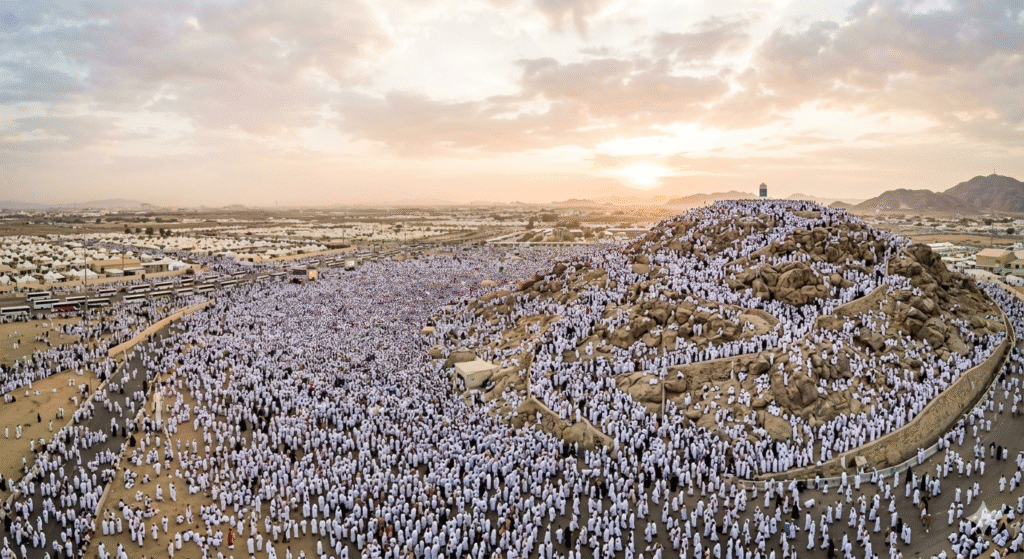
A Sea of White and a Sky of Mercy: 1.8 Million Pilgrims Stand at Arafat on the ‘Day of Desire’
Arafat, Makkah – May 26, 2026
As the dawn broke over the rugged peaks of Jabal al-Rahmah (the Mount of Mercy), a sea of white began to stir. The vast, sun-scorched plains of Arafat, usually silent save for the desert wind, have been transformed today into the beating heart of the Islamic world. In a scene that has repeated itself for fourteen centuries, over 1.8 million pilgrims from nearly every nation on earth have gathered to perform the most sacred rite of the Hajj: the Wuquf, or the “Standing at Arafat” .
Under a sky burning with the heat of a Saudi summer—where temperatures have soared past 45 degrees Celsius (113 degrees Fahrenheit) —the faithful remain unmoved . Clad in the simple, seamless white garments of Ihram, which strip away all markers of race, class, and nationality, the pilgrims raise their hands in silent supplication. Today is not merely a ritual; it is the climax of the pilgrimage, known in Islamic tradition as “the Day of Desire” and “the Day of Forgiveness.” It is the day Muslims believe that the gates of heaven open, the devils are chained, and God descends to the lowest heaven to ask His servants what it is they seek.
The ‘Standing’ at the Mount of Mercy
The focus of this great gathering is Jabal al-Rahmah, a small granite hill located approximately 20 kilometers east of the Grand Mosque in Makkah . It was here, 1,400 years ago, that Prophet Muhammad (Peace Be Upon Him) delivered his Farewell Sermon, laying out the foundations of human rights, racial equality, and social justice that still echo through the ages.
At just 65 meters high, the mountain is modest in stature but monumental in spiritual weight . By mid-morning on Tuesday, the streets leading to the mount were impassable, filled with pilgrims crying, praying, and reciting the Quran. While Saudi authorities have long urged pilgrims not to crowd the mountain itself—emphasizing that the entire plain of Arafat is sacred, not just the hill—the pull of history remains irresistible for many who seek to stand where the Prophet stood .
Yet, the true essence of the Day of Arafah is not the climbing of a mountain, but the internal ascent of the soul. The Wuquf requires pilgrims to be present within the boundaries of Arafat between midday and sunset. They spend these precious hours engaged in Du’a (supplication), Tawbah (seeking repentance), and Dhikr (remembrance of God). For those not on Hajj, Muslims worldwide observe a fast on this day, believing it expiates the sins of the previous year and the year to come.
A Sermon of Unity and Resilience
At midday, the atmosphere in the Namirah Mosque reached a fever pitch of emotion. The Imam, Sheikh Ali Abdul Rahman Al-Hudhaifi—the esteemed Imam of the Prophet’s Mosque in Madinah—ascended the minbar to deliver the historic Hajj sermon .
In a powerful address translated into dozens of languages and broadcast globally, Sheikh Al-Hudhaifi urged the Ummah (global Muslim community) to “hold fast to Taqwa (piety).” He described the Day of Arafah as the ultimate symbol of human equality, where a king and a laborer stand side by side, indistinguishable before their Creator .
“The true preparation for the Hereafter lies in Tawheed (monotheism) and sincere worship of Allah alone,” the Imam declared, his voice echoing through the mosque and across the plain . He warned against the divisiveness plaguing the modern world, urging believers to abandon backbiting, falsehood, and political discord. “There should be no disobedience, no arguing during Hajj, and no political slogans,” the sermon stressed, reminding the massive crowd that Hajj is a sanctuary of peace and patience .
Following the sermon, the Imam led the congregation in a combined and shortened Zuhr and Asr prayer, a specific concession granted to pilgrims to ease the burden of the long, hot day .
The ‘Prayer for Gaza’ in the Shadow of Geopolitics
While the official sermon focused on universal piety, the emotional undercurrent of this year’s Hajj is impossible to ignore. The pilgrimage is unfolding against the backdrop of the ongoing humanitarian crisis in Gaza and the wider geopolitical tensions in the Middle East .
Despite strict warnings from Saudi Minister Tawfiq al-Rabiah against “political activity” during the rites, the plight of the Palestinians is a ghost that walks beside every pilgrim here . Many worshippers were visibly emotional when the Imam made specific supplications for the oppressed. “Pray for our brothers and sisters in Palestine who have been touched by harm,” the sermon pleaded, a call met with thousands of whispered “Ameens” (amen) .
Egyptian pilgrim Mohammed Asser, 46, captured the sentiment of the crowd. “We are here to beg for our own sins, but in this place, God listens to everything,” he told reporters. “I pray for the forgiveness of my parents, for my children, and for the people of Gaza who cannot be here because their land is destroyed. May God help them” .
Technology, Cooling, and the Logistics of Faith
Managing the largest annual gathering of people on earth requires a logistical miracle, and Saudi Arabia has once again deployed its full arsenal of modern technology to ensure safety.
The Deputy Emir of Makkah, Prince Saud bin Mishaal, visited the site to oversee operations, affirming that the Kingdom would “continue developing the Hajj system” as part of its enduring mission to serve the Guests of God . The government has mobilized thousands of security personnel and health workers. Given the extreme heat, the “Green Arafat” initiative is in full effect, with misting fans, cooled pavement, and thousands of air-conditioned tents lining the valleys of Arafat and Mina .
The Mashaer Train, an electric rail system connecting the holy sites, is running at maximum capacity, shuttling pilgrims efficiently between Mina, Arafat, and Muzdalifah to prevent the catastrophic crowd crushes that have marred Hajj in past decades.
Sunset: The Rush to Muzdalifah
As the sun begins to dip below the horizon, casting the plain in a golden-red hue, a palpable shift in energy occurs. The standing at Arafat concludes not with a bang, but with a collective, tearful sigh of relief. It is believed that on this day, God frees more souls from the hellfire than on any other.
At the moment of sunset, the pilgrims will not break their fast (as they are not actually fasting while traveling, though many choose to spiritually fast). Instead, they will begin a peaceful, mass exodus from Arafat towards Muzdalifah .
Muzdalifah is an open area between Arafat and Mina. Here, the pilgrims will spend the night under the open sky, collecting pebbles for the symbolic “Stoning of the Devil” ritual that will take place in Mina starting tomorrow, the first day of Eid al-Adha.
Tonight, the sky over Muzdalifah will be the only roof for nearly two million people. It is a night of rest, but also of preparation for the “Days of Tashreeq” to come—the slaughtering of sacrificial animals, the shaving of heads, and the return to the Grand Mosque in Makkah for the Tawaf al-Ifadah.
For the pilgrims standing on the scorched earth of Arafat today, the journey is far from over. But for this one moment, suspended between the mount of mercy and the mercy of the Almighty, there is only prayer, hope, and the profound silence of a million voices talking to their Lord. It is, as the preachers call it, the greatest day of the year.